
Niche Job Boards: How to Find and Use Them in 2026
Niche Job Boards: How to Find and Use Them in 2026

Niche job boards are websites that list openings for one industry, profession, or type of worker, such as tech, health care, nonprofits, media, or remote work. They are worth your time because the listings are narrower, the employers are looking for your kind of skills, and you scroll past far fewer irrelevant postings. The catch is that there are hundreds of them, and most job seekers don’t know which two or three deserve a spot in their weekly routine. This guide shows you how to find them, judge them, and use them without burning out.
We built ResumeMatch because we know how it feels to open ten tabs, scroll for an hour, and still not know where you fit. Niche boards can help. So can a smarter process.
TL;DR
- A niche board lists jobs for one field or audience. A general board lists everything. Use both, but lean on the niche ones for roles that match your skills.
- Government career guidance suggests spending no more than about 10% of your search time on the big general boards and putting the rest into specialty boards, company sites, associations, and networking.
- Find boards through professional associations, your school’s career center, and the job postings you already like. Then test each one for a week.
- Check every listing for legitimacy. An honest employer never charges you to apply.
- Tailor your resume to each niche. Vocabulary that works in a health care posting will not work in a software one.
Table of Contents
- What niche job boards are, and how they differ from general sites
- Why a mix beats any single board
- Types of niche boards, and who they suit
- How to find the right niche boards for you
- Judge a board before you commit
- Using salary information to know your market value
- Tailor every application to the board’s field
- Spot fake listings and scams
- Our perspective: the board is not the bottleneck
- Let ResumeMatch do the sorting
- A simple weekly routine
- FAQ
- Sources
What niche job boards are, and how they differ from general sites
A general job site serves every industry and every level. A niche board narrows the field. It might focus on one industry (technology, finance, construction), one role family (marketing, teaching), one audience (veterans, new graduates, people who want flexible work), or one location type (remote only).
That narrowing changes three things for you:
- Relevance. Search results are mostly roles you could actually do. You spend less time filtering out noise.
- Employer intent. Companies that pay to post on a specialty board usually want people who already speak the language of the field.
- Competition quality. You may face fewer applicants overall, though the ones you meet are often well matched. That is a reason to tailor your resume, not a reason to relax.
Industry-specific boards also tend to offer filters that general sites lack: certifications, clearance levels, specific tools, license types, or shift patterns. A tech-focused board, for example, lets you filter by skills and experience level. A health care board may let you filter by license or setting.
Other names for the same thing include specialized job boards, industry-specific job boards, and niche job sites. They all mean the same idea: a board built around one slice of the job market.
Why a mix beats any single board
No board has every job. Many employers post only on their own career page. Others pay for one specialty board and nothing else. And some roles are filled through people before they are ever posted.
CareerOneStop, the career resource sponsored by the U.S. Department of Labor, makes this point directly: online job banks should be only one of your job-search methods, alongside networking and contacting employers directly. The same guide recommends spending no more than 10% of your search time on the big job boards and pointing the rest toward specialty boards, company websites, regional boards, aggregators, professional-association sites, and networking.

Forbes’s career coverage lands in the same place: combine large boards with specialized sites rather than relying on one source.
A workable split for a typical week looks like this:
| Activity | Share of search time | Why |
|---|---|---|
| Two or three niche boards in your field | 30% | High relevance, focused filters |
| Target company career pages | 25% | Roles often appear here first |
| Networking and outreach | 30% | Reaches the unposted jobs |
| One big general board | 10% | Wide net, low signal |
| Tracking and follow-up | 5% | Keeps everything moving |
This split is our suggestion, built around the 10% guideline above. Adjust it to your field. A nurse and a software engineer will not spread their time the same way.
Types of niche boards, and who they suit
We will describe the categories rather than rank individual sites, because the best board for you depends on your field and changes over time.
Industry boards
These cover one sector: technology, health care, finance, construction, hospitality, education, media, nonprofits, and more. CareerOneStop’s own guidance gives examples such as a tech-focused board and a health care board, which shows how widely the category runs. If you have a clear target industry, start here.
Role-based boards
These focus on a function that cuts across industries, such as marketing, design, data analytics, or customer service. They suit career changers who know the job they want but not yet the industry.
Audience boards
Some boards serve a specific group: recent graduates, military veterans, people seeking senior-level roles, or workers who want flexible or remote jobs. If you are early in your career, a board built for entry-level and internship listings often has employers that actively want new graduates.
Association and regional boards
Professional associations frequently run their own job boards, and many are free to browse. Regional boards cover one city or state and can be the best source for local employers. CareerOneStop lists regional boards and professional associations as places worth searching alongside the big names.
Government boards
For public-sector work, go to the official source. The FTC recommends using official sites like USAJobs.gov for federal vacancies. If you are applying for federal roles, the format of your resume matters too, and our guide to the federal resume format covers it.
How to find the right niche boards for you
This is the hard part, and it is where most job seekers get stuck. Recent graduates and career changers often don’t know the field’s vocabulary yet, so they don’t know what to search for. Here is a process that works.
- Write down three to five target job titles. Use the titles you see on postings, not your current one. If you are switching fields, include the closest titles in the new field.
- Search your association. CareerOneStop’s Professional Association Finder lets you look up national professional associations by occupation or industry. Many of them host job listings or link to them.
- Ask people in the field. Message two or three people in your target role on a professional network and ask where they look for openings or where their company posts. Most people are glad to answer a short, specific question.
- Use your school’s career center. If you are a recent graduate, your college often keeps lists of boards that employers use to hire new graduates.
- Follow the postings you like. When you find a job that fits, note where you found it. Look at where similar employers post. Patterns show up quickly.
- Run a one-week test. Pick three boards. For a week, track how many relevant listings each one shows, how fresh they are, and whether the employer name is real. Keep the two that earn it.
A note for career changers
The hardest part of a switch is translating what you have done into the language of a new field. A bartender who manages a team, handles cash, and trains new staff has real experience for an account or operations role, but the job title won’t show it. Niche boards help here, because their postings teach you the vocabulary. Read ten listings on one board and you’ll see which skills and tools keep coming up. Then rework your resume around them. Our guide to a career change resume format shows how.
A note for recent graduates
You may not have a long work history, so lead with skills, projects, internships, and coursework. Look for boards that carry entry-level and internship listings, and don’t skip association boards, since many have student or early-career sections. Apply to a smaller number of well-matched roles instead of dozens of vague ones.
Judge a board before you commit
Not every niche board is worth your attention. Run each one through this checklist:
- Are listings current? Look for posting dates. Old listings that never leave the page are a bad sign.
- Do listings name the employer? Anonymous postings are harder to verify and harder to follow up on.
- Does it link to the real application? The best boards send you to the employer’s own site or a recognizable applicant system.
- Is it free for job seekers? Browsing and applying should cost nothing.
- Does it show salary? More on this below.
- Does it match your level? A board full of executive searches won’t help a new graduate, and the reverse is also true.
Using salary information to know your market value
Some niche boards show salary ranges. Treat those as one data point and check them against official wage data.
CareerOneStop’s Salary Finder covers more than 800 occupations and gives wage information by location, based on Bureau of Labor Statistics estimates. Its page on highest-paying careers uses BLS data to show 2025 median wages. The BLS itself notes that people use earnings data to compare their pay with others in similar occupations.
Here is a simple way to use all of this:
- Look up your target occupation and location in the Salary Finder.
- Note the median and the range.
- Compare with salaries posted on the niche boards you use.
- If listings sit well below the official median, ask yourself why. It could be a small employer, a lower-cost region, or a weaker offer.
- Use the range, not a single number, when you negotiate.
Tailor every application to the board’s field
A niche board gives you a head start only if your resume speaks to the reader. Employers who post on specialty boards expect specific tools, certifications, and terms. A generic resume wastes the advantage.
On a tech-oriented board, for example, a hiring team will scan for named tools. If you work with spreadsheets and data, it helps to show exactly what you can do, and a guide on Excel skills for your resume shows what to list and how to prove it. The same logic holds anywhere: name the tools, the licenses, the methods, and the results.
A few habits make tailoring faster:
- Keep a master resume with every skill and achievement.
- For each application, copy the posting’s key requirements into a list and match them against your resume.
- Put the closest matches near the top of your resume.
- Make sure the file passes an applicant tracking system. Our ATS-friendly resume design guide walks through a quick parse test.
- Save the file with a clean name. See our resume file naming workflow.
Save your best effort for priority roles and use lighter versions for the rest. You don’t need to rewrite from scratch for every listing, but the jobs you truly want deserve real attention.
Spot fake listings and scams
Specialty boards are not immune to scams. Fake postings exist on every kind of site. The FTC gives clear advice:
- Verify the job directly with the employer using contact information you know is legitimate.
- Search the company name along with words like “scam” or “fraud.”
- Treat any request for money or sensitive information early in the process as a red flag.
- Remember that honest employers don’t charge applicants to get a job.
Stale and unauthorized listings are a problem too. In one 2016 case, the FTC alleged that some listings on a lead-generation site were not current and that employers had not authorized the site to collect applications. The lesson: when a listing looks good, find it on the employer’s own careers page before you hand over personal details.
Our perspective: the board is not the bottleneck
We talk to a lot of job seekers, and the pattern is familiar. People assume they need to find the one perfect site. Usually the real problem is a mismatch between how their resume describes them and how employers describe the job.

A niche board narrows the pile. It does not fix the mismatch. If your resume says “bartender” and the posting says “team lead, operations,” a keyword filter may never connect the two, even though your experience fits. That is why we built ResumeMatch to read your resume for skills, not just job titles, and then match you to live listings across multiple job boards. Niche boards are one of the best places to look, and we think the strongest search uses them alongside a tool that does the sorting for you.
Our advice, in short: pick two or three niche boards, keep your resume tuned to each field’s language, and track every application. A search that feels organized feels a lot less overwhelming. You can do this.
— Resume
Let ResumeMatch do the sorting
If checking board after board sounds exhausting, this is what we made ResumeMatch for. Upload your resume and our AI extracts your skills and keywords, then matches you with tailored listings across multiple job boards in about 30 seconds. You also get a Career Probability Report with resume gap analysis, salary insights, and career strategy, plus tools for application tracking, interview prep, and recruiter outreach.
The ResumeMatch Membership is $15 per month, and it starts with a 72-hour free trial. If you would rather hand off the applying, our Let Us Apply For You service is a $50 one-off fee, where agents apply to jobs on your behalf.
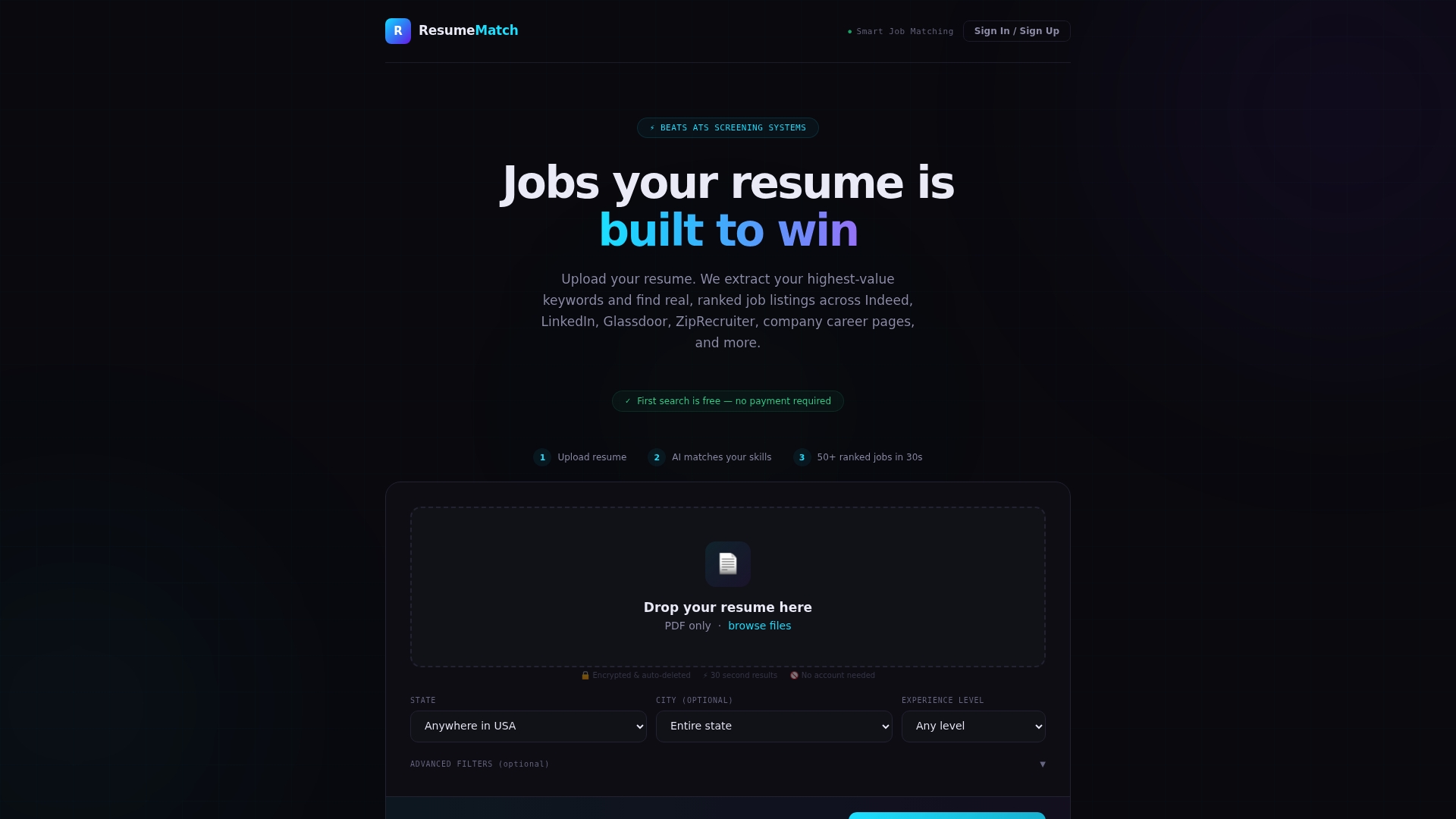
Try ResumeMatch free for 72 hours and see which jobs fit your resume today. To learn how matching works, read our guide to personalized job matches that actually fit.
A simple weekly routine
Once you have your boards, a routine keeps you from drifting.
- Monday: Review new listings on your two or three niche boards. Shortlist five to eight.
- Tuesday and Wednesday: Tailor your resume and apply to the top roles first.
- Thursday: Visit the career pages of five target employers and reach out to one person at each.
- Friday: Update your tracker, follow up on applications from the prior week, and note which boards produced the best leads.
After three or four weeks, drop the board that gave you the least and test a new one. Your list should change as you learn.
FAQ
Are niche job boards better than general job sites?
They are better at relevance, not at volume. A niche board shows more of the jobs you could actually do, while a general site shows more jobs overall. Most job seekers do best using a couple of each, with the bulk of their effort going to specialty boards, company pages, and networking.
How many niche job boards should I use?
Two or three is plenty to start. More than that and you will spend your week scrolling instead of applying. Test each for a week, keep the ones that give you fresh, relevant listings, and swap out the rest.
Do niche job boards cost money for job seekers?
Browsing and applying on a legitimate board should be free. Employers usually pay to post. If a site asks you for payment to see listings or to be considered for a job, be careful, because the FTC says honest employers do not charge applicants to get a job.
How do I find niche job boards if I’m changing careers?
Start with the job titles and skills used in your new field, then look up professional associations for that field and check whether they run job boards. Read a handful of postings to learn the vocabulary, and ask two or three people in the field where they look for openings.
Can I trust the salary numbers on a job board?
Use them as a starting point. Compare them with official wage estimates, such as the BLS-based figures in CareerOneStop’s Salary Finder, and look at the range for your location and occupation before you negotiate.
Sources
- CareerOneStop: Post your resume wisely
- CareerOneStop: Professional Association Finder
- CareerOneStop: Salary Finder
- CareerOneStop: Highest Paying Careers
- BLS: Earnings and other compensation data
- FTC: Looking for a job? Scammers might be looking for you
- FTC: Looking for a postal job? Also look out for job scams
- FTC: Charges against an education lead generator
- Forbes: 15 Best Job Search Sites