
Job Applications: About 18 to an Offer, Plus Weekly Targets
Job Applications: About 18 to an Offer, Plus Weekly Targets

The number of applications it takes to land an offer varies by role, field and resume quality. Federal data points to roughly one interview per six applications, and about a 37% chance of an offer once you have interviewed. A solid starting target is 10 to 25 tailored applications a week.
TL;DR:
- Jobseekers without interviews still had about a 10% offer chance, but referrals and direct employer contact can create routes beyond cold online applications.
- Unemployed jobseekers can start with 15 to 25 tailored applications weekly; employed jobseekers should target 8 to 15 and prioritize referrals and recruiter conversations.
- If applications draw few responses, pause volume, revise resume keywords and role targeting, then track rates by source before changing one variable at a time.
- No public dataset ranks platforms by offer odds, so tag each application by source and shift effort toward channels that produce interviews for you.
Table of Contents
- What the data shows about applications, interviews, and offers
- Why your number could be higher or lower
- Weekly and daily application targets that make sense
- How to get more interviews and offers from each application
- How to track your job-search funnel
- Managing follow-ups without becoming a nuisance
- Which job search platforms give you the best odds
- What shortens a job search more than volume
- Where ResumeMatch fits into a higher-yield search
- FAQ
- Sources
What the data shows about applications, interviews, and offers
The best public evidence comes from the Bureau of Labor Statistics. Its analysis of a Current Population Survey supplement, how jobseekers search for jobs, links the number of applications people sent to the interviews and offers they got. The headline result is an approximate ratio of one interview for every six applications.
The second finding matters even more for your planning. Jobseekers who had at least one interview had about a 37% chance of receiving an offer. Those with no interviews had about a 10% chance. That gap tells you where the real work is: getting to the interview stage changes your odds more than any other single step.
Here is what those numbers mean in plain terms:
- Six applications per interview is an average, not a promise. Some people hear back quickly, while others need many more applications.
- A 37% offer chance after interviewing implies that you will often need several interviews, not one, before an offer arrives.
- A 10% chance without interviews shows that offers do sometimes come through other routes, such as referrals or direct contact, but they are the exception.
- Applications are one channel among many. BLS data on active search methods show that 56.1% of unemployed jobseekers sent resumes or filled out applications, while 50.8% contacted employers directly.
Do the math with the averages. If six applications produce one interview, and roughly 37% of people who interview get an offer, you would need around three interviews to expect one offer. That works out to about 18 applications. This is a rough funnel calculation from averages, not a forecast for your situation, but it explains why many published guesses cluster in the dozens rather than the hundreds.
So why do you see such different numbers online? One range that appears in the BLS data is 21 to 80 applications; reported totals can vary widely. They are not contradictory. They come from different samples and different definitions:
- Some surveys count only tailored, high-effort applications. Others count every click of an “Easy Apply” button.
- Some samples focus on entry-level or high-volume roles, where interview rates may be lower per application but openings are plentiful.
- Some include only people who got an offer, which leaves out those still searching and skews the picture.
- Self-reported counts are fuzzy. People round, forget and sometimes count differently.
Then there are the long-tail stories. A Business Insider profile described a job seeker who applied to roughly 2,000 positions over two years before landing an offer. That case is real, and it shows how much variance exists. It is also a reminder that sheer volume is not a strategy. If your numbers are drifting toward the long tail, the answer is almost never “apply to more.” It is usually “change what you are doing per application,” which we cover below.
If you want to see how another dataset frames the same question, our own breakdown of job application success rates walks through offers per batch of applications.
Why your number could be higher or lower
Think of the 20 to 200 range as a spectrum. The factors below decide where you land on it.
- Role seniority and specialization. Niche and senior roles may need fewer applications because the pool of qualified candidates is small. But they can involve more interviews, more stakeholders and a longer lead time. The time required for applications can vary considerably by role.
- Industry hiring patterns. High-volume service and entry-level roles post many openings and receive many applicants. Specialized technical and executive roles post fewer openings but may filter harder on exact experience.
- Application quality. A resume tailored to the posting, with the job’s own keywords and a format that applicant tracking systems can read, raises interview rates per application. This is the factor you control most directly.
- Sourcing channel. Referrals and direct outreach usually convert far better than cold online applies. A hiring manager who has heard your name is reading your resume differently from one who sees it in a pile of hundreds.
- Geography and salary expectations. Tight local markets, remote roles that draw national applicants and asking for well above a role’s typical pay all push your number up.
- Market seasonality. Hiring often slows around the end of the year and picks up in the new year. BLS openings and hires data can help you see how hiring volume moves over time.
The takeaway: if you are a mid-career specialist with a strong network, expect to be at the low end of the range. If you are changing fields, applying to crowded entry-level postings by cold apply only, or sending the same resume everywhere, expect the high end.
Pro Tip: Before you send an application, ask yourself: “Could this resume be sent unchanged to other jobs?” If yes, take time to match its keywords and top bullet points to this posting.
Weekly and daily application targets that make sense
Targets help because they turn a vague worry into a plan you can finish by Friday. The ranges below are practical starting points that we suggest, not figures from a survey. Adjust them using your own funnel results, which we cover in the tracking section.
- Unemployed and actively searching: 15 to 25 targeted applications a week. This is a near full-time search, so protect time for networking and interview prep alongside it.
- Employed but looking: 8 to 15 applications a week. You have less bandwidth and less urgency, so be pickier and lean on referrals and recruiter conversations.
- New graduates: 15 to 30 applications a week, with extra emphasis on networking. You have fewer credentials to signal, so introductions from alumni, professors and internship contacts do a lot of the work.
- Daily cadence: 2 to 5 tailored applications a day is a sustainable rhythm. Three good applications beat ten rushed ones, because customization is what moves the interview rate.
- When to ramp up or slow down: If you have sent many applications and gotten almost no responses, do not just increase volume. Slow down, review your resume and targeting, then resume. If you are getting interviews and are stretched thin, scale back applications and put the time into prep.
Our guide to the job search workflow for new job seekers shows how to split a week between applying, networking and interview prep so none of them gets squeezed out.
One caution about the numbers above: they assume each application is tailored. A weekly application target is achievable only if you are efficient with a strong base resume, a focused list of target titles and a routine. If you find yourself copying and pasting the same materials to hit a quota, you are building volume at the cost of yield.

How to get more interviews and offers from each application
Raising your yield per application is the fastest way to shorten the search. These are the tactics that tend to matter most.
- Tailor for ATS and humans. Pull the exact skills, tools and titles from the posting and mirror them where they honestly apply to you. Keep formatting plain: standard headings, no text boxes, no tables in the resume body, and a file type the posting accepts. Then paste your resume into a plain text editor to see if it still reads in order.
- Write bullets that show results. Specific outcomes beat duty lists. If you want examples of wording, this guide to resume examples with PAR bullets shows how to state a problem, an action and a result in one line.
- Ask for introductions. Referrals work because they replace a stranger’s resume with a recommendation. A simple message does it: say what role you are targeting, name the company, and ask whether they would be comfortable passing your resume to the hiring manager or introducing you.
- Target by fit. Prioritize postings where you meet most of the core requirements and could plausibly be shortlisted. Reaching slightly is fine. Applying to roles that need years of experience you do not have wastes your best hours.
- Follow up after interviews. Send a short thank-you within a day, reference something specific from the conversation, and ask about next steps and timing. This keeps you present while the team decides and often surfaces useful details about the process.
Pro Tip: Keep a “master resume” with every project and metric you have, then build each tailored version by deleting what does not fit rather than writing from scratch. It can make customization more efficient.
How to track your job-search funnel
You cannot fix what you do not measure. A spreadsheet with a few columns is enough. For each application, record:
- Date submitted, company, role and where you found it
- Whether you applied cold or through a referral
- Whether you got a response, and what kind
- Interview invites and interviews attended
- Offers received and the outcome
From there, compute three simple rates:
- Response rate: responses divided by applications
- Interview rate: interviews divided by applications
- Offer rate: offers divided by interviews
Compare your interview rate to the BLS benchmark of about one interview per six applications. If you are well above it, your materials and targeting are working, and you can send fewer applications. If you are well below it, the resume or the targeting needs attention before volume does.
Review your numbers over a rolling period. A brief dip in results may be noise, but a sustained lack of progress is a signal to change something. Change one thing at a time, such as the resume headline, the job titles you target or the channel you use, so you can tell what helped.
For a quick setup, our walkthrough on how to track job applications in 10 minutes gives you a starting template.
Managing follow-ups without becoming a nuisance
Tracking is only half of the system. The other half is knowing when to follow up and what to say, and a tracker makes that easy because every application has a date next to it.
A simple cadence works for most roles. If a posting gives a timeline, wait until it passes. If it does not, use your judgment about when to check in. A short, polite message that restates your interest, names the role and offers one relevant detail is enough. If you have no reply, consider sending one more polite follow-up later. After that, move on and leave the door open.
After an interview, send a thank-you promptly. If the interviewer gave a decision date, wait until it passes before asking, then ask for an update on timing rather than the outcome. Add a “next follow-up date” column to your tracker and sort by it each morning, so nothing slips through while you focus on new applications.
Keep notes on every conversation: names, topics discussed, anything the interviewer cared about. Those details make your follow-ups specific, and specific messages get answered far more often than generic ones.
Which job search platforms give you the best odds
Not every channel converts equally, and the official data gives you a clear hint. BLS survey results show that jobseekers use several methods at once, including sending applications and contacting employers directly. Success rarely comes from only one.
Broad job boards offer volume, which is useful for exploring the market, but they also draw the largest applicant pools, so your resume competes with many others. Company career pages tend to get fewer duplicate submissions and show roles before some aggregators pick them up. Niche and professional boards narrow the pool to people in your field, which often means a better interview rate per application. Referrals and direct outreach sit at the top for conversion, because someone is vouching for you.

We are not aware of a public dataset that ranks platforms by application-to-offer ratio, so treat any claim that “Platform X has the best odds” with caution. Use your own tracker instead. Tag each application with its source, and over time you will see which channel produces interviews for you. Shift your hours toward it.
What shortens a job search more than volume
We have read a lot of job-search data, and the pattern is consistent: more applications do not shorten a search as reliably as better ones do. People who stall usually are not short on effort. They are sending the same resume to postings that are not quite right and hoping the numbers will do the work.
What we see change outcomes is a combination of three habits. Spend part of every day on networking, even if it is only two messages. Send two or three genuinely tailored applications daily rather than mass applying. And review your funnel numbers weekly, so you can correct course early instead of discovering a month later that something was broken.
If your search feels long, that is not a verdict on you. It is information about your funnel, and funnels can be fixed one stage at a time. Keep going, measure honestly, and change one thing at a time.
— Resume
Where ResumeMatch fits into a higher-yield search
If you want fewer wasted applications, we built ResumeMatch for exactly that. Our AI reads your resume, pulls out the keywords that matter and matches you to live job listings across multiple platforms. Our Career Probability Report shows your strongest matches, resume gaps and salary insights, and our tracking tools keep your funnel in one place.
Short on time? Our “Let Us Apply For You” agent service sends personalized applications on your behalf for a one-off $50. Our ResumeMatch Membership is $15 per month.
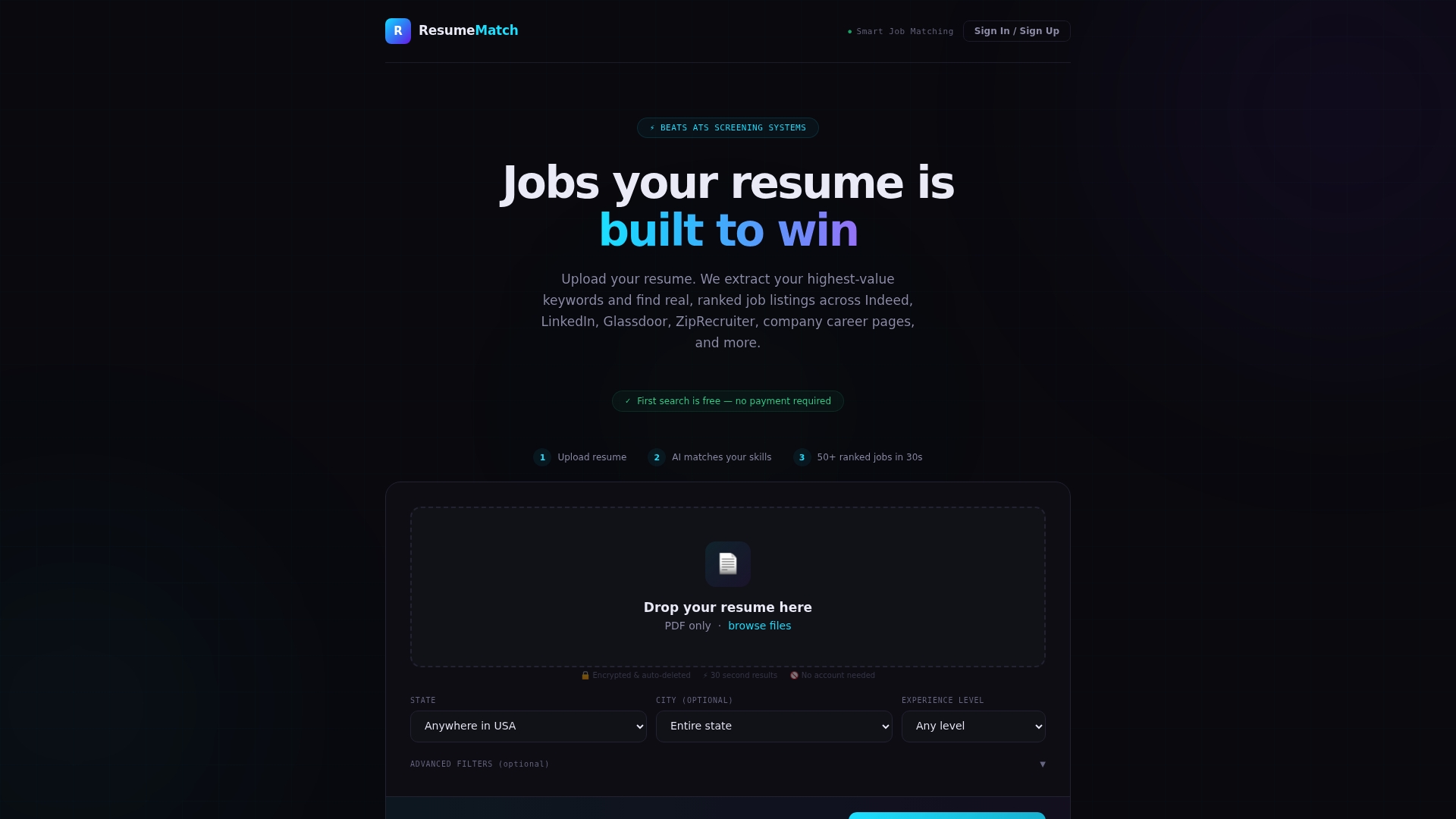
Start with ResumeMatch and see which roles fit you best today.
FAQ
How many applications does it usually take to get a job?
There is no single number; the applications it takes to land an offer vary from person to person. Federal data shows about one interview per six applications, so your own result depends on how well each application is targeted.
What are the odds of getting a job offer?
Interviews are the biggest swing factor. BLS found that jobseekers with at least one interview had about a 37% chance of an offer, compared with about 10% for those with none.
How many job applications should I send per week?
A reasonable starting range is 15 to 25 targeted applications a week if you are unemployed, and 8 to 15 if you are employed. Adjust it up or down based on how many interviews you are getting.
Is it better to send more applications or better ones?
Better ones, almost every time. Tailored resumes, referrals and direct outreach raise the interview rate per application, which shortens the search more than extra volume does.
Sources
- How do jobseekers search for jobs? New data on applications, interviews, and job offers
- Job Searcher Got Offer After 2 Years and 2,000 Apps: What Worked - Business Insider