
1 Offer from 20–30 Applications: Job Seekers' Success Rate
1 Offer from 20–30 Applications: Job Seekers’ Success Rate

Most job seekers land somewhere between 1 interview for every 6 applications they send, based on BLS data on jobseeker search patterns, and roughly a 37% chance of an offer once they get that interview. That means sending 20 to 30 targeted applications can reasonably produce one offer if your resume and outreach are on point. The single move that changes those odds fastest: trade volume for targeting, lean on referrals and tailored resumes over mass-applying, and track your own numbers so you know what’s actually working.
TL;DR:
- Focusing on referrals, company careers pages, and niche job boards improves your chances more than mass-applying on high-volume sites.
- Tailoring your resume with exact keywords, measurable results, and simple formatting significantly increases your likelihood of passing ATS screening and securing interviews.
- Tracking application data such as source, resume version, response time, and outcome helps identify which strategies actually improve your success rate.
- Applying roughly 20 to 30 targeted, well-crafted applications gives most job seekers around a 37% chance of receiving an offer, based on industry benchmarks.
- Using AI tools for keyword optimization and following a disciplined follow-up process can boost your late-stage interview and offer conversion rates.
Table of Contents
- Benchmarks job seekers should know: apply rates and conversion numbers
- The application funnel: click, apply, interview, offer
- Why rates vary: channels, industry, seniority, and timing
- Personal factors that change your odds: resume, keywords, networking, interview readiness
- Practical, prioritized tactics to increase your application success rate
- Measure and improve your own funnel: metrics, a simple dashboard, and experiments to run
- Realistic expectations, persistence, and when to change strategy
- How ResumeMatch helps you act on these numbers
- Sources
- FAQ
Benchmarks job seekers should know: apply rates and conversion numbers
Before you can tell if your search is going well, you need a baseline. A few numbers from recent employer and jobseeker research give you that starting point.
On the employer side, Appcast’s 2025 recruitment marketing benchmark report found the apply rate rose to about 5.19%, meaning roughly 5 out of every 100 people who click a job ad go on to submit an application. That’s a click-level number, not your personal odds, but it tells you how much attention a typical posting gets before anyone even applies.
On the applicant side, the BLS analysis of Current Population Survey data is the most useful yardstick for individual job seekers. It found:
- Jobseekers average about 1 interview for every 6 applications submitted.
- Those who land at least one interview have roughly a 37% chance of receiving an offer.
- Jobseekers who never get an interview have a notably lower chance of receiving an offer.
Employer-side recruiting data from CareerPlug’s hiring metrics guide adds another layer: employers invite an average of around 3% of applicants to interview, and convert about 27% of those interviews into hires. Some employer datasets show many applicants are required for each hire made, the exact number varying by role and industry, depending on the role and industry.
Roughly 1 in 6 applications leads to an interview, and about 37% of interviews lead to an offer, according to BLS research on jobseeker outcomes. Run that math forward: if you send 18 applications, you might expect around 3 interviews, and from those, roughly 1 offer. That’s not a guarantee, it’s a planning tool, and it’s exactly why quality per application matters more than raw quantity.

The application funnel: click, apply, interview, offer
Every job search moves through the same four stages, and knowing what happens at each one helps you figure out where your search is actually stalling.
Click to apply is the first filter. Someone sees a posting and decides whether to start the application. This is where the 5.19% apply rate comes from, and it’s mostly about how compelling the job ad looks, not something you control as an applicant.

Apply to interview is where your resume does its work. Applicant tracking systems (ATS) scan for keyword matches to the job description before a human ever sees your file, which is why generic resumes sent to dozens of postings tend to underperform tailored ones.
Interview to offer is where preparation and fit take over. This is the stage where the BLS’s 37% figure applies, and it’s also the stage most within your control once you’re in the room or on the call.
A few things happen at each stage that explain why a single percentage can mislead you:
- ATS software often screens out resumes before a recruiter reads them, based on keyword and formatting mismatches.
- High-volume roles draw hundreds of applicants, which drags employer-side interview rates down regardless of your resume quality.
- A strong interview-to-offer rate doesn’t help you if your resume never gets you an interview in the first place.
Pro Tip: Before optimizing your resume further, check whether you’re losing ground at the apply-to-interview stage or the interview-to-offer stage. The fix is different for each.
Why rates vary: channels, industry, seniority, and timing
Not all applications are created equal, and comparing your results against a flat national average can give you the wrong read on how you’re doing.
Source matters. CareerPlug’s recruiting benchmarks show job boards generate the largest share of applicants but convert to hires at a lower rate than referrals, company careers pages, or niche industry sources. A referral that skips the resume pile entirely tends to move faster and convert better than a cold application into a job board’s queue of hundreds.
Industry and role type shift the numbers too. A high-volume retail or customer service role might draw 150 applicants for one opening, while a specialized technical role might draw a dozen, with each candidate far more qualified on paper. Your personal odds look very different in those two situations, even if your resume quality is identical.
A few patterns worth knowing:
- Referrals and company careers pages tend to convert to hires more efficiently than general job boards, per CareerPlug’s data.
- Niche technical and senior roles usually have smaller applicant pools but higher expectations per candidate.
- Mass-applying to dozens of postings a week tends to produce diminishing returns once your time-per-application drops too low for real tailoring.
Timing plays a role as well. Hiring often slows around major holidays and picks back up in January and again after Labor Day, though this varies by industry and company budget cycles.
Personal factors that change your odds: resume, keywords, networking, interview readiness
Benchmarks tell you what’s typical. What actually moves your personal numbers comes down to a handful of controllable factors.
Referrals change everything. A referred candidate skips a chunk of the early screening that trips up cold applicants, which is part of why CareerPlug’s data shows referral-sourced hires converting more efficiently than job board applicants. If you know someone at a company you’re targeting, that conversation is often worth more than five extra applications.
Resume and keyword alignment decide whether you clear the ATS stage at all. A quick checklist:
- Match your resume’s skills section language to the exact terms in the job description, not synonyms.
- Put measurable results in your bullet points (numbers, percentages, timeframes) instead of vague duties.
- Tailor your headline or summary line to the specific role title you’re applying for.
- Keep formatting simple: standard headings, no tables or graphics that confuse ATS parsing.
Interview readiness and follow-up decide the late-stage outcome. Older BLS career guidance has long pointed to focused, targeted job search strategies over a scattershot approach, and that advice still holds.
Burnout is a quiet variable most people underestimate. When you’re sending applications late at night after weeks of rejection, quality drops, typos creep in, and tailoring gets skipped, which drags your real conversion rate down even though your effort feels higher.
Practical, prioritized tactics to increase your application success rate
Here’s the order of operations that gets you the most improvement for the least wasted effort.
- Prioritize your channels before you touch your resume. Referrals first, then company careers pages, then niche job boards for your industry, and general job boards last. CareerPlug’s benchmarks consistently show this order converts better than starting with high-volume boards.
- Rebuild your resume around the job description, not your career history. Pull the exact skills and terms from three or four postings you’re targeting and make sure your resume’s skills section reflects that language. Our guide on tailoring resumes for ATS systems walks through this in more detail.
- Run a simple A/B test on your own applications. Send version A of your resume to ten postings and version B to another ten, then track which one produces more interview invitations. Small, controlled comparisons like this reveal what actually works in your specific market, not just what worked for someone else.
- Build your networking playbook before you need it. Reach out to two or three people a week in your target field with a short, specific message asking about their role, not a job. An informational interview that goes well often turns into a referral without you ever having to ask directly.
- Set a follow-up cadence and stick to it. A polite check-in email five to seven business days after an interview, and another after two weeks of silence, keeps you visible without becoming a nuisance. Ghosting from employers is common enough that proactive follow-up genuinely helps, according to Upwork’s research on candidate ghosting.
- Use AI tools for keyword optimization, then edit everything yourself. AI can help you spot missing keywords fast, but resumes that read as generic or overly templated tend to lose the specificity that makes a hiring manager remember you. Tools like ResumeMatch’s AI matching or a document workflow like Semester Flow’s AI docs can speed up the mechanics, but the final pass should sound like you.
Pro Tip: Treat every application as a small experiment. If you’re not tracking which resume version, channel, and follow-up approach produced results, you’re guessing at what to repeat.
Measure and improve your own funnel: metrics, a simple dashboard, and experiments to run
You can’t improve what you don’t track, and a spreadsheet with a handful of columns tells you more than any national benchmark.
Log these fields for every application:
- Date applied, role title, and company.
- Source (referral, careers page, job board, or other).
- Resume version used.
- Interview received (yes or no) and offer received (yes or no).
- Time to first response, in business days.
A simple weekly view might look like this:
Once you have four or five weeks of data, you can see which source and which resume version is actually converting, rather than guessing. Our own guide to tracking job applications walks through setting this up in under 10 minutes.
Realistic expectations, persistence, and when to change strategy
A slow month doesn’t mean you’re doing it wrong. Job searches often stretch across several weeks even for strong candidates, and the numbers above are averages, not guarantees for any single person. What matters is whether your own tracked data shows movement.
If four to six weeks of tracked applications show no interviews at all, that’s your signal to change your resume, your channels, or both, rather than just sending more of the same. If burnout is creeping in and your application quality is slipping, it’s worth pausing to reset rather than pushing through on autopilot. And if you’ve optimized what you can control but still want a faster path, a managed application service or resume coaching can be a reasonable next step rather than a last resort.
— Resume
How ResumeMatch helps you act on these numbers
Knowing the benchmarks is one thing. Acting on them every day, for every application, is where most job seekers run out of steam. ResumeMatch was built to take on the repetitive parts of the funnel we just walked through, so your time goes toward the moves that actually move your odds.
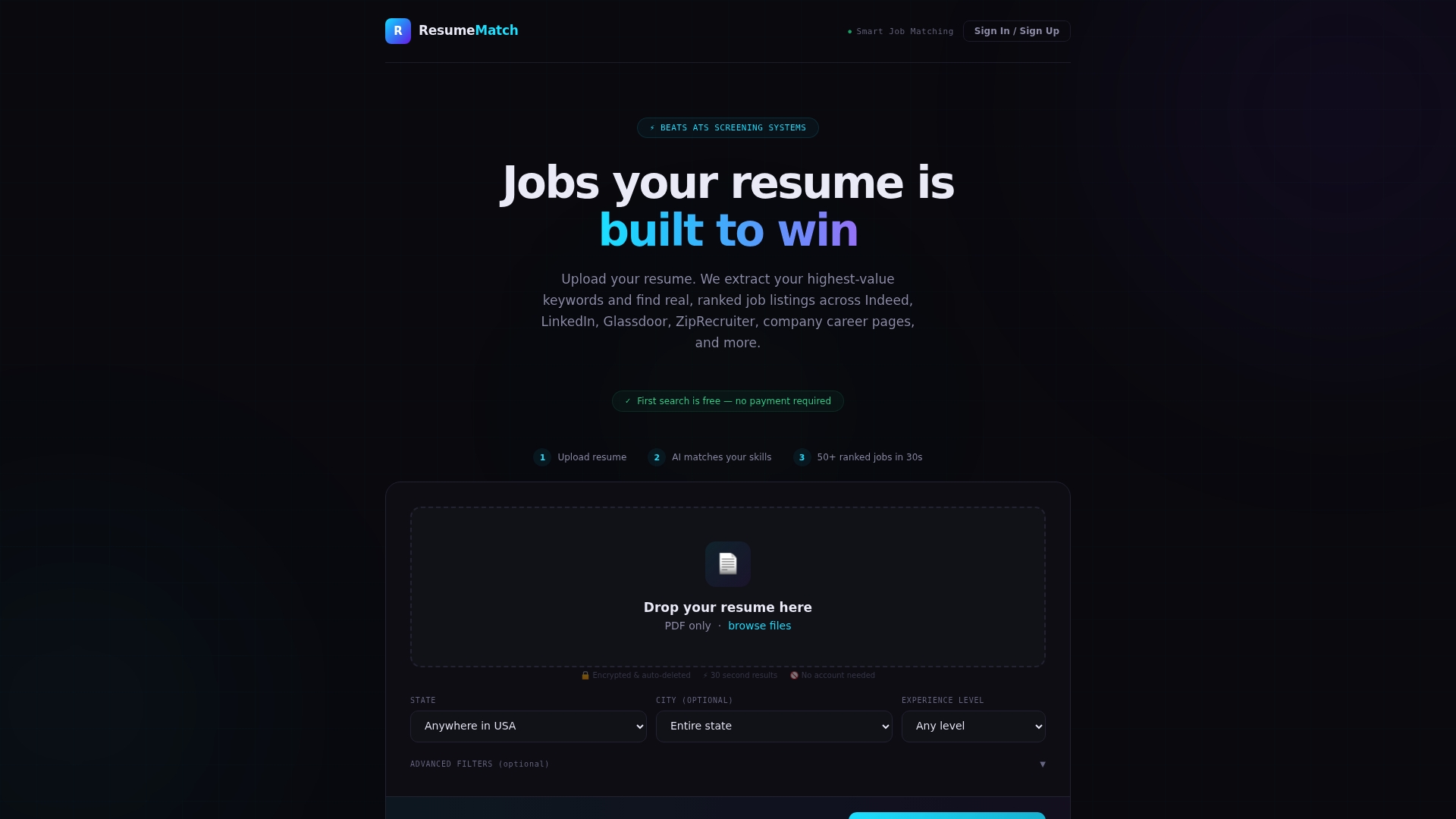
Here’s what it handles:
- AI resume analysis that extracts the keywords a given job posting is screening for, to help improve resume compatibility with ATS systems.
- A career analysis report with salary insights and a personalized strategy based on your resume’s strengths and gaps.
- Tailored job matching across multiple job boards, designed to help you find relevant roles more efficiently.
- Application tracking features to help capture your application data automatically rather than manually tracking it.
- An optional application submission service where agents apply on your behalf for a one-time fee.
If you want the resume optimization and tracking tools working for you day to day, the ResumeMatch Membership runs $15 per month. Start there and let the platform handle the parts of the funnel that eat the most time.
Sources
- Appcast releases 2025 recruitment marketing benchmark report
- How do jobseekers search for jobs? New data on applications, interviews, and job offers
- Hiring metrics: a data-backed guide for employers
FAQ
What is the 70/30 rule in hiring?
There’s no BLS or industry-standard definition of a “70/30 rule” in the sourced hiring research, so treat any specific version you encounter with caution. What’s well supported instead is that targeted, quality applications tend to outperform high-volume, generic ones.
Why is it so hard to get a job right now?
Difficulty varies a lot by industry, role, and location, and the benchmark data doesn’t point to one single cause. What the numbers do show is that employers often invite only around 3% of applicants to interview, according to CareerPlug’s recruiting metrics, which means competition at the top of the funnel is intense regardless of the broader economy.
Is it true that most jobs aren’t advertised?
This figure isn’t confirmed in current BLS or recruiting benchmark data, so it’s best treated as a commonly repeated claim rather than an established statistic. What the sourced research does support is that referrals and direct outreach convert more efficiently than public job board applications, according to CareerPlug’s channel data.
What is the hardest month to get hired?
Sourced benchmark data doesn’t identify a single hardest month, since hiring pace depends heavily on industry and company budget cycles. Many job seekers notice slower activity around major holidays, but no specific month is confirmed as universally hardest in the research used here.
How many applications does it typically take to get one job offer?
Based on BLS research, roughly 6 applications tend to produce 1 interview, and interviewed candidates have about a 37% chance of an offer. That works out to somewhere around 18 to 30 well-targeted applications for a reasonable shot at one offer, though your actual number depends on your resume, channel, and industry.