
Job Search Workflow Explained for New Job Seekers
Job Search Workflow Explained for New Job Seekers

A job search workflow is a structured, repeatable system that connects five sequential stages: targeting, preparation, tailoring, tracking, and follow-up. Most job seekers treat each application as a one-off task. That approach wastes time and produces inconsistent results. A systematic job search process turns scattered effort into a compounding execution framework where each stage feeds the next, improving your match probability at every step. Resume-match was built around this exact principle: the right role finds you faster when your process is tight.
What are the essential stages in an effective job search workflow?
A well-built job application workflow runs five stages in sequence for each application and in parallel across your full pipeline. Skipping any stage creates gaps that show up later as silence from employers.
Stage 1: Targeting

Targeting means deciding which roles and companies are worth your time before you write a single word. You define your criteria: industry, role level, company size, location, and culture fit. Ten targeted applications backed by research and referrals regularly outperform a hundred anonymous submissions. Targeting is the filter that makes every other stage more efficient.
Stage 2: Preparation
Preparation means building your reusable application assets before you need them. This includes your resume base, a LinkedIn profile, a cover letter template, and a library of achievement bullets. Professionals who prepare these assets upfront spend far less time on each individual application. Think of it as building a toolkit once and reaching for the right tool each time.
Stage 3: Tailoring
Tailoring means adjusting your prepared assets to match the specific job posting. You swap in relevant keywords, reorder bullet points, and align your summary to the role’s priorities. This stage takes minutes when your asset library is ready, not hours. Tailoring is what separates a generic submission from one that reads like it was written for that exact role.
Stage 4: Tracking
Tracking means logging every application in a centralized system with dates, contacts, and status. Without tracking, you cannot tell whether your targeting is off, your resume is weak, or your follow-up is missing. Centralized tracking reveals exactly where your pipeline stalls so you can fix the right problem.
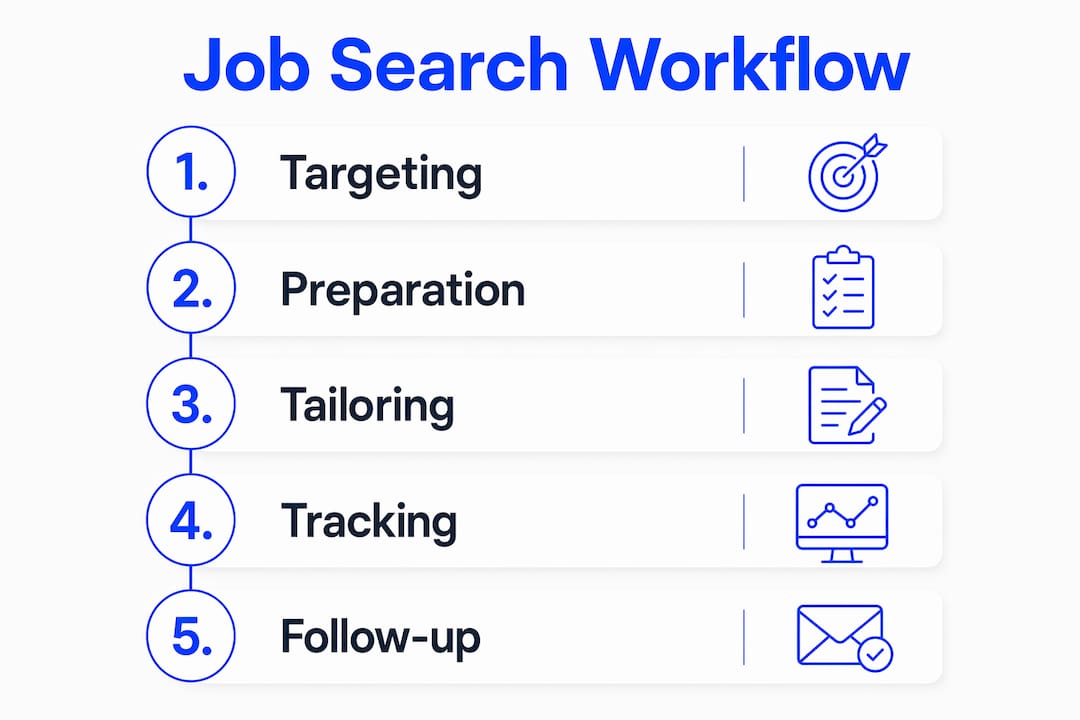
Stage 5: Follow-up
Follow-up means reaching out after submission at disciplined intervals with messages that add value. A good follow-up references the specific role and restates why you are the right fit. It signals professionalism and keeps your name visible without becoming repetitive.
Pro Tip: Block two hours every Sunday to review your pipeline, plan the week’s applications, and write any follow-up messages. Treating this as a scheduled work session, not a mood-dependent task, keeps your search moving.
How can a modular asset library speed up your tailoring process?
A modular asset library is a personal document containing pre-written, reusable pieces of your professional story. It is the single biggest time-saver in any effective job search process.
The library typically contains:
- Achievement bullets in STAR format. STAR stands for Situation, Task, Action, Result. Each bullet describes a specific accomplishment with a measurable outcome. Professionals build 40–60 of these bullets covering their full career history, then pull the most relevant ones for each application.
- Skill blocks. Short, grouped lists of technical and soft skills organized by category, such as project management, data analysis, or client communication.
- Summary variants. Two or three versions of your professional summary written for different role types. A marketing manager applying to both brand strategy and content roles needs a different opening for each.
- Cover letter paragraphs. Pre-written middle paragraphs that describe your core value, ready to be inserted and lightly edited.
The power of this approach is recombination. You are not rewriting from scratch. You are selecting, arranging, and lightly editing assets you already trust. Modular asset libraries reduce tailoring time from hours to minutes and dramatically cut the burnout that comes from starting every application with a blank page.
Pro Tip: After every interview, add a new bullet to your library based on what you talked about. Interviews surface stories you forgot you had.
Organize your library in a simple document with clearly labeled sections. Google Docs works well because you can search it quickly. Review and update it every two weeks to add new accomplishments and remove outdated ones.
Why is tracking your job application pipeline critical?
Tracking turns your job search from a guessing game into a diagnostic system. Without data, you cannot tell whether the problem is your targeting, your resume, or your follow-up cadence.
The core metrics to track are straightforward:
| Metric | What it tells you |
|---|---|
| Applications sent | Your weekly output and targeting volume |
| Screening calls received | Whether your resume and targeting are aligned |
| Interviews scheduled | Whether your positioning resonates with recruiters |
| Offers received | Whether your interview conversion is working |
| Follow-ups sent | Whether you are maintaining momentum after applying |
When applications go out but screening calls do not come back, the problem is usually targeting or resume fit. When screening calls happen but interviews do not follow, the issue is likely positioning or how you present your experience. Pipeline tracking makes these patterns visible so you fix the right stage instead of working harder at the wrong one.
A simple spreadsheet covers most job seekers’ needs. Columns for company name, role title, date applied, current status, next action, and contact name give you everything you need to manage 20 to 30 active applications without losing track of any of them.
Pro Tip: Set a rule: if an application has been in “submitted” status for 10 business days with no response, move it to “follow-up due” and send a brief, specific message that day.
Weekly review loops that include planning, tracking, and reflection help you sustain the search as a system rather than relying on daily motivation. Motivation fluctuates. A review habit does not.
How do you follow up without being perceived as noise?
Follow-up is the most underused stage in the job application workflow. Most job seekers either skip it entirely or send a generic “just checking in” message that adds nothing. Neither approach works.
Effective follow-up has four characteristics:
- It is timely. Send your first follow-up five to seven business days after submitting your application. If you interviewed, send a thank-you note within 24 hours and a follow-up check-in after seven to ten business days of silence.
- It is specific. Reference the exact role title, something from the job description, or a detail from your conversation. Generic messages signal that you are copying and pasting across dozens of applications.
- It adds value. Share a brief insight relevant to the company’s work, mention a recent achievement that connects to the role, or restate one specific reason you are a strong fit. Effective follow-up restates your fit rather than asking for a status update.
- It respects limits. Two follow-up messages per application is the professional ceiling. After that, move on and keep your pipeline active elsewhere.
Common mistakes to avoid include following up the day after applying, sending the same message twice, and using subject lines like “Following up again.” Each of these signals impatience rather than professionalism. The goal is to stay visible without creating friction.
Key Takeaways
A job search workflow succeeds when targeting, tailoring, tracking, and follow-up operate as a connected system rather than isolated tasks.
| Point | Details |
|---|---|
| Workflow beats volume | Ten targeted applications outperform a hundred random ones when backed by research and referrals. |
| Build assets before applying | A modular library of STAR-format bullets and summary variants cuts tailoring time from hours to minutes. |
| Track to diagnose, not just record | Pipeline metrics reveal which stage is stalling your search so you fix the right problem. |
| Follow up with specificity | Reference the exact role and restate your fit; generic check-ins add no value and get ignored. |
| Review weekly | A scheduled weekly review sustains momentum better than relying on daily motivation alone. |
What I’ve learned from watching job seekers get this wrong
Most job seekers treat the search as a numbers game. Send more applications, get more interviews. That logic sounds reasonable, but it consistently fails in practice.
What I’ve observed is that the volume approach creates a feedback loop of discouragement. You send 80 applications, hear back from three, and conclude the market is impossible. The real problem is usually targeting. You applied to roles that were a poor fit, with a resume that was not tailored, and no follow-up to compensate.
The job seekers who get hired faster are not the ones applying most. They are the ones who treat the search as an execution system with a feedback loop. They notice when screening rates drop and adjust their targeting. They notice when interviews stall and work on their positioning. They treat every week as a data point, not just a grind.
The hardest mindset shift is accepting that rewriting your resume from scratch for every application is not diligence. It is inefficiency. Building a modular library once and recombining it is the professional approach. It produces better output in less time and leaves energy for the parts of the search that actually require creativity, like preparing for interviews and building genuine connections.
If I could give one piece of advice to anyone starting a job search, it would be this: set up your tracking system and your asset library before you send a single application. The first week feels slow. Every week after that moves faster.
— Resume-match
How Resume-match fits into your job search workflow
Building and maintaining a job search workflow takes real effort, especially when you are also managing the emotional weight of the search itself.
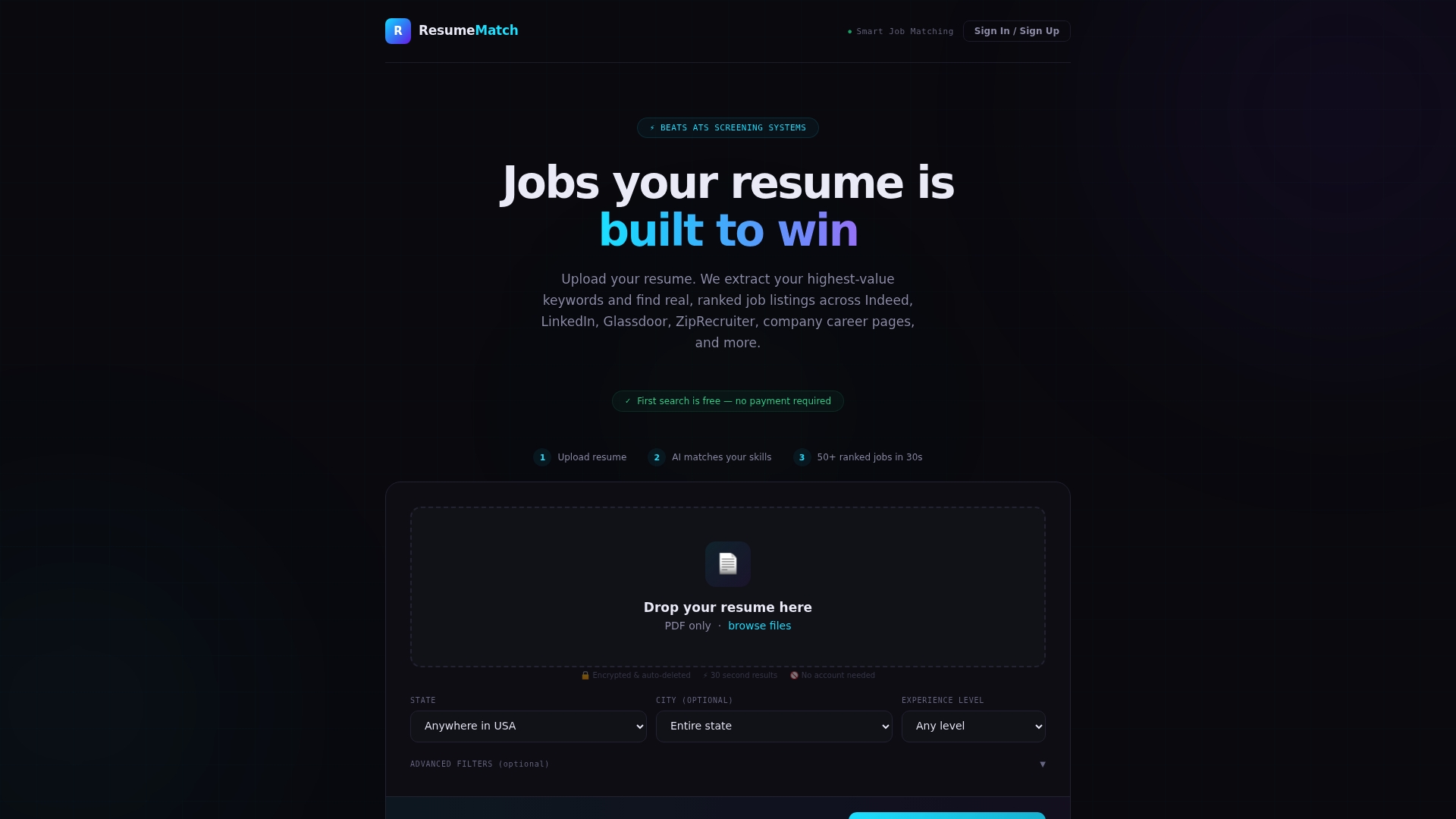
Resume-match analyzes your resume with AI, extracts the keywords that define your skills and experience, and matches you to relevant job listings across multiple platforms in 30 seconds. That directly supports the targeting and tailoring stages of your workflow. Instead of spending hours scanning job boards, you see roles that are already aligned with what your resume says you do well. Resume-match also generates a Career Probability Report that gives you a critical read on your resume, potential salary ranges, and personalized career strategies. You can find jobs built for your resume and spend your energy where it counts most: tailoring, following up, and preparing to interview.
FAQ
What is a job search workflow?
A job search workflow is a structured, repeatable process built around five stages: targeting, preparation, tailoring, tracking, and follow-up. It turns job hunting from a series of random tasks into a system that improves results over time.
How many applications should I send per week?
Quality outperforms quantity in an effective job search process. Ten well-targeted, tailored applications per week produce better results than sending dozens of generic submissions.
What is a modular asset library in job searching?
A modular asset library is a personal document containing pre-written achievement bullets in STAR format, skill blocks, summary variants, and cover letter paragraphs. Job seekers recombine these assets to tailor each application quickly without starting from scratch.
How do I know if my job search workflow is working?
Track your pipeline metrics: applications sent, screening calls received, and interviews scheduled. If applications go out but calls do not come in, the issue is targeting or resume fit, not effort.
When should I follow up after applying for a job?
Send your first follow-up five to seven business days after submitting your application. Keep it specific to the role and focused on why you are a strong fit rather than asking for a status update.