
Ask First, Apply Through a Referral: Copy-Ready 3-Line Pitch
Ask First, Apply Through a Referral: Copy-Ready 3-Line Pitch

Yes, applying through a referral increases your chances of being reviewed. It does not guarantee an offer. The single move that matters most: ask the employee to submit the referral before you hit apply. Get that sequence right and you gain real visibility with the hiring team. Get it backward and you may lose referral credit entirely, even if the same person vouches for you.
TL;DR:
- Asking for a referral before applying is essential, as most companies require the referrer to submit the record in advance to credit the referral.
- Confirm that the referral has been logged in the company’s portal, preferably by obtaining a confirmation number from the referrer, before submitting your application.
- A referral increases interview chances from about 3% to roughly 40%, but it does not guarantee an offer or exempt you from meeting role requirements.
- Building a targeted referral network over time and providing referrers with a ready packet speeds up the process and improves the quality of recommendations.
- Using tools like ResumeMatch can help you quickly tailor your resume and generate the necessary pitch, saving time and increasing your chances of securing referrals.
Table of Contents
- How Do You Apply Through a Referral, Step by Step?
- What Does “Referred By” Mean on a Job Application?
- What Should You Say When Asking for a Referral?
- What Belongs in Your Referral Packet?
- How Long Should You Wait Before Following Up?
- Do Referrals Actually Improve Your Odds?
- How ResumeMatch Speeds Up the Referral Process
- Do Referrals Matter More at Some Companies Than Others?
- How Do You Build a Network That Keeps Producing Referrals?
- Why Targeted, Honest Referrals Beat Volume Every Time
- Let Resume-match Handle the Parts That Slow You Down
- Sources
- FAQ
How Do You Apply Through a Referral, Step by Step?
Getting this right is mostly about sequence. Miss the order and you can do everything else perfectly and still lose the benefit.
Start by auditing your network before you touch a job posting. Warm contacts, people who’ve worked alongside you or managed you, carry more weight than a name you met once at a conference. Rank them by how well they can speak to your actual work, not by job title or seniority.
Once you’ve picked a target role and a referrer, assemble a small packet: the job link or requisition number, a resume link (not a PDF attachment buried in an email), and a three line pitch explaining how you know each other and why you fit. Having this ready before you ask saves your contact time and makes saying yes easy.
Here’s the sequence that protects your referral status:
- Ask first. Message the referrer before you apply, and be specific about the role.
- Confirm submission. Wait for them to tell you they’ve filed the referral in the internal portal, not just mentioned your name informally.
- Apply. Submit your application only after the internal referral record exists.
- Track it. Log the date you applied and the date the referral was confirmed, similar to how tracking job applications keeps multi-role searches from turning into guesswork.
- Follow up and thank. A short thank-you message costs nothing and keeps the relationship warm for future asks.
This order exists because many companies require the employee to submit the referral before the candidate applies, and reversing it can strip the referral of its credit even when the intent was there all along.
What Does “Referred By” Mean on a Job Application?
That field on the public application form is not the same thing as a referral. It’s a source attribution box, a way for the company’s tracking system to note where you heard about the role. Typing a name into it doesn’t automatically create the internal referral record that gets you flagged for priority review.
The real referral happens when the employee logs into the company’s internal portal and files your name as their referral, separate from anything you type on your end. Applicant tracking systems handle this differently, and some merge records by matching your email address across both submissions, which is one more reason to keep your contact details identical everywhere.
A few mechanics worth knowing before you assume you’re covered:
- Some ATS platforms only recognize a referral if it’s filed within a set window, often before or within a day or two of your application.
- Certain roles, especially executive or contract positions, are commonly excluded from referral programs altogether.
- Referral bonuses are frequently tied to the new hire completing a probationary period, which shapes how selective employees are about who they refer.
Pro Tip: Ask your referrer directly, “Did the portal give you a confirmation number?” A confirmation means it’s logged. A vague “yes, I put your name in” might mean it isn’t.
What Should You Say When Asking for a Referral?
The easiest way to get a yes is to make the ask require almost no effort on the other end. Send one person one job, not a blast to five contacts about three different openings. Vague requests get vague responses, or none at all.
Here’s a short message you can adapt for a direct message or email:
- Subject: Quick favor, referral for [Job Title] at [Company]
- Body: “Hey [Name], I saw [Company] is hiring a [Job Title] (link below) and thought of you. Would you be comfortable referring me? Happy to send anything you need to make it quick.”
Then hand them the exact text they can paste straight into the internal form, since prefilled referral language speeds up submission and removes the guesswork of what to write:
- Line 1: How you know them (“We worked together on the marketing team at [Previous Company] for two years.”)
- Line 2: How long you’ve known them and in what capacity.
- Line 3: Why you’re recommending them (“She consistently hit campaign targets and would bring strong analytical skills to this team.”)
The tone shifts slightly depending on who you’re asking. A former manager can speak to your performance directly, so let them lead with results. A former colleague should focus on day-to-day collaboration. An acquaintance or someone from a networking event needs more context from you upfront, maybe a sentence about your shared connection before the pitch. If you’re going recruiter-first because you don’t know anyone internally yet, treat that first message as relationship-building, not a referral request. Ask about the role and the team before asking for anything else.
What Belongs in Your Referral Packet?
A referrer who has to hunt for information is a referrer who procrastinates. Hand them everything in one message.
- The job link or requisition number, so there’s no ambiguity about which posting you mean.
- A resume link they can open in one click, not a file that needs downloading, and definitely not multiple versions to sort through.
- A one paragraph pitch tailored to that specific role, echoing two or three keywords straight from the job posting.
- Your LinkedIn profile, optional but useful if the referrer wants a second reference point.
Use the same email address for your application that you gave the referrer for the internal submission. This single detail matters more than most candidates realize, since it’s often what allows the ATS to merge your application with the referral record instead of treating them as unrelated entries. Keep every line short. Nobody wants to reformat your paragraph before pasting it somewhere. If you’re unsure which keywords the posting emphasizes, running your resume against the listing to check for matching language before you send anything saves a round of back and forth.
How Long Should You Wait Before Following Up?
Patience has a shelf life here. Give your referrer two to three business days before sending a reminder, and keep that reminder short: “No pressure, just checking if you had a chance to submit that referral.” If you still hear nothing after one nudge, let it go and apply on your own rather than pushing a second time.
If you’ve already applied and realize afterward that a referral would help, be upfront about it. Tell the person you applied on [date] and ask if they can still note the referral or reach out to the recruiter directly, since some programs allow retroactive credit even though many don’t.
- Wait 2 to 3 business days before your first check in.
- Send one polite reminder, then move on regardless of the response.
- Thank the referrer the moment you hear back, whether or not you land an interview.
- If you’re hired, consider following up regarding the referral bonus, which is typically tied to completion of a probation period lasting several months.
A quick thank you note after being hired goes further than most candidates think. It’s also the kind of gesture that keeps a contact willing to refer you again down the line.
Do Referrals Actually Improve Your Odds?
The numbers back up what most job seekers suspect. An analysis across 38 million applications found that referred candidates reached an interview about 40% of the time, compared to just 3% for inbound applicants who applied cold. That gap is large enough to change how you prioritize your job search time.
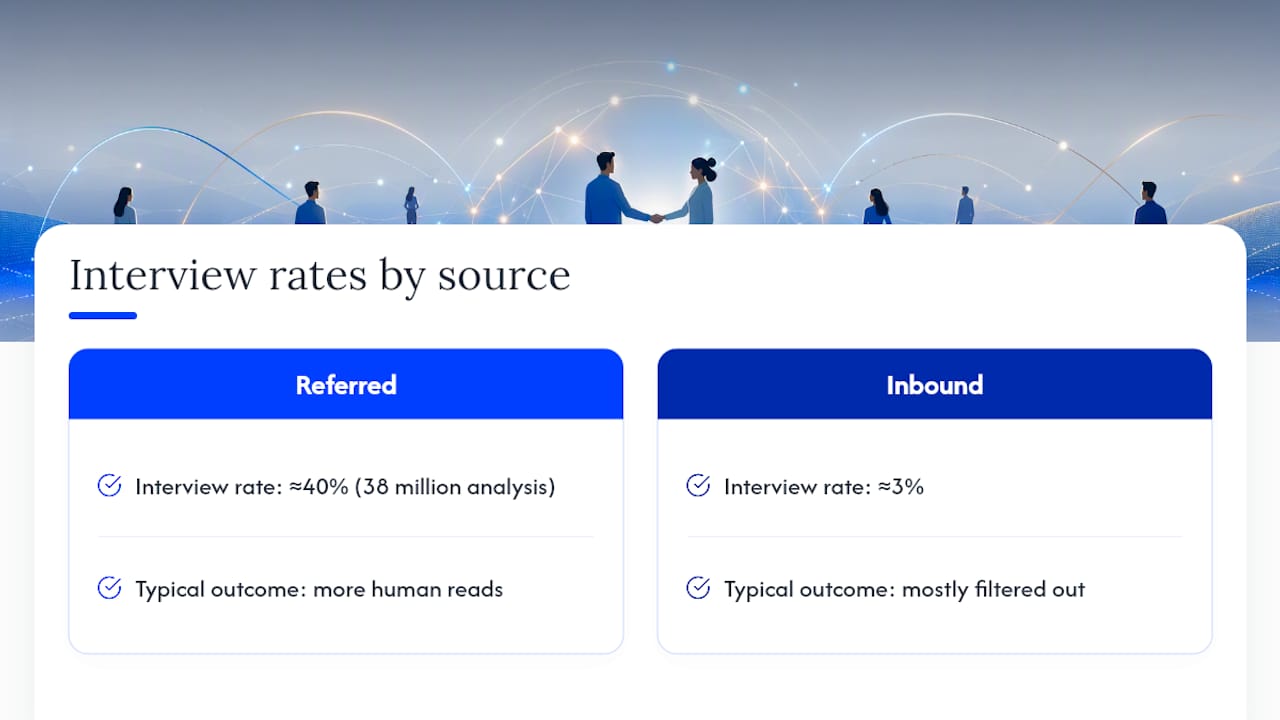
The takeaway: a referral doesn’t guarantee an offer, but it dramatically improves the odds your application gets a human read instead of getting filtered out before anyone sees it.
That said, referral programs come with real limits. Some companies exclude executive roles or short-term contract positions from referral bonuses entirely. Others pay the bonus only after the new hire survives a probation period, which makes employees more selective about who they’re willing to put their name behind. A referral from someone who barely knows your work can carry less weight than no referral at all, since recruiters often ask referrers follow-up questions about the candidate’s skills.
Referral status changes your path through the hiring process. It typically signals to a recruiter that your resume deserves a closer look, but it doesn’t erase gaps in required experience or skip you past a skills assessment. Treat it as a better seat in line, not a guaranteed win.
How ResumeMatch Speeds Up the Referral Process
Building the packet described above takes time you may not have when you’re applying to multiple roles at once. An AI-powered resume analysis can pull the vital keywords from a job posting and check them against your resume quickly, helping you write a pitch line that echoes the language in the listing instead of guessing.
A Career Probability Report can offer a breakdown of resume gaps, salary insight, and a personalized strategy that can help when deciding which contacts to approach first. Combined with application tracking tools, this can help create a faster path from “find the job” to “hand the referrer a resume link and a three-line pitch,” the exact packet outlined earlier in this guide.
Do Referrals Matter More at Some Companies Than Others?
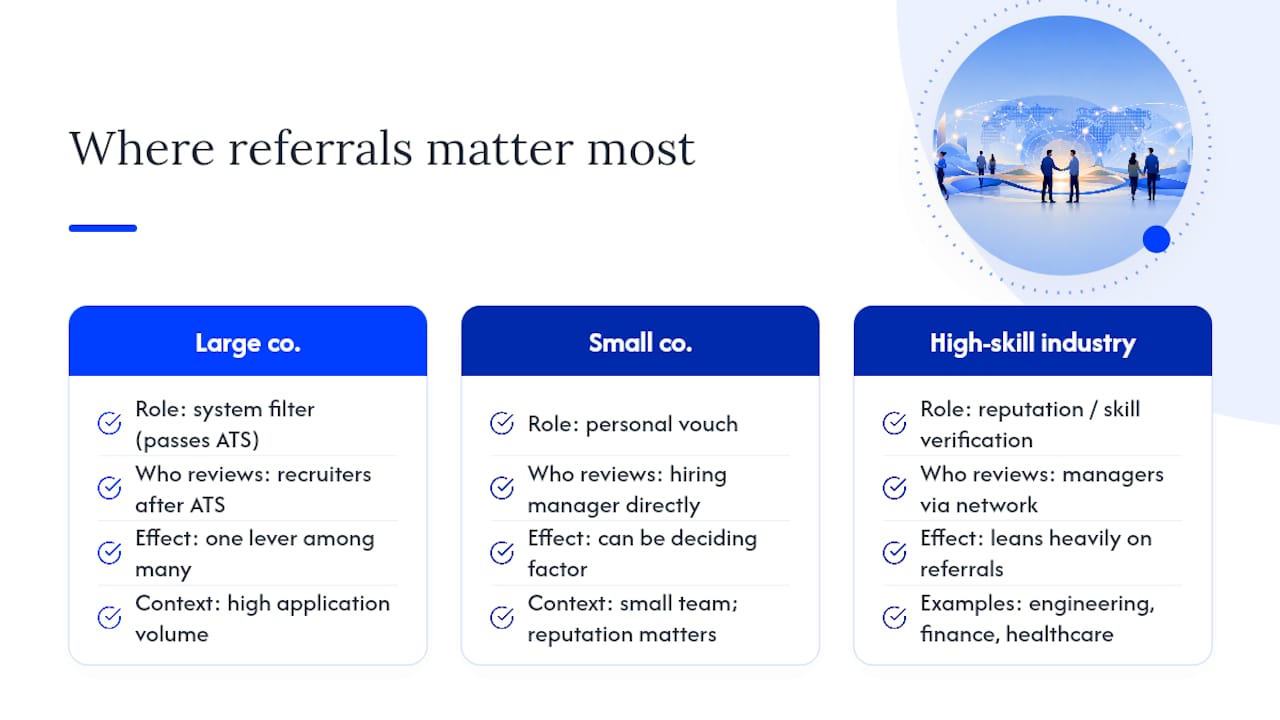
Referral impact shifts depending on where you’re applying. At large companies with high application volume, a referral often functions as a filter that gets your resume past an automated first pass and in front of an actual recruiter, since these organizations receive far more applications than they can manually review.
At smaller companies and startups, the dynamic is different. Hiring managers are often reviewing applications directly, so a referral works more like a personal vouch than a system flag. A recommendation from someone the hiring manager already trusts can move you to the top of a short list simply because the team is small enough that reputation carries weight.
Industry also plays a role. Fields with tight-knit professional communities, engineering, finance, and healthcare among them, tend to lean on referrals heavily because reputation and skill verification matter more when the talent pool is specialized. In industries with higher turnover and less specialized skill requirements, referrals still help, but the effect is often less pronounced because companies are filling roles faster and casting a wider net regardless.
None of this means a referral is wasted effort at any company size. It means calibrating your expectations: a referral at a 50,000-person company is one lever among many in an automated system, while a referral at a 30-person startup might be the deciding factor.
How Do You Build a Network That Keeps Producing Referrals?
A referral network isn’t something you build the week you start job hunting. It’s built well before you need it, through consistent, low-effort contact that keeps you visible to people who could vouch for you later.
Stay in touch with former colleagues and managers even when you’re not job searching. A quick message congratulating someone on a promotion or asking how a project turned out keeps the relationship active without asking for anything. When you do eventually need a referral, you’re not reaching out cold.
Being specific about your goals helps your contacts help you. Career center guidance consistently points to sharing your strengths and target roles clearly, so people in your network can think of you when a relevant opening appears rather than guessing what you’re looking for. The same logic applies to platforms like LinkedIn: an updated profile that clearly states what you do and what you want makes it far easier for someone to recommend you confidently.
Professional communities, whether that’s an alumni association, a trade group, or an online community tied to your field, are worth showing up to consistently rather than only when you’re between jobs. Tools built around AI-assisted recruiting workflows are also changing how referral tracking happens internally, which makes it even more valuable to have real relationships behind your application, not just a name in a system.
Why Targeted, Honest Referrals Beat Volume Every Time
The instinct to message everyone you’ve ever worked with is understandable, but it backfires. A referral works because someone is putting their professional judgment on the line for you, and that only means something if they actually know your work.
Treat every ask as a professional request, not a casual favor. Make it fast for the referrer: give them the link, the pitch, and the exact wording so all they have to do is paste and click submit. And respect their right to say no. A referrer who hesitates and gets pushed into vouching for you anyway may give a lukewarm recommendation that does more harm than good. A strong, specific yes from one person beats five uncertain maybes.
— Resume
Let Resume-match Handle the Parts That Slow You Down
Building a referral packet from scratch, matching your resume to the right keywords, tracking who you asked and when, eats into the hours you should be spending on outreach itself. Resume-match analyzes your resume and matches you to tailored job listings across multiple boards in about 30 seconds, so you walk into a referral conversation with a resume link and a pitch that already echoes the posting’s language.
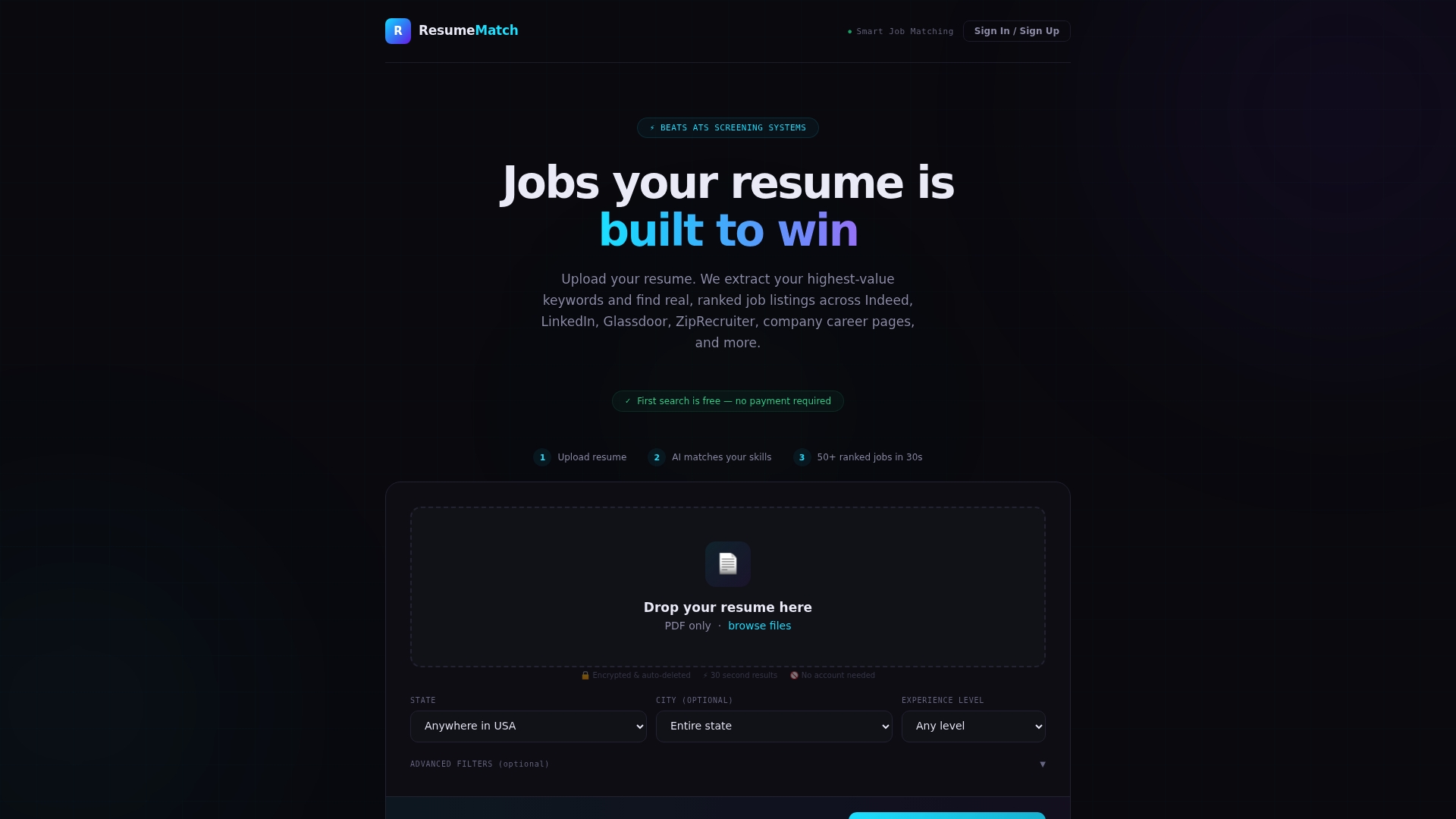
A membership plan provides ongoing access to resume-to-job matching and a Career Probability Report that flags gaps before a referrer sees your resume. An optional agent service is available to submit applications on your behalf, with a guaranteed minimum number of personalized submissions. Either option removes a step from the checklist above so you can spend your time on the outreach that actually needs a human touch. Start at Resume-match to see which fits your search.
Sources
- How to Ask for a Referral for a Job (2026) | Happenstance
- Referrals 1st, Apply 2nd
- What Does “Referred By” Mean on a Job Application?
FAQ
Is it easier to get a job through a referral?
Referred candidates reach the interview stage far more often than cold applicants, with one analysis putting the interview rate at about 40% versus 3% for inbound applications. It improves your odds of being seen, but you still need to meet the role’s requirements.
Do you apply before or after getting a referral?
Ask for the referral first and wait for confirmation it’s been submitted internally before you apply. Applying first can prevent the referral from being credited at many companies, since some systems only recognize referrals filed before the candidate’s own application.
What does “referral application” mean?
It means you’re applying to a role after an employee at that company has formally submitted your name through the internal referral portal, not just mentioned you casually. This is different from simply naming a contact on the public application form.
What does it mean when a job application asks who referred you?
That field captures where you heard about the job, but it doesn’t automatically create the internal referral record. The actual referral status usually comes from the employee filing it separately in the company’s internal system.
How can Resume-match help with referral applications?
Resume-match analyzes your resume against a job posting’s keywords in about 30 seconds and generates a Career Probability Report, which makes it faster to build the tailored pitch and resume link a referrer needs to submit you.