
Skills-Based Job Matching: A 2026 Guide for Job Seekers
Skills-Based Job Matching: A 2026 Guide for Job Seekers

Skills-based job matching is defined as the process of connecting candidates to job opportunities based on their demonstrated skills and competencies rather than job titles or credentials. This approach is reshaping how employers find talent and how job seekers present themselves. AI now powers most of these systems, and understanding what is skills-based job matching gives you a real edge in a competitive market. Resume-match was built specifically to help you navigate this shift, analyzing your resume and surfacing roles that fit what you can actually do.
What is skills-based job matching and why it matters
Skills-based job matching, also called competency-based or skills-first hiring, evaluates candidates by what they know and can do rather than where they worked or what their title was. A bartender who managed a team of 12, handled vendor contracts, and trained new staff has account management skills. Traditional keyword searches would never surface that person for an account manager role. Skills-based matching does.
The numbers behind this approach are striking. Skills-based AI search finds 3.2 times more qualified candidates than keyword searches, and expands candidate pools by 6 times on average compared to title-based methods. That means more relevant opportunities reach you, and more employers can find you, even when your job title does not match the role you are targeting.

This method also improves the quality of matches. AI-powered matching improves candidate-job fit quality by 67%, with an accuracy F1 score of 0.91 versus 0.70 for keyword methods. An F1 score measures how well a system balances finding the right candidates without missing qualified ones. A score of 0.91 is close to the ceiling of what is practically achievable.
How skills-based matching improves fairness and relevance
Skills-based hiring reduces bias by removing the filter of job title and credential prestige. Evaluating candidates by recent skills and recency of application improves precision and surfaces transferable talent that keyword filters miss entirely. A warehouse supervisor who built scheduling systems and managed safety compliance has operations and project management skills. Title-based filters would never connect that person to a project coordinator role.
The benefits for job seekers are concrete:
- Transferable skills get recognized. You are evaluated on what you can do, not just what your last employer called you.
- Career changers get a fair shot. Skills from one industry often map directly to roles in another.
- Recent experience carries more weight. A skill you used last month ranks higher than one listed from a decade ago.
- Gaps in employment matter less. The focus stays on demonstrated competency, not continuous employment history.
- Niche skills get matched. Specialized technical abilities surface roles that generic job boards would never show you.
Pro Tip: When listing transferable skills, always include the context and scale of your work. “Managed inventory” is weak. “Managed $2M annual inventory across 3 locations using SAP” tells the AI exactly what you know and at what level.
How does AI and semantic search power skills-based matching?
Traditional job matching uses Boolean keyword searches. If your resume says “Postgres” and the job posting says “PostgreSQL,” a Boolean system misses the match entirely. Semantic AI does not make that mistake. Skills ontologies map related competencies so the system recognizes that “PostgreSQL” and “Postgres” are the same skill. The same logic applies to “machine learning” and “ML,” or “customer success” and “client retention.”
This is how semantic AI works differently from keyword matching. It reads meaning and context, not just strings of text. It understands that a “Python developer” likely knows “data structures,” “APIs,” and “version control” even if those words do not appear on the resume. That inference is what makes skills-based matching genuinely useful.
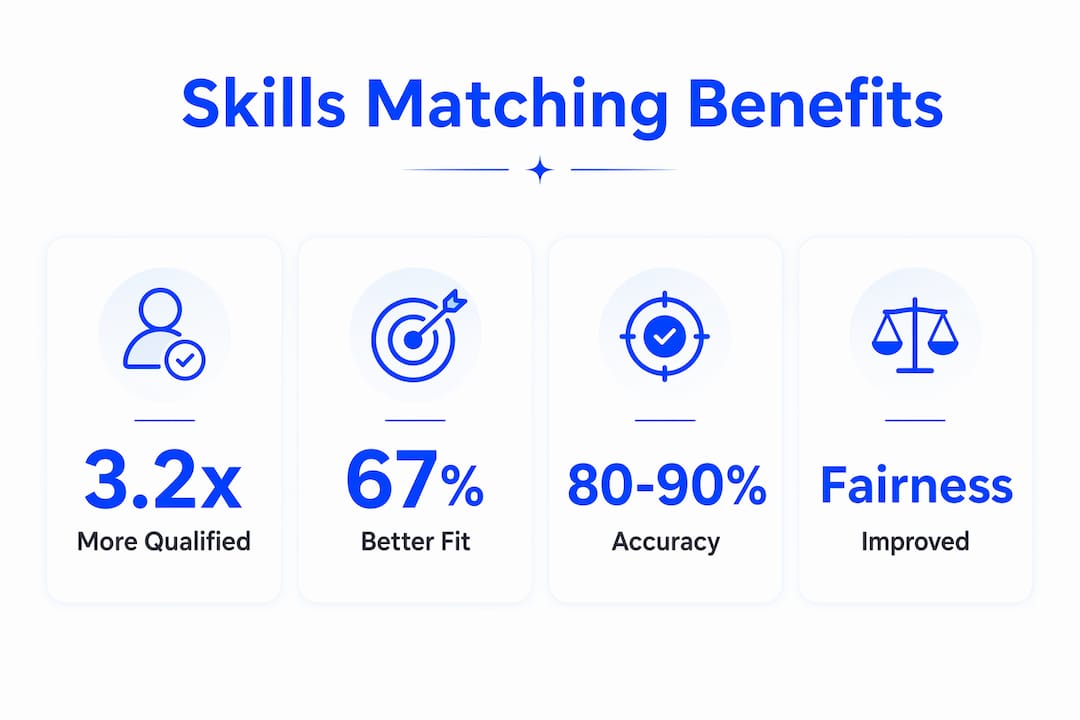
Here is how AI matching compares to traditional keyword methods across four key dimensions:
| Dimension | Keyword matching | AI skills-based matching |
|---|---|---|
| Candidate pool size | Narrow, title-dependent | 6x broader on average |
| Accuracy (F1 score) | 0.70 | 0.91 |
| Shortlisting time | Up to 3 hours | Under 5 minutes |
| Synonym recognition | None | Full ontology mapping |
The system also gets smarter over time. Reinforcement learning from recruiter feedback continuously improves AI matching accuracy and adapts to nuanced hiring preferences. When a recruiter accepts or rejects a candidate, the AI learns from that signal and adjusts future matches accordingly. That feedback loop means the system you use today is more accurate than the one from six months ago.
Pro Tip: Use plain text formatting in your resume. Complex tables, text boxes, and graphics confuse AI parsers. A clean, single-column layout with standard section headings gives the system the best chance to read every skill you have listed.
How to optimize your profile for skills-based job matching
Your resume is the primary input for any skills-based matching system. The quality of what goes in determines the quality of what comes out. Indeed processed over 4 billion unique data points about job seekers’ qualifications and preferences to build its matching engine. That scale shows how much detail these systems absorb. The more clearly you describe your skills, the more accurately you get matched.
Follow these practices to get the most from skills-based systems:
Do:
- List skills with context, tools, and measurable outcomes.
- Include both the full term and common abbreviations (“Search Engine Optimization (SEO)”).
- Update your profile regularly to reflect recent work.
- Use standard section headings: Skills, Experience, Education.
- Include adjacent skills you use regularly, even if they are not your primary specialty.
Avoid:
- Vague phrases like “strong communicator” or “team player” without evidence.
- Overloading your resume with buzzwords that mean nothing without context.
- Using graphics, icons, or tables that break AI parsing.
- Listing skills from 10 years ago that you no longer practice.
- Copying job descriptions word for word. AI systems detect this and it reduces your credibility score.
AI match scores and feedback explain why you ranked where you did, and job seekers can use that reasoning to revise resumes and fill skill gaps. Treat your match score as a diagnostic, not a verdict. A low score on a specific role tells you exactly which skills to add or clarify.
Pro Tip: Tailor your resume for each role by moving the most relevant skills to the top of your skills section. AI systems weight skills that appear early and frequently. A small reorder can meaningfully change your match score.
Common misconceptions about skills-based job matching
Skills-based matching is not a perfect system. The most common misconception is that a high match score guarantees an interview. It does not. Match scores rank you relative to other candidates. If 200 people apply and all have strong profiles, a score of 85% might still place you outside the top 20.
Watch out for these specific pitfalls:
- Assuming the AI reads your resume the way a human does. AI parses structured data. Unusual formatting, embedded images, or non-standard fonts can cause skills to be missed entirely.
- Relying on job title alone to signal your skills. A title like “Analyst” means different things at different companies. The AI needs the actual skills listed, not just the title.
- Ignoring skill recency. A skill listed without a date or context may be weighted lower than one tied to a recent role.
- Over-optimizing for one role type. Stuffing your resume with keywords for a single role type can make you invisible to adjacent opportunities that might be a better fit.
- Expecting the system to infer everything. Even the best semantic AI cannot infer skills you never mentioned. If you know it, list it.
Semantic hallucination can occur when complex resume formatting hinders AI parsing. Top systems handle 80–90% of edge cases, but that still leaves a meaningful gap. A skill buried in a graphic or a table cell may simply not exist in the system’s view of your profile.
AI matching also works best when combined with human judgment. Most hiring processes use AI to create a shortlist, then rely on recruiters to make final decisions. Understanding that two-stage process helps you prepare for both.
Key takeaways
Skills-based job matching outperforms title-based hiring because it evaluates what you can do, not just what you have been called, giving every qualified candidate a fairer shot at the right role.
| Point | Details |
|---|---|
| Definition matters | Skills-based matching evaluates competencies and recent experience, not job titles or credentials. |
| AI accuracy is high | AI matching reaches an F1 score of 0.91 versus 0.70 for keyword methods, meaning far fewer qualified candidates get missed. |
| Formatting affects results | Clean, text-based resumes give AI parsers the best chance to read every skill you have listed. |
| Match scores are diagnostic | Use your score and feedback to identify skill gaps and improve your resume for future applications. |
| Transferable skills count | Skills from one industry often map directly to roles in another when clearly described with context. |
Why skills-based matching is the best thing to happen to job seekers in years
I have watched hiring go through a lot of changes, and most of them favored employers. Skills-based matching is genuinely different. For the first time, a bartender who ran a team and managed vendor relationships has a real path to an account manager role, without needing to explain themselves in a cover letter. The system sees the skills. That is a meaningful shift.
What I find most encouraging is the feedback loop. When AI systems learn from recruiter decisions, they get better at recognizing the kinds of skills that actually predict success in a role. That is not just good for employers. It is good for you. The system becomes a better advocate for your abilities over time.
The part that still requires your attention is visibility. AI cannot match what it cannot read. Job seekers who treat their resume as a living document, updating it with new skills, recent projects, and clear context, will consistently outperform those who submit the same file for every application. The technology is ready. The question is whether your profile is ready to meet it.
Reskilling and continuous learning are becoming part of the matching equation too. Systems are beginning to weight recent certifications, completed courses, and demonstrated upskilling alongside work history. If you are building new skills right now, list them. Do not wait until you have a job title to prove it.
— Resume
How Resume-match puts skills-based matching to work for you
Resume-match analyzes your resume with AI, extracts your skills, and matches you to relevant job listings across multiple platforms in 30 seconds. The system does not just scan for keywords. It reads your competencies and surfaces roles that align with what you can actually do.
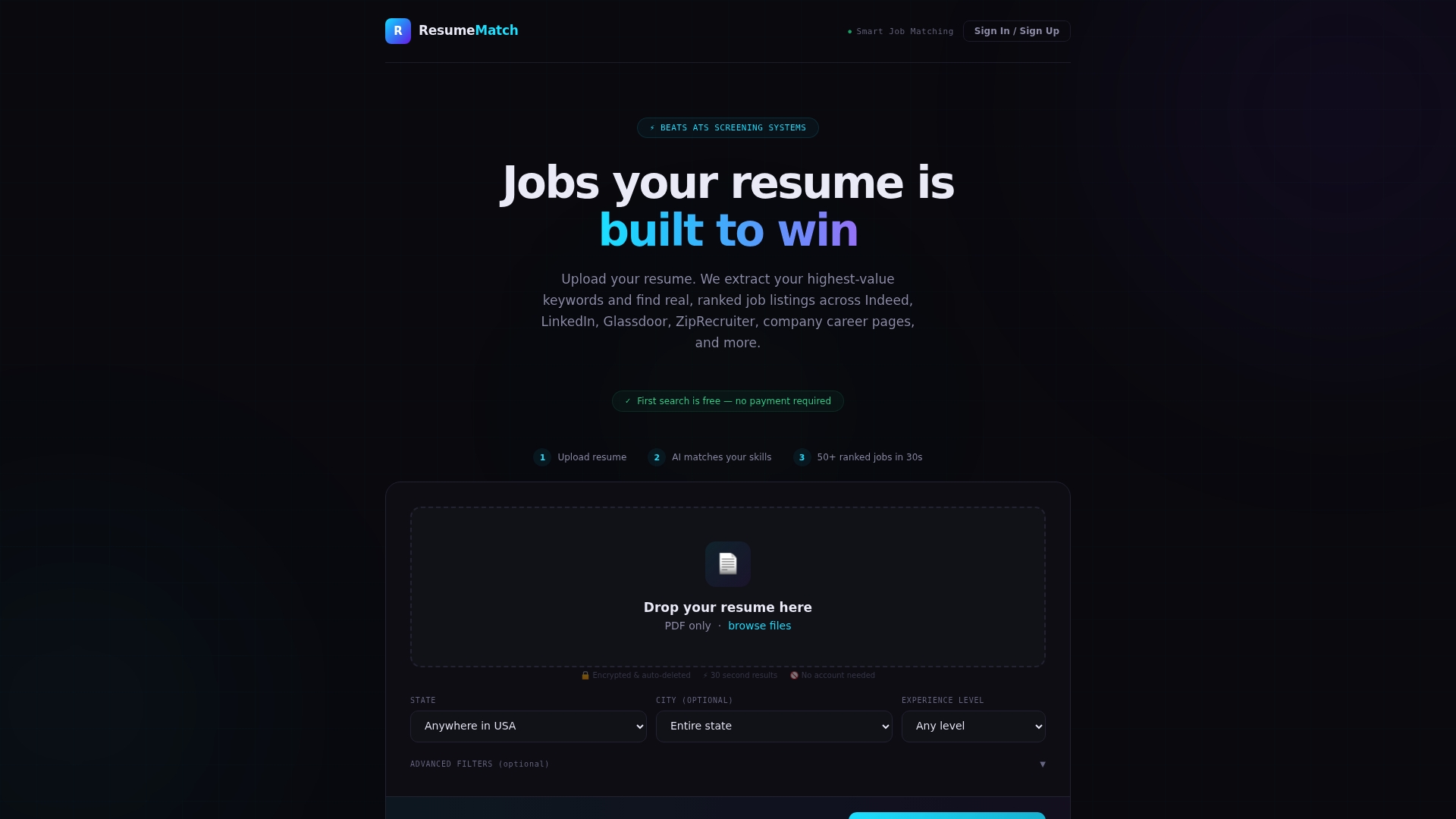
Every match comes with a Career Probability Report that breaks down your resume’s strengths, flags skill gaps, and gives you salary insights for the roles you are targeting. You get the same kind of feedback a recruiter would give you, without the waiting. If you want to see which roles fit your skills right now, find your matched jobs and let the AI do the work.
FAQ
What is skills-based job matching?
Skills-based job matching is the process of connecting candidates to jobs based on their demonstrated skills and competencies rather than job titles or credentials. AI systems analyze resume content and compare it to job requirements at the skill level.
How does job matching work with AI?
AI job matching uses semantic search and skills ontologies to identify equivalent skills across different terminology, then ranks candidates by how closely their skills align with a role’s requirements. The system also learns from recruiter feedback to improve accuracy over time.
What are the main benefits of skills matching for job seekers?
Skills matching surfaces transferable talent, gives career changers a fair evaluation, and expands the range of relevant roles you are shown. AI-powered systems find 3.2 times more qualified candidates than keyword searches.
What is a match score and how should I use it?
A match score is a ranking that shows how closely your skills align with a specific job’s requirements. Treat it as a diagnostic tool. Low scores on specific roles tell you which skills to add or clarify in your resume.
How can I improve my results with skills-based hiring systems?
List every skill with context, tools used, and measurable outcomes. Use plain text formatting so AI parsers can read your resume accurately. Update your profile regularly to reflect recent work and new skills.