
How AI Personalizes Job Recommendations for Job Seekers
How AI Personalizes Job Recommendations for Job Seekers

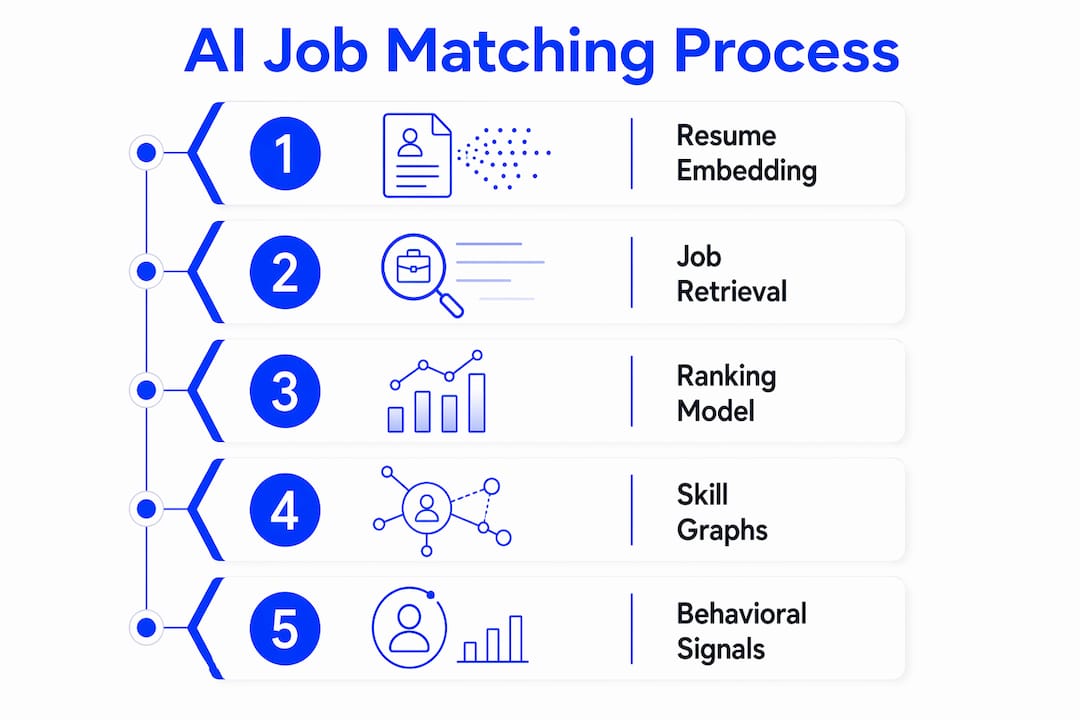
AI personalizes job recommendations by converting your resume, job descriptions, and browsing behavior into numeric representations called embeddings, then ranking matches using models that continuously learn from real hiring outcomes. Here is what drives that process:
- Semantic embeddings: Your resume and job postings are each mapped to a point in vector space, so the system compares meaning, not just matching words.
- Skills extraction and taxonomies: AI pulls structured skills from unstructured text and maps them to a shared vocabulary so “React engineer” and “front-end developer” land near each other.
- Behavioral signals: Every click, save, application, and dismissal teaches the model what you actually want, not just what you typed.
- Ranking models: A second-stage model scores and orders candidates by combining semantic similarity, skills overlap, seniority, location, and recency.
- RLHF (Reinforcement Learning from Human Feedback): Models learn from recruiter accept/reject actions and hiring outcomes, refining match criteria over time.
The bottom line: today’s job platforms do far more than filter by keyword. They build a working model of your career profile and update it every time you interact with the system.
Table of Contents
- How AI personalizes job recommendations: the core mechanics
- What signals and inputs feed the AI matching system
- How the personalization stack actually ranks your matches
- How platforms measure whether personalization is working
- Bias, fairness, and privacy: what U.S. job seekers should know
- Concrete steps to improve the AI recommendations you receive
- Resume-match applies these same techniques to your job search
- Key Takeaways
- Where job-matching AI is headed
- Selected sources for further reading
- Resume-match gives you a faster path to the right roles
How AI personalizes job recommendations: the core mechanics
The foundation of modern job matching is the embedding. A recommendation engine, as IBM defines it, uses analytics and machine learning to predict fit between a user and an item. In job search, that means converting your resume and a job posting into high-dimensional numeric vectors, then measuring how close those vectors are to each other using cosine similarity.

Why does this matter? Because two documents can describe the same role using completely different words. A resume that says “React engineer with TypeScript experience” and a posting that says “front-end developer, JavaScript frameworks required” will score low on a keyword filter. In vector space, they sit close together because the model has learned that these phrases appear in similar professional contexts.
Two-tower vs. cross-encoder architectures represent the main engineering tradeoff. A two-tower model computes separate embeddings for the job seeker and the job posting, then compares them with a dot product. This is fast enough to run across millions of pairs in real time. A cross-encoder processes both documents together and produces a more accurate score, but the compute cost makes it impractical for large-scale retrieval. Most production systems use two-tower models for initial retrieval and reserve cross-encoders for offline model distillation or re-ranking a small shortlist.
Pro Tip: Write your resume using the same phrasing that appears in job postings you want. If postings say “data pipeline” rather than “ETL workflow,” use that language. Embeddings are trained on real job-market text, so matching the vocabulary of your target role improves your position in vector space.
Skills-based matching is a practical guide to improving your match quality through resume language and profile completeness.
What signals and inputs feed the AI matching system
AI matching models are only as good as the data they receive. Platforms pull from several distinct input categories, and understanding them tells you exactly where to invest your effort.
Primary inputs job seekers control:
- Resume and profile text: The raw material for skills extraction and embedding generation. Gaps, vague titles, or parsing errors propagate directly into lower match quality.
- Structured fields: Job titles, employment dates, location, and education level feed rule-based filters before the model even runs.
- Explicit preferences: Desired role, salary range, work type (remote, hybrid, on-site), and industry signals you set manually. These act as hard or soft filters on the candidate pool.
- Activity signals: Clicks, saves, applications, and dismissals are implicit ratings. Platforms treat them the same way a streaming service treats watch history.
- Assessment and certification data: Verified skills badges, test scores, and certifications add structured, trustworthy signals that carry more weight than self-reported text.
Inputs from the employer side:
- Job posting metadata (required vs. preferred skills, seniority level, team size)
- Recruiter engagement signals (which profiles they viewed, saved, or contacted)
- Historical hiring data for that role or team
One research finding worth knowing: many job queries use three or fewer keywords. Platforms that surface dynamic facet suggestions, such as workplace type or industry, help job seekers refine their intent in real time, which improves both the quality of search results and downstream application rates. Using those filters when they appear is a low-effort way to send cleaner signals to the model.
Activity signals compound over time. A profile you updated six months ago and never touched again gives the model a stale picture. Platforms weight recency, so regular activity, even just saving a few relevant jobs, keeps your signal fresh.

How the personalization stack actually ranks your matches
Personalization happens at two distinct stages: retrieval and ranking. Most of the magic is in ranking.
Retrieval is the broad pass. The system filters millions of jobs down to a few thousand candidates that are plausibly relevant, using embedding similarity and hard filters like location and seniority. Speed is the priority here.
Ranking is where your individual profile shapes the final ordered list. A scoring model takes the retrieved candidates and assigns each one a relevance score based on a combination of signals. The final ranked match typically combines semantic similarity, skills overlap, seniority fit, recency, location, and behavioral signals into a single ordered list.
| Stage | Primary signals used | Goal |
|---|---|---|
| Retrieval | Embedding similarity, location, seniority, job type | Narrow millions to thousands |
| Ranking | Skills overlap, behavioral history, recency, collaborative signals, RLHF | Order by predicted fit |
| Re-ranking | User preferences, diversity constraints, freshness | Final list shown to user |
Skills graphs add another layer. Rather than treating skills as isolated keywords, a skills graph maps relationships between them. “Python” connects to “data science,” “machine learning,” and “automation.” This lets the model infer adjacent competencies you may not have listed explicitly.
Collaborative filtering works similarly to how music platforms suggest songs. If job seekers with profiles similar to yours consistently applied to and got hired for a certain role type, the system surfaces that role to you, even if your resume does not mention it directly. A large-scale randomized experiment on a national job board found that collaborative-filtering recommendations increased the probability of a job seeker working at a recommended workplace by 5%.
RLHF closes the loop. When a recruiter accepts or rejects a candidate, that signal trains the model to better understand what that team actually wants, beyond what the job description says. RLHF captures implicit preferences from reviewer actions and improves match calibration over time. LLM-based generative approaches go further: research on the GIRL framework demonstrates that PPO-based reinforcement learning can align a language model’s job description generation to recruiter preferences captured in a reward model.
The short flow: your resume enters retrieval as an embedding → the ranking model scores it against retrieved jobs using skills, behavior, and collaborative signals → reinforcement learning from human feedback further refines the final order you see.
How platforms measure whether personalization is working
Platforms track personalization success through a set of engagement and hiring metrics. Understanding these helps you interpret what “better recommendations” actually means for your job search.
The core metrics are:
- Apply rate: The share of shown jobs that result in an application. Higher apply rates signal that recommendations are relevant.
- Match-to-apply rate: How often a recommended match converts to an application, specifically for AI-surfaced jobs.
- Match-to-hire rate: The downstream metric that matters most. Did the recommendation lead to a hire?
- Dismiss-to-apply ratio: A lower ratio means fewer irrelevant results and more useful ones.
- Time-to-fill: How quickly a role gets filled when AI-assisted matching is in use.
Real-world signal: LinkedIn’s STAR system, which combines LLM embeddings with Graph Neural Networks, produced a modest increase in job applications site-wide and a reduction in the dismiss-to-apply ratio in A/B testing. A slight increase in successful job search sessions (defined as a session ending in an application, save, or job alert) was also observed.
For job seekers, these numbers translate into a practical experience: fewer irrelevant alerts cluttering your inbox, more roles that actually fit your background appearing at the top of your feed, and faster discovery of opportunities you would not have found through manual search. The employment effects of personalized recommendations are also measurable at the labor-market level, with treated job seekers showing higher employment rates within six months of first exposure to recommendations.
Platforms run A/B tests continuously to validate that model changes actually improve these metrics before deploying them broadly. When a platform shifts from keyword-heavy taxonomy systems to LLM embeddings, the metric improvements show up in application behavior and relevance scores, not just in offline benchmarks.
Bias, fairness, and privacy: what U.S. job seekers should know
AI can both reduce and reproduce bias. That is not a reason to avoid AI-driven platforms, but it is a reason to use them with your eyes open.
The fairness concern is structural. If a model trains on historical hiring data from a company that systematically favored certain candidate profiles, it learns to replicate that pattern. Proxy signals, such as zip code, school name, or gap years, can encode demographic information even when protected characteristics are never explicitly included. LinkedIn’s STAR system documentation acknowledges bias and fairness as explicit modeling challenges in large-scale job matching, alongside cold-start and filter bubble problems.
Product teams address this through skills-based matching (which focuses on demonstrated competencies rather than credentials), fairness monitoring in A/B tests, and human-in-the-loop review for high-stakes hiring decisions. The U.S. Equal Employment Opportunity Commission has issued guidance on AI-assisted hiring tools and their potential to create disparate impact under Title VII, which means employers using these systems carry legal accountability for discriminatory outcomes. This article is general information, not legal advice; consult an employment attorney or the EEOC directly for guidance specific to your situation.
Practical dos and don’ts for job seekers:
- Do keep your resume factual and skills-focused. Concrete, verifiable skills carry more weight than vague descriptors.
- Do list certifications and completed assessments. Verified signals are harder for a model to discount.
- Don’t rely solely on what the AI surfaces. Broaden your search manually for roles in adjacent fields.
- Don’t assume a lack of recommendations means you are unqualified. Cold-start effects are real, especially for new profiles.
Pro Tip: Review the privacy settings on every job platform you use. Most platforms, including LinkedIn and Indeed, let you control what data is used for personalization, who can see your profile activity, and whether your information is shared with third parties. Spending five minutes on these settings gives you meaningful control over your data footprint.
Concrete steps to improve the AI recommendations you receive
Signal quality is everything. A complete, machine-readable, recently updated profile gives the AI accurate material to work with. A sparse or poorly formatted one produces weak matches regardless of how good the underlying model is.
Here is a practical checklist:
- Update your profile and resume now. Recency is a ranking signal. A profile last touched a year ago signals low engagement to the model.
- List adjacent skills explicitly. If you manage data pipelines, also list the specific tools: Apache Airflow, dbt, Snowflake. Skills graphs connect these to broader role categories.
- Quantify your achievements. “Reduced processing time by 40%” is more parseable and more credible than “improved efficiency.” Numbers give the model structured anchors.
- Use machine-readable formatting. Plain text or a clean single-column layout parses reliably. Resume parsing errors from tables, graphics, or multi-column PDFs can strip skills and dates entirely, reducing your match accuracy.
- Tailor each application. Even small adjustments to mirror the language of a specific posting move your embedding closer to that job’s vector.
- Use activity signals deliberately. Save jobs you genuinely want. Dismiss ones that are off-target. Apply promptly to strong matches. Each action teaches the model your preferences.
- Use facet filters when they appear. Platforms that surface dynamic filters for workplace type, industry, or seniority level let you refine intent in real time. Multi-attribute queries consistently produce better downstream outcomes than single-keyword searches.
- Optimize your LinkedIn profile vocabulary. Using the right LinkedIn keyword strategy increases your visibility to both recruiter searches and algorithmic recommendations.
- Review platform privacy settings. Control what behavioral data feeds your recommendations and what is visible to employers.
Before/after example: A profile that lists “managed social media” as a single bullet will match broadly but weakly. Rewriting it as “managed Instagram and LinkedIn content calendars, grew organic reach by 35%, used Hootsuite and Sprout Social” gives the model specific skills, tools, and a quantified outcome. The embedding shifts toward digital marketing and social media manager roles rather than generic “communications” postings.
Common mistakes to avoid: uploading a PDF with embedded images (text becomes invisible to parsers), writing an objective statement instead of a skills summary, and using a single generic resume for every application.
Resume-match applies these same techniques to your job search
Resume-match uses resume parsing, skills extraction, and cross-board matching to surface tailored job opportunities in about 30 seconds. The same mechanisms described in this article power the product directly.
Here is how the features map to the techniques:
- Resume parsing and keyword extraction → embedding generation and skills taxonomy matching
- Career Probability Report → outcome signals: competitive job matches, salary insights, and resume gap analysis
- Application tracking → behavioral feedback loop that refines future recommendations
- Recruiter outreach templates and interview preparation → downstream support once the match is made
- Agent-based application service → a done-for-you option where Resume-match’s team applies on your behalf
What this means in practice: A mid-career professional who uploads their resume gets a ranked list of matched roles across multiple job boards, a salary range for their profile, and a clear view of which skills gaps are costing them matches. That is the Career Probability Report doing the work that would otherwise take hours of manual research.
Resume-match is built for job seekers who want the AI to do the heavy lifting, whether that means surfacing the right roles faster or getting an agent to handle applications entirely.
Key Takeaways
AI personalizes job recommendations by combining semantic embeddings, skills graphs, behavioral signals, and RLHF-refined ranking models into a continuously improving match engine.
| Point | Details |
|---|---|
| Embeddings power matching | Resumes and job postings are converted to vectors; cosine similarity finds meaning-based matches, not just keyword matches. |
| Behavioral signals matter | Clicks, saves, applications, and dismissals all teach the model your preferences; regular activity keeps your signal current. |
| Profile quality drives results | Parsing errors from images or complex PDF layouts can strip skills and dates, directly reducing match accuracy. |
| Fairness requires awareness | AI can reproduce historical hiring bias through proxy signals; skills-focused, factual resumes reduce this risk for job seekers. |
| Resume-match accelerates the process | Resume-match parses your resume, extracts skills, and matches you to roles across multiple boards in about 30 seconds. |
Where job-matching AI is headed
The shift from keyword filters to semantic meaning space is already complete at the major platforms. What comes next is more interesting: multimodal signals (video introductions, portfolio work, verified project outputs) feeding into matching models alongside text, and more transparent explanations of why a role was recommended, not just that it was. We are also watching the move toward tighter candidate experience, where the AI does not just surface a match but helps you understand what is missing from your profile to close the gap.
At Resume-match, we believe job seekers deserve to understand the system they are working within, not just receive a list of jobs. That means building tools that show you the reasoning, flag the gaps, and give you control over your own data. The goal has always been to make the AI work for you, not just on you.
Selected sources for further reading
- How can AI improve search and matching? — OECD/IZA working paper on a large-scale randomized trial of collaborative-filtering job recommendations; covers employment effects and congestion.
- Policy-Grounded Dynamic Facet Suggestions for Job Search — Research on how dynamic query refinement improves search precision and apply rates.
- A Scalable and Efficient Signal Integration System for Job Matching — LinkedIn’s STAR system paper; covers LLM + GNN integration, A/B test results, and bias challenges.
- Generative Job Recommendations with Large Language Model — The GIRL framework paper; explains PPO-based RL fine-tuning for generative job recommendations.
- How AI Job Matching Works: The Algorithms Behind Candidate Fit — Practitioner explainer covering RLHF, ranking models, and match calibration.
- AI Job Matching Explained: How AI Job Matching Works in 2026 — Covers embedding-based matching, skills graphs, and resume formatting best practices.
- Why LinkedIn’s job recommendations were broken and how an LLM fixed them — Engineering narrative on the shift from taxonomy-based to LLM embedding systems and metric outcomes.
- What is a Recommendation Engine? — IBM’s foundational definition of recommendation systems and their ML underpinnings.
- Skills-Based Job Matching: A 2026 Guide for Job Seekers — Resume-match’s own guide to skills-focused resume optimization and matching tactics.
- ResumeMatch — Find Jobs Built For Your Resume — Resume-match landing page; starting point for uploading your resume and running a match.
Resume-match gives you a faster path to the right roles
Most job seekers spend hours manually searching boards, tweaking resumes, and guessing which roles are realistic for their background. Resume-match cuts that down to seconds. Upload your resume, and the AI parses your skills, extracts keywords, and matches you to relevant roles across multiple job boards simultaneously. The Career Probability Report goes further: it shows you competitive matches, salary ranges tied to your profile, and the specific gaps holding you back from stronger matches.
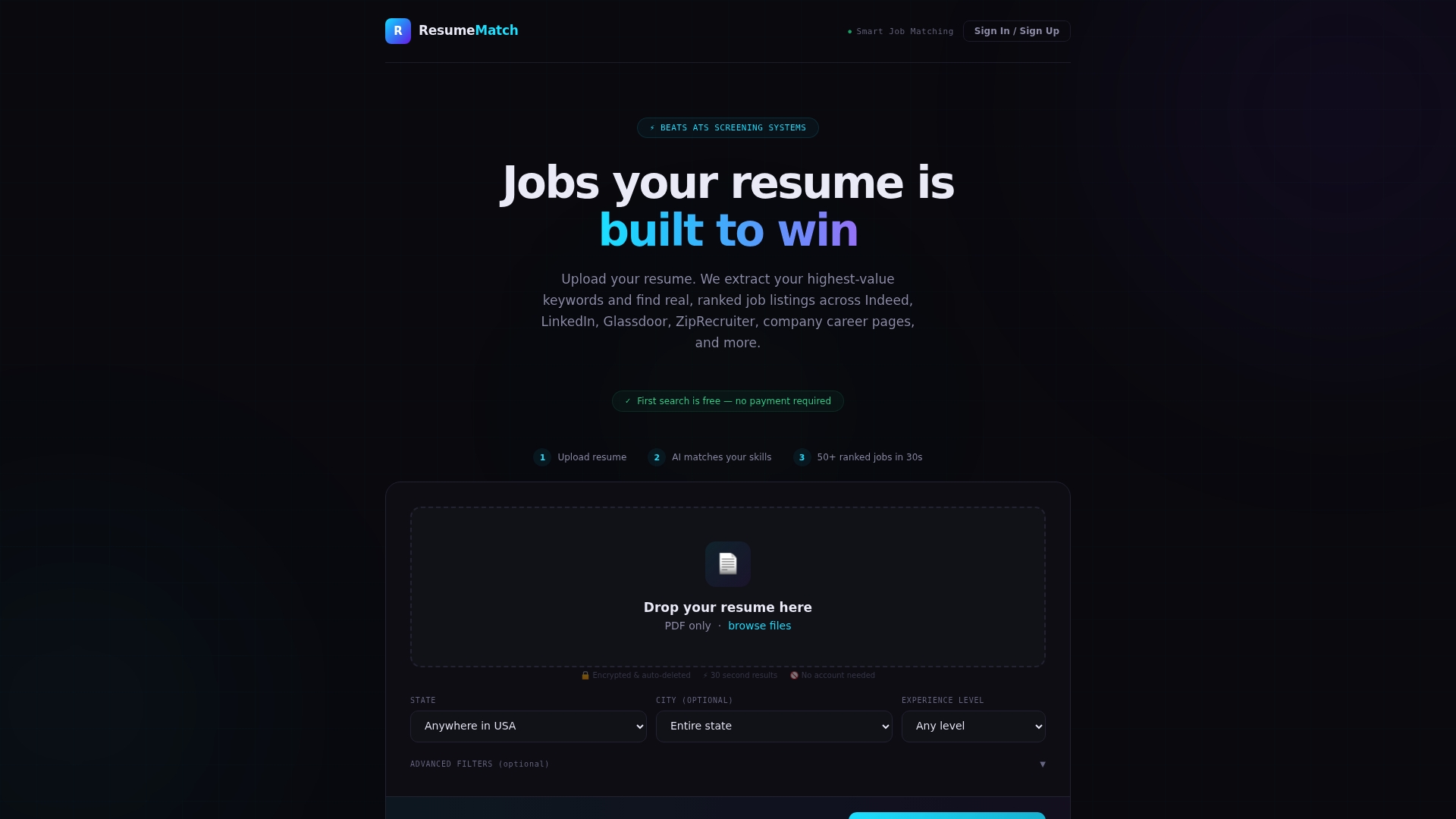
For job seekers who want even less friction, the agent service has Resume-match’s team apply on your behalf, so you stay focused on preparing for interviews rather than filling out forms. It is a practical next step for anyone who has read this far and wants to put these AI matching principles to work immediately.
Start your free trial at Resume-match and see which roles your resume actually matches today.