
Cover Letter Closing: How to End Your Letter Well
Cover Letter Closing: How to End Your Letter Well

A strong cover letter closing does four things in about three to five sentences: it restates your interest, sums up your value in one line, thanks the reader and asks for a conversation. Then you add a simple sign-off like “Sincerely,” and your typed name. That is the whole job. The hard part is making those few lines sound like you and fit the role, so this guide gives you the formula, examples for different situations and the phrases to leave out.
We built ResumeMatch because we know how it feels to polish a resume, then freeze at the last paragraph of the letter. You do not need clever. You need clear, confident and specific.
TL;DR
- Close with four parts: your interest, one sentence of value, a thank you and a forward-looking call to action.
- Keep the final paragraph short and add no new information. It wraps up what the letter already said.
- Use “Sincerely,” “Best regards,” or “Best,” followed by a comma and your typed name.
- Tailor the last lines to the employer by naming the role, the team or a specific need from the job posting.
- Skip hopeful, passive phrases such as “I hope to hear from you soon.”
Table of Contents
- What the closing paragraph is for
- The four-part closing formula
- Cover letter closing paragraph examples
- Choosing your sign-off
- Tailor the closing to the job and employer
- Phrases and habits to avoid
- How long should the closing be?
- Our perspective on closing lines
- After you send: follow-up and interview prep
- Let ResumeMatch handle the matching
- FAQ
- Sources
What the closing paragraph is for
Your opening paragraph earns attention and the body paragraphs prove you can do the work. The closing paragraph does something different: it ends the letter on a professional, positive note. Career guidance describes it as a place to recap your skills and express interest without adding new information.
Think of it as a handshake at the end of a meeting. The reader should finish the letter knowing three things: you want this specific job, you can help, and you would like to talk.
University career centers say much the same. A typical recommended closing briefly reiterates your interest, states your fit concisely, signals you want to speak further, reminds the reader how to reach you and thanks them for their time. That is a lot of work for a short paragraph, which is why a formula helps.
The four-part closing formula
One widely shared structure has four parts: reaffirm your interest, summarize your value in one sentence, thank the reader and finish with a confident, forward-looking sentence. Here is how to handle each one.

1. Reaffirm your interest
Name the role and the company. This is the line that tells the reader the letter was written for them and not for a hundred other postings.
Weak: “I am interested in this position.”
Better: “I would be excited to bring my experience to the Training Coordinator role at Brightpath Health.”
2. Sum up your value in one sentence
Career advisors recommend a closing that synthesizes why you are a strong match for the position and the company. One sentence is enough. Pull from points you already made in the body.
Example: “My background in onboarding new hires and building clear training materials fits what your team needs as it grows.”
The guidance on keeping this concise is simple: summarize your main qualifications without repeating your job history.
3. Thank the reader
A short thank you for their time and consideration is standard. One sentence, no groveling. “Thank you for considering my application” does the job.
4. End with a confident next step
Good closings include a call to action, such as asking for an interview. One example from university career guidance is “I look forward to speaking with you more about my qualifications”.
If you want to be a little more direct, you can offer your contact details. One career center guide suggests requesting a personal interview and including your phone number or email address, and optionally saying you plan to follow up. Only promise a follow-up if you will actually do it.
Cover letter closing paragraph examples
These are original samples. Copy the structure, then swap in your own details. Each one follows the four parts above.
For a recent graduate
“I am eager to bring my coursework in data analysis and my internship experience to the Junior Analyst role at Northfield Logistics. I have built dashboards that helped a student organization track its budget, and I would love to do the same for your operations team. Thank you for your time and consideration. I look forward to discussing how I can contribute.”
For a career changer
“I am excited about moving from hospitality management into customer success at Lumen Software. Leading a team of twelve and resolving daily guest issues taught me to listen closely and solve problems fast, skills that apply directly to your clients. Thank you for reviewing my application. I would welcome the chance to talk about how my experience can support your customer team.”
If you are changing fields, your closing works best when it ties a skill from your old world to a need in the new one. Our guide to transferable skills examples can help you find the right one to name.
For an experienced professional
“I would welcome the opportunity to lead your regional sales team at Cedar Ridge Supply. My record of growing accounts and mentoring new reps matches the goals described in your posting. Thank you for your consideration. My resume is attached, and I look forward to a conversation about the role.”
For a short, direct closing
Sometimes two sentences are plenty:
“Thank you for considering my application. I look forward to discussing how my skills can help your team reach its goals for the coming year.”
For a role found through a referral
“Thank you for considering my application. Marcus Lee on your design team suggested I reach out, and I would be glad to talk about how my background in user research can support the product group.”
Only name a referrer if they have said it is fine to do so.
Choosing your sign-off
The sign-off sits between your final paragraph and your name. Use a professional closing that ends in a comma, such as “Regards,” “Best,” or “Sincerely,”. Yale’s career office suggests “Sincerely,” “Yours truly,” or “Best regards,” followed by your name.
| Sign-off | Tone | Best for |
|---|---|---|
| Sincerely, | Classic, safe | Almost every application, especially formal industries |
| Best regards, | Warm and professional | Corporate, tech and nonprofit roles |
| Best, | Friendly, semi-casual | Startups and email-style letters |
| Respectfully, | Formal | Government, academic and legal settings |
| Thank you, | Polite, simple | When your last line is not already a thank you |
If you are unsure, “Sincerely,” is the default most advisors recommend. Pair it with a closing paragraph that matches the company’s tone and you are set.
Formatting your name and contact details
After the sign-off, type your full name. A handwritten signature is not typically expected or necessary, though on a printed letter you can add one above your typed name.
A clean ending looks like this:
Sincerely,

Jordan Rivera
(555) 123-4567
jordan.rivera@email.com
Check the phone number and email twice. A great letter that sends the reply to a typo helps no one. National careers guidance in the UK also lists correct contact details as part of a good ending.
Attaching a resume? Name the file clearly so the recruiter can find it later. Our post on resume file naming shows a simple format to copy.
Tailor the closing to the job and employer
A generic closing is easy to spot. “I look forward to hearing from you” could end any letter ever written, and that is the problem. Career advisors say not to use a form-letter approach. Instead, explain how your experience fits the hiring criteria in the posting, and speak to the specific group if you are writing to one.
Here is a quick way to customize the last paragraph in under five minutes:
- Reread the posting. Find the one or two needs that come up most, such as “cross-functional communication” or “managing deadlines.”
- Match one of your results to it. Pick a result you already described in the letter body.
- Name the role and company. Do it once in the closing, spelled exactly as in the posting.
- Mention the team or goal if you know it. A line about a recent launch or a stated company priority shows you did your homework.
- Read it aloud. If it could be sent to any employer without changes, rewrite it.
The same guidance warns against simply repeating the resume. Your closing should connect, not list.
Before and after
Generic: “I believe I would be a good fit and hope to hear from you.”
Tailored: “I would love to help Harbor Credit Union expand its member outreach, building on the community programs I ran at my last role. Thank you for your time. I look forward to talking about how I can contribute.”
The second version has a company, a task, a proof point and a clear next step, in about the same length.
Personalizing gets faster when you know which skills a posting really wants. Our guide to getting personalized job matches explains how to read a listing against your own background.
Phrases and habits to avoid
Passive, hopeful language. Career guidance says to avoid wording like “I hope to hear from you soon” if you want to sound confident. Try “I look forward to speaking with you” instead.
New information. The final paragraph should wrap up points already made. Save fresh achievements for the body or the interview.
Repeating your whole resume. One sentence of summary beats a second list of duties.
Overly casual sign-offs. Skip “Cheers,” “Later” or anything with an emoji.
Demands. “Call me this week” can read as pushy. “I would welcome a conversation” invites without pressuring.
Apologies. Phrases like “I know I may not have all the experience” undercut the confidence you built in the body.
Typos in the name or company. Read the last paragraph slowly, since this is where a copy-pasted company name from an earlier application tends to hide.

How long should the closing be?
Three to five sentences is a good range, and for many roles two or three will do. The letter overall should fit on one page, so the closing has to be the most compact part. If yours runs past six lines, cut the summary sentence first, then trim the thank you.
Before you send, run this checklist:
- Does it name the role and the company?
- Is there one sentence that says why you fit?
- Is there a thank you?
- Is there a clear, confident next step?
- Is the sign-off followed by a comma and your name?
- Are your phone number and email correct?
Our perspective on closing lines
We hear the same worry from job seekers again and again: “I wrote the whole letter, and now I don’t know how to end it.” We have been there, and we wish we had had better help when we were applying.
Here is what we believe. A closing line is not a ritual. It is the last proof that you understand the job. When someone applies as a bartender who managed a team, the closing should say “I have led people under pressure,” not just “I hope to hear from you.” Skills matter more than job titles, and the closing is where you connect the two.
That is why we built ResumeMatch around real skills and not only keywords. Our AI reads your resume, scores it against live job listings and shows where your experience lines up with what employers ask for. The Career Probability Report adds a resume gap analysis, so you can see which strengths to name in your letter and in your closing paragraph.
Job hunting feels lighter when you have a clear workflow: ranked matches, a stronger resume, outreach, tracking and interview prep in one place. You already have the skills. Your closing just needs to say so.
Resume
After you send: follow-up and interview prep
A good closing sets up the next step, so be ready for it. If you said you would follow up, put a reminder on your calendar and keep to it. Our walkthrough on how to track job applications shows how to log the date you applied, the contact and your next move in about ten minutes.
If your closing earns an interview, you may be asked to meet on camera. Reviewing video interview best practices ahead of time helps you feel settled when the invitation arrives.
Also keep realistic expectations. Most searches take many applications, and our post on job application success rates walks through what that looks like. A well-closed letter is one piece of a steady workflow. If you are new to the process, our job search workflow guide lays out each step in order.
Let ResumeMatch handle the matching
Writing a tailored closing is easier when you know which jobs fit you. ResumeMatch analyzes your resume, pulls out the keywords and skills that matter and matches you with live listings from multiple job boards in about 30 seconds. Your Career Probability Report shows competitive matches, salary insights, resume gaps and a career strategy, plus tools for application tracking, interview prep and recruiter outreach templates.
You can start with a 72-hour free trial. After that, the ResumeMatch Membership is $15 per month. If you would rather hand off the applications, our Let Us Apply For You service is $50 one-off, and it guarantees a minimum number of personalized applications.
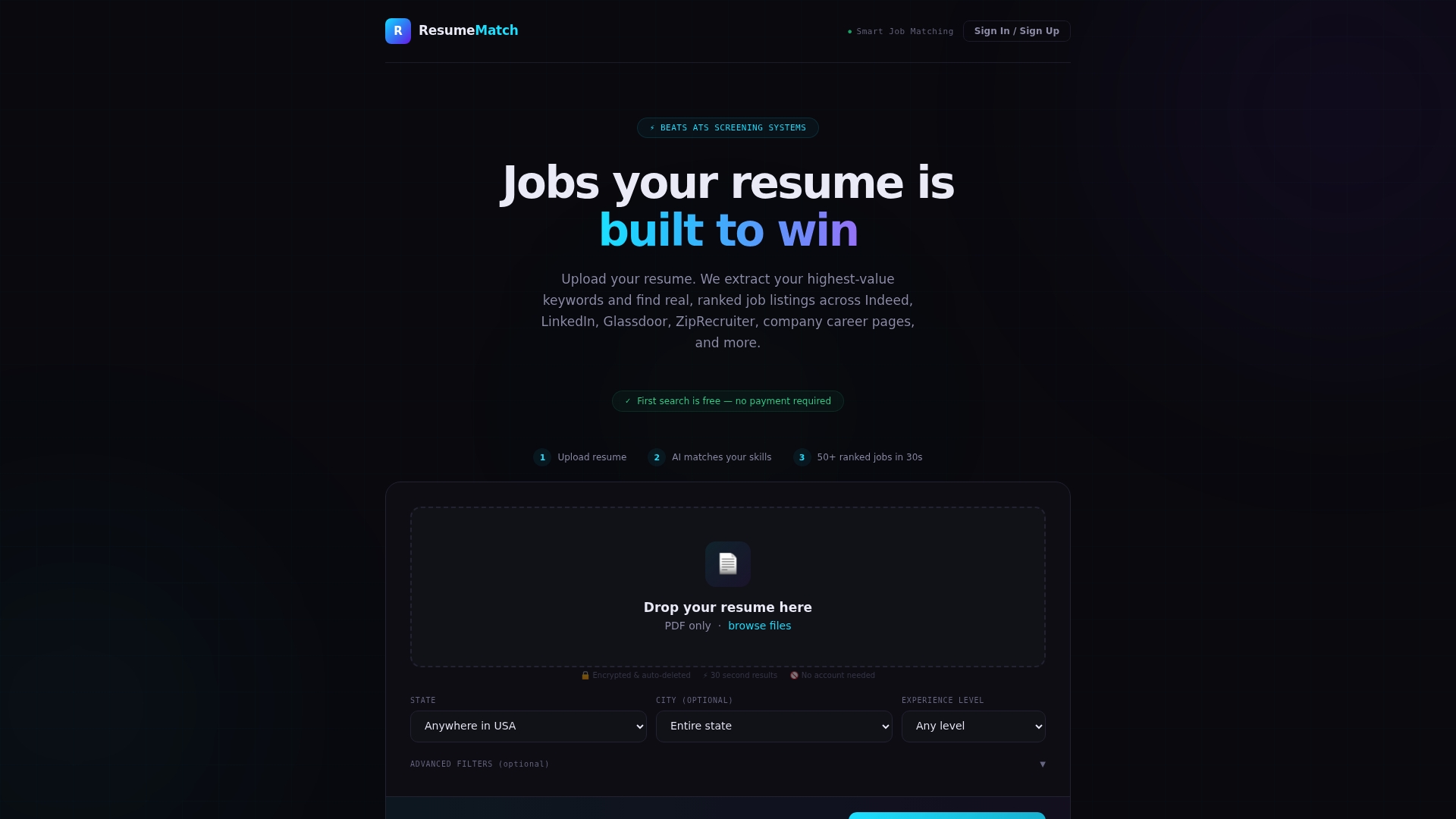
Try it with your current resume and see which roles match your skills today.
FAQ
What should the last paragraph of a cover letter include?
It should restate your interest in the role, sum up why you fit in one sentence, thank the reader and suggest a next step such as an interview. It should not introduce new qualifications. Think of it as a short wrap-up of points you already made.
What is the best sign-off for a cover letter?
“Sincerely,” is the safest choice and works in nearly every industry. “Best regards,” and “Best,” are also common and a bit warmer. Whichever you choose, end it with a comma and type your name below.
Do I need a handwritten signature?
For an emailed or uploaded cover letter, no. A typed name is enough. On a printed letter you can sign above your typed name if you like.
How do I personalize my cover letter closing?
Name the role and company, then tie one strength to a need in the job posting. Mention the team or a goal if you know it. If the sentence could be sent to any employer unchanged, rewrite it with a detail only this job has.
Should I say I will follow up?
You can, as long as you plan to do it. A line such as “I will follow up next week to see if you need anything further” shows initiative. If the posting says no calls or emails, skip it and simply say you look forward to speaking.
Sources
- How to end a cover letter (with examples and tips), Adobe
- Build Paragraphs, UC Santa Barbara Career Services
- Cover Letter Resources, University Career Center
- How to End a Cover Letter: Strategies and Examples, Grammarly
- Cover Letter Writing Guide 2023, Illinois Tech
- Cover Letters & Correspondence, Yale Office of Career Strategy
- How to write a cover letter, National Careers Service
- Cover Letters and E-mail Correspondence, Georgetown Law
- How to Write Effective Cover Letters, Columbia SIPA