
10–15 Transferable Skills Examples to Power a Career Change Resume
10–15 Transferable Skills Examples to Power a Career Change Resume

Transferable skills are the abilities you build in one role, project, or hobby that carry real value into a completely different job. The ones worth putting on your resume are specific: communication, problem solving, project coordination, leadership, and adaptability. Don’t just list them. Prove each one with a short, evidence-backed bullet in your Experience section, the same way you would back up a sales number.
TL;DR:
- Focus on including 10 to 15 proven transferable skills on your resume, each backed by measurable achievements in the experience section.
- Highlight specific, evidence-based bullets that demonstrate skills like communication, leadership, and problem solving, tailored to the job posting.
- Avoid vague labels and overused verbs, instead providing concrete results with numbers, timeframes, or recognized outcomes.
- Use the manual worksheet or AI tools to identify and articulate transferable skills, especially when changing industries or roles.
- Prepare for interviews by revisiting your resume examples, practicing the Context-Action-Result storytelling, and bringing artifacts to substantiate your claims.
Table of Contents
- Transferable Skills Examples Grouped by Category
- How to Turn a Skill Into a Resume Bullet Recruiters Believe
- A 30-Minute Method to Find Your Own Transferable Skills
- Mistakes That Quietly Sink a Transferable Skills Section
- Where an AI Resume Tool Fits Into This Process
- Transferable Skills vs. Soft Skills vs. Hard Skills
- Skills You Didn’t Know Counted, From Hobbies to Side Projects
- Why Transferable Skills Matter Most During a Career Change
- Proving Transferable Skills When You’re Sitting Across From an Interviewer
- What I’d Actually Prioritize First
- Try an Automated Skills Audit Alongside the Manual Method
- Sources
- FAQ
Transferable Skills Examples Grouped by Category
You don’t need thirty skills on your resume. You need the right ten to fifteen, each backed by a bullet that shows what happened when you used it. Below is a working list organized by category, with resume-ready phrasing and a note on how the same skill looks different depending on the field.
1. Communication
Every hiring manager scans for this one first, whether the job posting says it outright or not.
- “Presented weekly performance updates to a 12-person team, cutting follow-up questions by simplifying data into three key visuals.”
- “Wrote onboarding documentation adopted by three departments after the original process caused repeated confusion.”
Role mapping: a teacher explaining a concept to a confused student uses the identical skill a product manager uses writing a spec that engineers won’t misread.
2. Leadership & People Management
You don’t need a “Manager” title to have led people. Coordinating volunteers, training new hires, or running a shift counts.
- “Trained 6 new hires on point-of-sale systems, reducing average onboarding time from two weeks to four days.”
- “Organized a 15-person volunteer schedule for a nonprofit fundraiser, resolving conflicts without a single missed shift.”
Role mapping: a bartender who manages closing staff and handles nightly cash reconciliation is doing the early version of what an account manager does with client budgets and reporting deadlines.
3. Analysis & Problem Solving
This is where a lot of candidates undersell themselves because the work felt routine at the time.
- “Identified a recurring billing error affecting 40+ customer accounts and built a checklist that eliminated the issue within one billing cycle.”
- “Diagnosed a bottleneck in the intake process and proposed a fix that cut average wait time by half.”
Role mapping: a mechanic tracing an intermittent electrical fault and a data analyst tracing a reporting discrepancy are running the same diagnostic process, just on different systems.
4. Organization & Project Delivery
Project coordination and time management are two of the most requested skills across job postings, and almost anyone has evidence of both.
- “Coordinated logistics for a 200-attendee event across five vendors, delivering on schedule and under budget.”
- “Managed competing deadlines across three concurrent class projects without missing a submission.”
Role mapping: a wedding planner sequencing vendors and a construction supervisor sequencing subcontractors are both running dependency-based scheduling, just in different industries.
5. Digital & Technical Literacy
Adaptability and digital fluency are climbing fast in importance, according to the World Economic Forum’s Future of Jobs Report, which flags analytical thinking and tech literacy as among the fastest-growing skill categories across industries.
- “Built a shared inventory tracker in Excel that replaced a paper log, cutting stock discrepancies by 30%.”
- “Migrated a team’s file system to a shared cloud drive, reducing lost-document complaints to zero.”
Role mapping: a retail employee who automates a spreadsheet and a junior analyst who automates a report are both converting manual work into a repeatable system, as described in this Network Administrator guide that highlights technical and transferable skills in IT roles.
6. Adaptability & Continuous Learning
This one is hard to prove with a single bullet, so anchor it to a specific change you handled, not a personality trait you claim to have.
- “Adjusted to a new POS platform mid-quarter with no drop in transaction speed or customer complaints.”
- “Learned a new CRM within two weeks of a company-wide software switch, then trained two coworkers on it.”
Role mapping: a server adapting to a new menu rollout overnight and a support rep adapting to a new ticketing platform are exercising the same fast-learning muscle.
7. Customer-Facing & Service Skills
If you’ve ever handled a complaint, resolved a return, or calmed down an angry customer, you have evidence for this category, even if your job title never said “customer service.”
- “Resolved an average of 25 customer service tickets daily, maintaining a 95% satisfaction rating.”
- “De-escalated a billing dispute that had already been forwarded to two other reps, closing it within one call.”
Role mapping: a barista handling a wrong order and a sales rep handling a missed shipment are both practicing service recovery, one of the most valued and least documented transferable skills.
8. Creative & Strategic Thinking
Strategic thinking doesn’t require a strategy title. It requires evidence that you looked past the immediate task.
- “Proposed a new social content format that increased engagement 3x over the previous quarter’s average.”
- “Redesigned a class project’s structure after the original plan proved too rigid, improving the final grade outcome.”
Role mapping: a small business owner rethinking a store layout and a marketing associate rethinking a campaign funnel are both running the same creative problem-solving loop.
Pro Tip: Pick your top 10 to 15 from this list based on the job posting in front of you, not on which ones feel most impressive. A skill nobody asked for is a wasted line.
How to Turn a Skill Into a Resume Bullet Recruiters Believe
A skill label without proof is just a claim. Recruiters and career coaches consistently recommend proving each transferable skill inside your Experience section with an achievement statement, not a list of adjectives in a skills box.
1. Use the Context → Action → Result structure. Start with the situation, describe what you did, and close with the measurable outcome.
- Weak: “Responsible for team communication.”
- Strong: “Ran daily standups for a 5-person team, cutting miscommunication-related delays by an estimated 20%.”
2. Add a number wherever you can. A timeframe, a headcount, a percentage, or a dollar figure turns a vague claim into something checkable.
- Weak: “Helped improve customer satisfaction.”
- Strong: “Improved customer satisfaction scores from 82% to 91% over two quarters by revising the response template.”
3. Name your collaborators. “Worked with the finance team to reconcile Q3 discrepancies” reads as more credible than “handled reconciliation,” because it shows scope.
4. Tailor keywords to the posting, carefully. If a job description says “cross-functional collaboration” and your bullet says “worked with other departments,” swap in the posting’s language, but only where it’s true to what you actually did. Matching language helps with applicant tracking systems and with a human reader skimming fast.
Before you submit, run this quick checklist:
- Does every bullet have a number, timeframe, or named result?
- Did you avoid restating the same verb (“managed,” “led”) more than twice?
- Does at least one bullet per job match language from the target posting?
- Is your skills section short and specific, not a wall of adjectives?
Pro Tip: Keep a short, separate skills section for scanning, but do your real convincing in the bullets below it. A skill mentioned twice, once as a label and once as proof, sticks.
A 30-Minute Method to Find Your Own Transferable Skills
You don’t need a career coach to extract your transferable skills. You need forty-five minutes and a three-column worksheet: Task, Action Verb, Evidence or Result.
- List your tasks. Go role by role, including volunteer work, class projects, and unpaid gigs, and write down five to eight things you actually did, not your job title.
- Convert each task into an action verb and an underlying skill. “Answered customer emails all day” becomes “resolved,” which maps to problem solving and communication.
- Add proof. For each task, jot down a number if you have one: how many emails, how much time saved, how many people involved.
- Match to the target posting. Read the job description and circle three to five skills it repeats. Cross-reference against your worksheet and build two to three proof bullets for each match.
If you’re a student or recent grad without much paid work history, this method still holds. A group project where you coordinated four teammates’ deadlines counts as project coordination. A club fundraiser where you tracked a $2,000 budget counts as financial organization. University career centers publish exactly this kind of task-to-skill mapping for exactly this reason.
Mistakes That Quietly Sink a Transferable Skills Section
“Team player” and “hard worker” tell a recruiter nothing checkable. Every hiring manager has read those phrases a thousand times, and none of them remember who wrote them. Replace labels with a specific instance: not “team player” but “coordinated with two other departments to launch a product update two days ahead of schedule.”
Overusing vague verbs is the second-biggest trap. “Helped with,” “assisted in,” and “was involved in” describe your proximity to work, not your contribution. Say what you actually did.
- Weak: “Helped with the customer database migration.”
- Strong: “Migrated 1,200 customer records to a new database with zero data loss.”
Mismatching keywords is the quieter mistake. Stuffing a bullet with posting language you didn’t actually do (“cross-functional strategic leadership” for a task that was really “answered questions from two coworkers”) reads as inflated the moment someone asks a follow-up question in the interview. Peer-reviewed research on competency frameworks backs this up directly: specific, behavior-based descriptions predict performance better than generic labels, and they read as more credible too.
Pro Tip: If you can’t picture the exact moment a bullet describes, a recruiter can’t either. Rewrite it until you can see it happening.
Where an AI Resume Tool Fits Into This Process
Doing the worksheet above by hand works. It also takes time most job seekers don’t have when they’re applying to a dozen roles a week. An AI resume analysis tool can read your resume, identify transferable skills, and match them to live job listings, generating a report that includes salary insights, gap analysis, and personalized recommendations.
If you’ve already done the manual audit, running it through an automated pass often surfaces skills you didn’t think to phrase in resume language, and flags gaps against the exact postings you’re targeting.
Some services offer agent-assisted application submission once your resume and skills are prepared.
Transferable Skills vs. Soft Skills vs. Hard Skills
These three terms get used interchangeably, and that’s where a lot of resumes go wrong. Hard skills are technical and specific to a field: coding in Python, reading a balance sheet, operating a forklift. They rarely transfer directly across industries.
Soft skills describe how you work: patience, empathy, work ethic. Investopedia’s definition frames them as personal traits rather than demonstrated abilities, which is exactly why they’re hard to prove on paper. “I’m a good communicator” is a soft skill claim. A bullet showing you wrote documentation that cut onboarding time in half is transferable skill evidence.
Transferable skills sit between the two. They’re built from soft skills but expressed as portable, measurable abilities, things like communication, leadership, and project coordination, that you can demonstrate with a specific example and carry from one job or industry into another. The distinction matters most on a resume: a skills section can list “communication,” but only an Experience bullet can prove you have it. Employers consistently rank competencies like teamwork, problem solving, and professionalism among the qualities they value most in candidates, which is exactly why treating them as provable rather than aspirational pays off.
Skills You Didn’t Know Counted, From Hobbies to Side Projects
Not every transferable skill comes from a paycheck. A lot of the most interesting ones show up in places job seekers overlook entirely.
Running a hobby Etsy shop teaches inventory management, customer service, and basic financial tracking, three things a retail or e-commerce employer cares about directly. Moderating a Discord server or subreddit with a few thousand members builds conflict resolution and community management skills that map cleanly onto social media or customer success roles.
Freelancing, even a handful of small gigs, builds project scoping, client communication, and deadline management, often faster than a traditional job does, because you’re doing all three roles yourself. A student who built the schedule for a campus club event practiced the same logistics coordination a corporate events coordinator lists on their resume.
The trick is translation, not invention. If you organized a 40-person tournament for a local gaming league, that’s event coordination and budget management, written the same way you’d describe a corporate offsite. If you built a personal budgeting spreadsheet that a few friends started using too, that’s basic financial modeling and, arguably, product thinking. The WSU Career Center makes this same point: entry-level candidates chronically underestimate what volunteer work and extracurriculars actually taught them, mostly because it didn’t feel like “real work” at the time.
Why Transferable Skills Matter Most During a Career Change
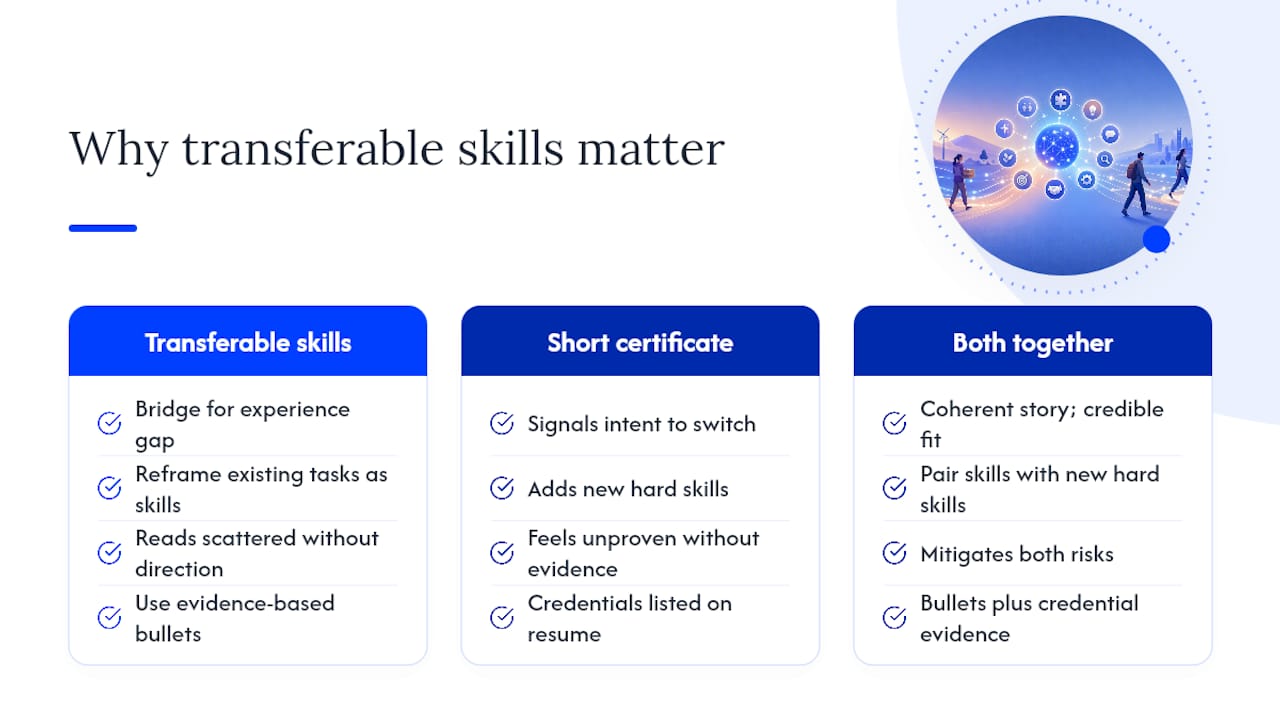
A career change resume has one job: convince a hiring manager that your lack of direct industry experience isn’t a real gap. Transferable skills are the bridge you build to close that gap, and they’re the only credible bridge available when your job titles don’t match the posting.
The move that works is reframing, not hiding. If you’re going from teaching into corporate training, you don’t downplay the teaching background, you highlight the curriculum design, public speaking, and performance assessment skills that a training coordinator role needs, using the same evidence-based bullets you’d use for any other skill. If you’re moving from retail management into project coordination, your experience scheduling staff and managing inventory turns into “coordinated logistics for a team of 12 across shifting priorities,” which reads as project management experience because it is.
Upskilling works alongside this reframe, not instead of it. Adding a short certificate or course in the target field gives you new hard skills to pair with the transferable ones you already have, and it signals intent to a recruiter who’s wondering whether you’re serious about the switch. Neither piece works well alone. A stack of transferable skills with no direction reads as scattered, and a certificate with no transferable evidence reads as unproven. Together, they tell a coherent story about why you’re a reasonable bet for a role you haven’t officially done yet.
Proving Transferable Skills When You’re Sitting Across From an Interviewer
A resume gets you the interview. The interview is where transferable skills either hold up or fall apart, because you’re being asked to go deeper than a bullet point allows.
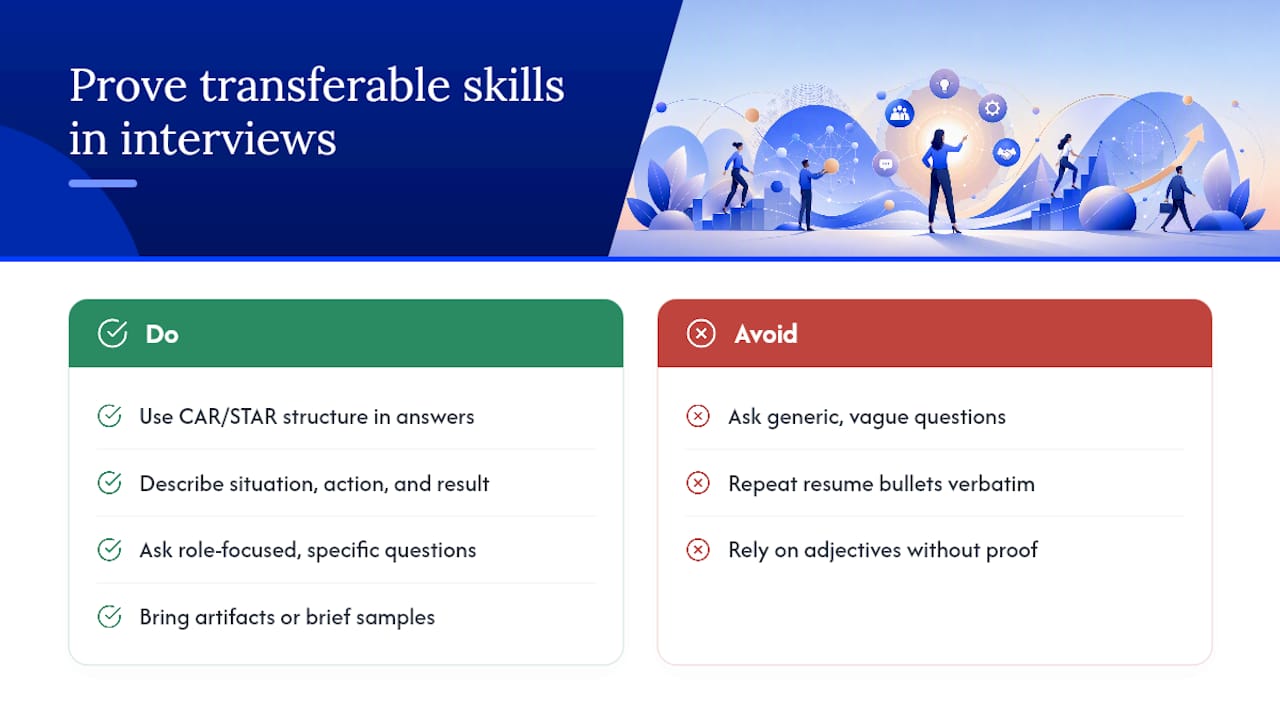
The behavioral interview format rewards exactly the same Context → Action → Result structure you used on your resume, just spoken instead of written. When an interviewer asks “tell me about a time you handled a conflict,” they’re testing whether the leadership or communication skill on your resume is real or decorative. Answer with the same specificity: what the situation was, what you actually did, and what changed because of it.
Ask questions that show you already understand the role’s real demands, not generic ones. Asking “how does your team currently track project handoffs between departments” signals organizational thinking before you’ve even started the job. It’s a subtler way of demonstrating a transferable skill than stating you have it.
Bring artifacts when you can. A portfolio link, a writing sample, or even a one-page project summary does more to prove analytical or creative skills than any adjective could. If your transferable skill is data analysis and you built a personal dashboard tracking a hobby’s stats, showing it briefly says more than describing it.
Finally, mirror the language from your resume bullets in your answers, but don’t just repeat them verbatim. An interviewer who reads “cut onboarding time by half” on paper and then hears you explain the actual mechanics behind that number in your own words walks away far more convinced than one who hears the same sentence twice.
What I’d Actually Prioritize First
If you only do three things from this article, pick your top three transferable skills based on the job posting in front of you, run the 30-minute worksheet method to find real proof for each, and rewrite your weakest three resume bullets before you send out another application. Everything else is optimization. For the deeper rework once your skills are solid, our guide to career change resumes walks through the professional summary piece this article doesn’t cover.
— Resume
Try an Automated Skills Audit Alongside the Manual Method
You’ve now got the manual method for finding, phrasing, and proving your transferable skills. If you’d rather have a second set of eyes catch what you missed, Certain AI resume analysis tools extract skills automatically, match them against live job listings across multiple boards, and return reports with salary insights and personalized strategies quickly.
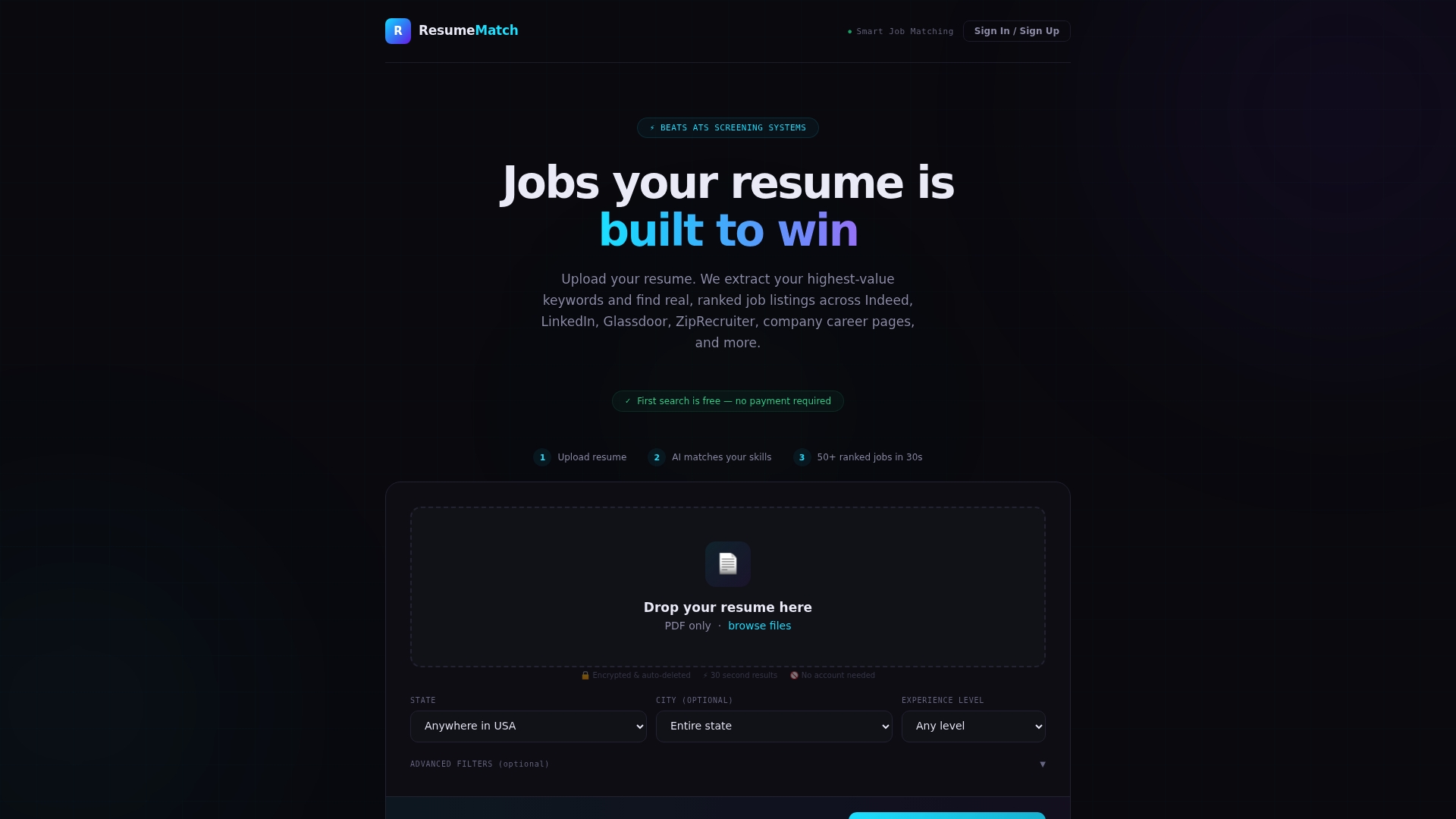
It’s built for exactly the moment you’re in after reading this: resume rewritten, skills identified, unsure whether it’s actually landing with the roles you want. The ResumeMatch Membership runs $15 per month after your trial and gives you ongoing keyword matching, gap analysis, and application tracking as you apply. If you’d rather hand off the applying itself, the Let Us Apply For You service is a $50 one-time fee, with agents submitting a guaranteed minimum number of personalized applications on your behalf. Either way, start by seeing what your current resume actually surfaces, and go from there.
Sources
- How we help: transferable skills (career coach perspective)
- Future of Jobs Report 2025 (WEF)
- Competency frameworks and performance (peer-reviewed article)
FAQ
How Many Transferable Skills Should I List on a Resume?
Pick 10 to 15 total, but only if each one is backed by a proof bullet somewhere in your Experience section. A shorter, evidence-backed list beats a long list of unproven labels every time.
What Are the Best Transferable Skills for a Career Change?
Communication, problem solving, project coordination, leadership, and adaptability tend to transfer across the widest range of industries, according to career competency research. Pick the three or four that best match your target role’s posting, and build your strongest proof bullets around those first.
Should I Include a Separate Skills Section on My Resume?
Yes, but keep it short and use it for scanning, not persuasion. The real convincing happens in your Experience bullets, where each skill gets backed by a specific, achievement-based statement rather than sitting alone as a label.
Can Resume-match Help Me Find My Transferable Skills Automatically?
Yes. Resume-match’s AI analysis extracts skills directly from your resume and matches them against live job listings, returning a Career Probability Report with gap analysis and salary insight in about 30 seconds.
Are Transferable Skills the Same as Soft Skills?
Not exactly. Soft skills describe traits like patience or empathy, while transferable skills are measurable, demonstrated abilities like communication or project coordination that you can prove with a specific resume example.