
Get Interviews: Career Change Resume With a 2–3 Sentence Professional Summary
Get Interviews: Career Change Resume With a 2–3 Sentence Professional Summary

The single best approach is a combination (hybrid) resume anchored by a target-role headline and a 2 to 3 sentence professional summary that bridges what you’ve done to what you want to do next. Follow it with a skills summary split into new-field and transferable skills, then relevant projects or certifications, then your chronological work history. Tailor keywords from 3 to 5 real job postings before you send anything.
TL;DR:
- A hybrid resume format emphasizes relevant skills and projects upfront, followed by a transparent chronological work history for easy ATS parsing.
- The professional summary should explicitly connect past experience to the new role in three concise sentences with targeted keywords.
- Keywords from target job postings should be mined, split into new-field and transferable skills, and supported with concrete evidence lines.
- Reordering experience highlights recent, relevant accomplishments over chronological order, with old roles compressed or reframed to emphasize transferable results.
- Using AI resume analysis tools can identify keyword gaps and improve the resume’s alignment with job postings, speeding up the career transition process.
Table of Contents
- Why the Combination Resume Wins for a Career Switch
- How Do You Write a Summary That Explains a Career Pivot?
- What Skills Should You List, and How Do You Prove Them?
- How Do You Reorder Experience to Highlight What Matters Now?
- Where Should Education and Certifications Go?
- Can You Show Me a Before/After Example and Template?
- How Can AI Resume Analysis Speed Up Your Career Change Rewrite?
- How Do You Write a Cover Letter to Match Your New Resume?
- What Career Pivots Actually Look Like Once You’re in It
- Let ResumeMatch Handle the Keyword Guesswork
- Sources
- FAQ
Why the Combination Resume Wins for a Career Switch
A pure chronological resume buries your best evidence at the bottom, under job titles that don’t match what you’re applying for now. A purely functional resume, the kind that lists skills with no dates or employers attached, tends to backfire even harder: hybrid formats improve ATS compatibility while keeping employment history transparent, and pure functional resumes often fail modern applicant tracking system parsing while raising a recruiter’s suspicion that something is being hidden.
The combination format solves both problems at once. It puts your transferable skills and relevant projects where a recruiter sees them in the first six seconds, then backs that up with a full, honest work history that any background check will match. Wharton’s guidance on career-change resumes recommends exactly this structure for most people changing fields: lead with skills and relevant projects, follow with chronological history.
Here’s the order that works, top to bottom:
- Target-role headline. One line, right under your name, naming the job title you want (not the one you had).
- Professional summary. Two to three sentences bridging past experience to the new role.
- Core skills. Grouped into new-field skills and transferable skills, not one long undifferentiated list.
- Projects and certifications. Especially anything completed in the last 12 to 18 months that’s relevant to the new field.
- Professional experience. Chronological, but rewritten so the bullets speak the new field’s language.
- Education and other. Degrees, older certifications, and anything else that supports the case.
Keep the formatting itself boring on purpose. Use a single column, a standard font like Calibri or Georgia, and skip tables, text boxes, and graphics inside the document. Most applicant tracking systems still choke on multi-column layouts and embedded images, which means a beautifully designed resume can get mangled before a human ever opens it.
How Do You Write a Summary That Explains a Career Pivot?
Your professional summary has one job: answer the question “why is this person applying for a role outside their current lane?” before the hiring manager has to ask it. A career-change resume should open with 2 to 3 sentences that explicitly bridge past experience to the new role and use industry-specific keywords to help pass ATS, and that bridge is the hardest sentence you’ll write on the whole page.
Use this formula: current identity + target role + transferable strengths + recent proof + value statement. That’s it. You’re not writing a biography, you’re writing a thesis statement for the rest of the resume.
A few rules make this easier:
- Name the target role directly. Don’t make the reader guess what you’re applying for.
- Show commitment, not curiosity. “Completing a UX certificate” reads stronger than “interested in UX.”
- Never apologize for the switch or hedge with phrases like “though I lack direct experience.” Recruiters notice the doubt before they notice the strength.
- Keep it to three sentences. Longer summaries read as unfocused, which is the opposite of what you want when you’re already asking someone to take a leap of faith on you.
Here are three quick examples, one per pivot type:
Technical pivot: “Data analyst with five years turning marketing spreadsheets into decisions, now pursuing full-stack development through a completed Python certification and two deployed personal projects. Skilled in SQL, logic-driven problem solving, and translating technical findings for non-technical stakeholders. Seeking a junior developer role where analytical rigor meets clean code.” This works because it names a specific credential and two visible artifacts, not a vague interest.
Management pivot: “Restaurant general manager with seven years leading teams of 20+, now transitioning into account management. Built the same skills account managers use daily: reading client needs, resolving conflict under pressure, and hitting revenue targets with a lean team. Ready to bring that operational discipline to a client-facing role.” Notice it never uses the word “just” or “only” to describe the restaurant background.
Creative pivot: “Elementary school teacher with eight years designing curriculum for diverse learners, moving into instructional content design. Experienced in breaking complex material into clear, sequenced lessons, a skill directly transferable to corporate training and e-learning design. Completed a certificate in learning experience design and built two sample course modules.” The certificate and the sample modules do the heavy lifting here, not the job title.
Pro Tip: Write your summary last, even though it goes first on the page. You’ll write a sharper bridge once you’ve already drafted your skills section and rewritten your bullets, because you’ll know exactly which strengths you’re actually proving.
What Skills Should You List, and How Do You Prove Them?
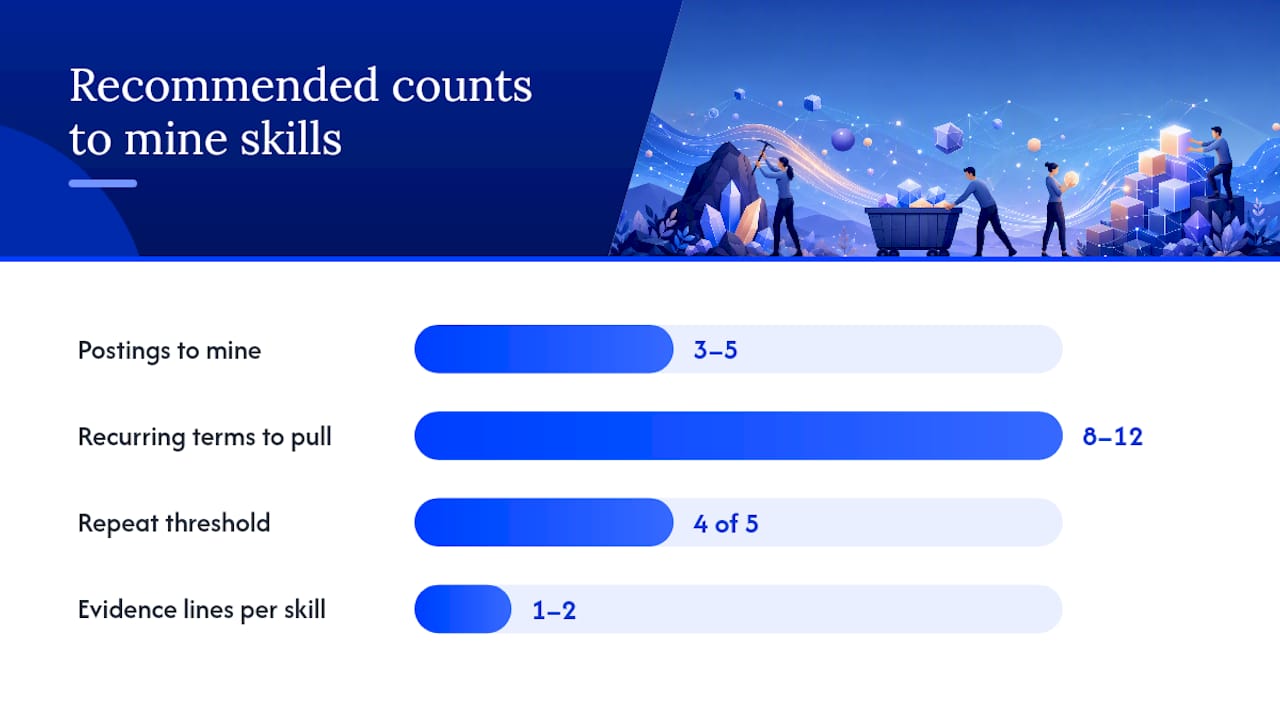
Start by mining the postings, not your memory. Best practice is to pull 3 to 5 target job postings and note the tools and phrases that repeat across all of them. If “stakeholder management,” “SQL,” and “cross-functional” show up in four out of five postings, those are the terms your resume needs to contain, in that language, not a paraphrase of it.
Once you have that list, split it into two labeled groups. Wharton’s approach calls for separating new-field skills from transferable skills so both an ATS scanning for exact keyword matches and a human scanning for judgment see what they each need in about four seconds.
Here’s the method in order:
- Pull 8 to 12 recurring terms from your target postings, prioritizing anything that appears more than once.
- Sort them into “New-field skills” (specific tools, software, certifications, processes unique to the target industry) and “Transferable skills” (leadership, analysis, communication, project management).
- Attach one or two short evidence lines under each skill or skill cluster, so it’s a claim backed by proof, not just a keyword sitting alone.
- Cut anything you can’t back up with a real example. A skill with no evidence line is a red flag waiting to be asked about in an interview.
An 8 to 12 skill range tends to hit the sweet spot: enough density to satisfy keyword scanning without turning the section into a wall of buzzwords a recruiter skims past. Here’s what a cluster looks like in practice, for someone moving from retail management into project coordination:
New-field skills: Agile fundamentals, Asana, cross-functional scheduling Transferable skills: Team leadership, budget tracking, vendor negotiation
Evidence lines under that cluster might read:
- Coordinated 6 part-time schedules and 3 vendor deliveries weekly using shared calendars and task boards, the same workflow project coordinators run in Asana or Trello.
- Managed a $40,000 quarterly inventory budget with zero overages across two fiscal years, demonstrating the budget discipline project coordination roles require.
That pairing, a labeled skill plus a concrete number or outcome, is what separates a skills section that gets read from one that gets skipped. A tool like ResumeMatch’s skills-based matching guide walks through this same grouping logic if you want a second framework to check your work against.
How Do You Reorder Experience to Highlight What Matters Now?
Chronology stays honest, but priority doesn’t have to. The fix is placement, not fabrication: put your most relevant proof first, even if it’s small, and let the older, unrelated roles settle further down the page.
Small projects carry more weight than people expect. Proof-of-work like short projects, freelance gigs, or volunteer roles should sit above older unrelated jobs because that placement signals genuine commitment to the new path, not just curiosity about it. A three-week freelance project in your target field, listed prominently, often does more convincing than a five-year job title in a field you’re leaving.
Once the order is set, rewrite each bullet using a formula that turns old-career tasks into new-career evidence: action verb + transferable task + tool or process + measurable outcome. This structure, backed by career-transition writing guides, forces every bullet to answer “so what does this prove for the job I actually want?” instead of just describing what you did.

Compare these two versions of the same job:
Before: “Responsible for scheduling staff and handling customer complaints at a retail store.”
After: “Resolved 15+ weekly customer escalations using de-escalation and root-cause analysis, while coordinating a 12-person schedule across three departments, the same stakeholder management and operational planning required in a client success role.”
The second version doesn’t invent anything. It just names the transferable skill and the scale, instead of describing the task in retail language a hiring manager in another field has to translate themselves.
A few placement rules to keep this consistent across the whole resume:
- Lead each older role’s bullet list with the achievement most relevant to your target field, not the one that happened first chronologically.
- Rewrite verbs to match the target field’s priorities. “Managed inventory” becomes “tracked and forecasted resource allocation” if you’re pivoting into operations or supply chain roles.
- Go back 10 to 15 years of work history, and no further, unless an earlier role is directly relevant to the new field.
- Trim or compress roles from more than 15 years back into a single line, or drop them if space is tight and relevance is low.
- Never delete a role to hide a gap. Compress it instead. Recruiters can tell the difference between a tight resume and a suspicious one.
Where Should Education and Certifications Go?
Move certifications above your work experience when they directly match a required credential in the job posting, or when your relevant work history is thin. A completed Google UX Design Certificate sitting near the top of the page tells a hiring manager you’ve already started closing the gap; buried at the bottom under “Education,” it barely registers.
Format each certificate line the same way every time: name, provider, completion date, and a short outcome or project tied to it. “UX Design Certificate, Google, completed March 2026, built two mobile app case studies” carries far more weight than the credential name alone.
A few placement calls worth making deliberately:
- If a credential is required (not just preferred) in the job posting, put it directly under your headline or professional summary, not buried in an education block.
- List in-progress coursework as “In Progress, expected [date]” rather than leaving it off. Momentum still counts.
- Link a portfolio or project repository directly under the relevant certificate line if you have one, since a hiring manager is far more likely to click a link that’s one line away from the credential it supports.
- Keep older, unrelated degrees lower on the page. A marketing degree from 12 years ago still counts as education, just not as your headline credential.
Can You Show Me a Before/After Example and Template?
Seeing the transformation side by side makes the formula click faster than any explanation. Here’s a compressed before/after for someone moving from hospitality management into human resources:
Before: “Managed daily hotel front desk operations and staff scheduling for a 40-room property.”
After: “Directed onboarding and scheduling for a 12-person front desk team, including conflict resolution and performance coaching, the same people-operations work central to an HR coordinator role.”
The rewrite doesn’t change what happened. It reframes the same facts using the vocabulary and priorities of the target field, which is the entire game in career-change resume writing.
Here’s a fill-in template you can copy directly into a blank document and build from:
| Section | What Goes Here |
|---|---|
| Target headline | The exact job title you’re applying for, one line under your name |
| Professional summary | 2 to 3 sentences: current identity, target role, transferable strength, recent proof |
| Skills, grouped | 8 to 12 terms split into “New-field skills” and “Transferable skills,” each with a short evidence line |
| Top projects/certifications | 1 to 3 recent, relevant items with date and outcome |
| Work history bullets | Chronological, rewritten with action verb + transferable task + tool + measurable outcome |
| Education/certs | Degrees and older certifications, most relevant first |
Before you send anything, run it through a short ATS checklist:
- Save the file as a .docx or a text-selectable PDF, never a scanned image or a design-heavy PDF export.
- Match keyword phrasing exactly to the job posting (“customer success” versus “client success” can matter to a parser).
- Remove tables, columns, headers, and footers that hide text from a parser.
- Use standard section headings like “Experience” and “Education” rather than creative labels a parser won’t recognize.
- Keep the file name simple and professional: “FirstName_LastName_Resume.pdf.”
For a deeper look at ATS formatting specifically, Resume-match’s guide to ATS-ready resume structure covers the parsing rules that trip up even strong candidates.
How Can AI Resume Analysis Speed Up Your Career Change Rewrite?
Writing a career-change resume by hand means guessing which keywords matter and hoping your phrasing matches what an ATS is scanning for. AI resume analysis removes most of that guesswork by scanning your draft against real job postings, extracting the terms that appear most often, and flagging where your current language misses the mark.
Here’s how that plays out in practice:
- The analysis extracts keywords from postings you’re targeting and checks your resume against them, the same mining process described earlier, done automatically.
- It runs an ATS-simulated scoring pass, showing you which sections would likely get flagged or skipped by a real parser before you find out the hard way.
- It flags gaps between what the role asks for and what your resume currently proves, so you know exactly which skill cluster or bullet needs another pass.
ResumeMatch’s Career Probability Report builds on that same analysis to give a fuller picture: a read on your resume’s current competitiveness, salary insight for your target role, and a prioritized list of next steps. If the report flags “stakeholder management” as missing from your summary but present in five of your target postings, that’s a one-line fix, not a rewrite.
Pro Tip: Run your resume through an analysis tool before you rewrite the summary, not after. You’ll waste less time polishing sentences around keywords that a parser was never going to catch anyway.
How Do You Write a Cover Letter to Match Your New Resume?
A career-change cover letter has one job the resume can’t fully do on its own: tell the story in your own voice, with the context a bullet point can’t hold. Where the resume proves your skills, the cover letter explains your reasoning, why this field, why now, and why your background is an asset rather than a liability.
Open with the same bridge language from your professional summary, but expand it. Name the role, name the transition, and get specific fast: “After five years managing high-volume retail teams, I’m moving into HR coordination because the parts of my job I was best at, coaching, scheduling, and resolving conflict, are the core of that role.” That sentence does more work than three paragraphs of enthusiasm.
The middle of the letter should carry one concrete story, not a list. Pick a single project, achievement, or moment that proves you can do the new job, and walk through it briefly: what the challenge was, what you did, what changed. This is where you can go deeper than the resume’s compressed bullets allow, giving a hiring manager the texture that makes your pivot feel deliberate instead of accidental.
Close by naming your next step, not your feelings about the opportunity. Skip “I’m excited about the possibility” in favor of “I’d welcome the chance to discuss how my scheduling and coaching experience applies to your coordinator role.” Confidence reads better than enthusiasm on paper, especially when you’re already asking someone to bet on a nontraditional candidate.
What Career Pivots Actually Look Like Once You’re in It
The clearest narrative bridge beats a flawless credential list almost every time. Hiring managers forgive gaps in direct experience far more easily than they forgive confusion about why you’re applying at all.
A realistic timeline: 1 to 3 months to finish a project or certificate, another 1 to 3 months to build out genuinely targeted applications, and 2 to 6 months before interviews start landing regularly. Persistence and repeated tailoring beat one “perfect” resume every time. Expect rejection along the way. It’s part of the process, not proof the pivot was wrong.
— Resume
Let ResumeMatch Handle the Keyword Guesswork
ResumeMatch is built for exactly the stage you’re at right now: you know the format, you know the formulas, but matching your rewritten resume to real, live job postings by hand is slow. The ResumeMatch Membership runs your resume through AI analysis that extracts keywords, scores it against real job listings across multiple boards, and delivers a full Career Probability Report with salary insight and a prioritized action list, all in about 30 seconds. That maps directly onto the skills mining and ATS tailoring covered above, just done for you instead of by hand with five browser tabs open.
If you’re short on time or just want a higher volume of targeted applications going out while you focus on interview prep, the Let Us Apply For You service is a one-time fee where an agent applies on your behalf, using the same keyword-matched approach. Start with the free trial on the ResumeMatch membership page, run your current draft through the analysis, and see exactly which lines are costing you interviews before you send another application.
Sources
For deeper reading beyond this guide: Excelsior OWL’s career-change resume walkthrough covers summary writing in detail, Harvard Business Review breaks down the storytelling problem, Wharton offers a template-based approach, and Jobity details the keyword-mining method used throughout this guide.
FAQ
What Is the 30-30-30 Rule for a Career Change?
There’s no single, widely recognized “30-30-30 rule” in career-change resume writing; if you’ve seen it referenced, definitions vary by source. The timeline that does hold up across career-transition guidance is closer to 1 to 3 months for project or certificate completion, another 1 to 3 months to build targeted applications, and 2 to 6 months before interviews pick up.
What Is the 7 Second Rule for a Resume?
Recruiters typically scan a resume for roughly the first several seconds before deciding whether to keep reading, which is why your target-role headline and professional summary need to state your value immediately rather than easing into it.
What’s Another Way to Say “Career Change” on a Resume?
You don’t need the phrase “career change” anywhere on the page. Let the target-role headline and summary do that work instead, framing your background as direct preparation for the new role rather than labeling it a switch.
Can You Give an Example of a Career Transition?
A retail manager moving into HR coordination is a common one: the coaching, scheduling, and conflict resolution skills transfer almost directly, and a resume that leads with those transferable skills and a completed HR certificate tells that story fast. Resume-match’s guide on personalized job matching walks through how to find postings that fit a transition like this one.