
Career Transition Timeline Explained for AI-Driven Job Seekers
Career Transition Timeline Explained for AI-Driven Job Seekers

As of June 2024, a realistic career transition typically takes from 3–6 months for an adjacent role shift to 12–24 months or more for a full reinvention. The three factors that determine where you land in that range: how much your current skills overlap with the target role, how long your financial runway can sustain the process, and how clearly you’ve defined the role you’re aiming for. One rule of thumb worth keeping: your timeline clock starts when you take a verifiable action, like sending a targeted application or completing an informational interview, not when you first feel restless.
Three determinants that shape your range:
- Skill overlap: Adjacent moves (same function, new industry) often close in 3–6 months. Full reinventions typically need 12–24 months.
- Financial runway: Mid-career pivots need 9–12 months of savings as a floor; full reinventions need 18–24 months.
- Role clarity: Vague targets extend every phase. A defined job title and industry cuts wasted effort fast.
Overly optimistic timelines are the single most common reason career pivots fail. Build in buffers from day one.
Table of Contents
- What each phase of a career transition looks like
- Sample timelines for four common career-change scenarios
- How to build your own personalized career-transition timeline
- How AI resume tools can shorten specific parts of your timeline
- Your one-page career-transition checklist and tracking template
- Key Takeaways
- The discomfort is part of the process
- Resume-match helps you move faster from day one
What each phase of a career transition looks like
Career transitions move through five distinct phases. Each has a purpose, a typical duration, and measurable outputs that tell you whether you’re actually moving forward.

| Phase | Typical Duration | Measurable Output |
|---|---|---|
| Assess | a few weeks | Skill inventory complete; job/career clarity confirmed |
| Plan & skill build | several months | Courses enrolled, proof projects started |
| Proof & network | a few months | informational interviews conducted; portfolio pieces developed |
| Active search | 1–3 months | multiple targeted applications submitted; recruiter contacts made |
| Ramp-up (new role) | several months | 3-month plan complete; performance baseline set |
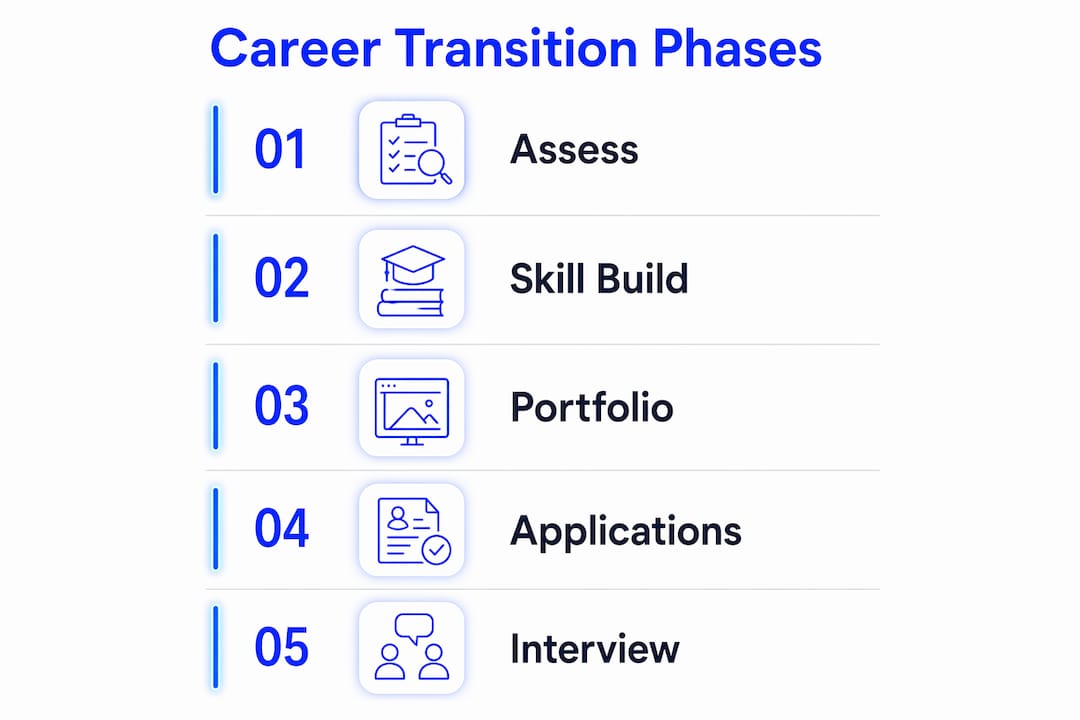
The preparation phase alone runs 5–11 months for most people, with active job search adding another 1–3 months on top. That math surprises a lot of job seekers who assume they can compress everything into 60 days.
A few things worth knowing about costs:
- Skill-build phase: online courses vary in cost depending on the field; bootcamps can be considerably more expensive.
- Networking: mostly time, not money. Budget 5–8 hours per week for outreach and follow-up.
- Active search: 10–15 hours per week is a realistic floor for a focused effort.
Pro Tip: Treat your financial runway as a hard project constraint, not a vague safety net. If you have 9 months of savings, your plan needs a go/no-go milestone at month 6. Running out of runway mid-search forces reactive decisions, like accepting the wrong offer out of pressure.
Sample timelines for four common career-change scenarios
These templates give you a starting point. Adjust the durations based on your own skill overlap and weekly hours available.
Scenario 1: Operations manager → product manager (adjacent shift)
| Timeline Type | Duration | Key Milestones |
|---|---|---|
| Compressed | 3–4 months | PM certification, 1 case study, 10 targeted apps |
| Typical | 5–7 months | 2 case studies, 3 informational interviews, 15 apps |
| Extended | 8–12 months | Side project shipped, community involvement, 10-15 apps |
Skill overlap is high here. Operations experience maps directly to roadmap prioritization and stakeholder management. The main gap is usually proof: hiring managers want to see a product decision you owned, even a small one. A single well-documented case study accelerates this scenario more than any certification.
Scenario 2: Marketing → UX design (sector switch)
Estimated duration: 6–10 months. Out-of-pocket costs: $500–$3,000 for a UX certificate program. The biggest risk is passive learning. Completing a course without building a portfolio of 3–4 real projects stalls the search indefinitely. What accelerates it: a volunteer redesign project for a nonprofit or a freelance audit for a small business.
Scenario 3: Non-technical → software engineering (full reinvention)
Full-time bootcamp paths run 4–9 months total; part-time or self-study paths stretch to 10–18 months. Budget $10,000–$20,000 for a quality bootcamp, or $0–$500 for a self-directed path using free and low-cost resources. The top risk: stopping at “I finished the bootcamp” without building two or three deployed projects that prove you can ship.
Scenario 4: Healthcare → health data analytics (adjacent with upskilling)
The fastest movers in this scenario already have Excel or basic SQL exposure from clinical documentation. That existing proof cuts the skill-build phase by 4–8 weeks compared to someone starting from zero. The real accelerator is a targeted certification like Google’s Data Analytics Certificate paired with a dataset project from a public health source.
Estimated duration: 5–9 months. Platforms like Coursera and similar resources for non-technical professionals can fill AI-adjacent skill gaps quickly when you pair them with hands-on projects.
How to build your own personalized career-transition timeline
A personal timeline isn’t a guess. It’s a calculation. Here’s the method:
- Inventory your current skills. List every skill you use weekly, not just what’s on your resume.
- Pull 10–15 target job postings in your destination role and industry. Save them.
- Classify each requirement by gap type: no gap (you have it), proof gap (you have it but can’t show it), refresh gap (you had it but it’s rusty), or full gap (you need to build it from scratch).
- Assign weeks per gap type. No gap: 0 weeks. Proof gap: 2–4 weeks to document. Refresh gap: 3–6 weeks. Full gap: 8–20 weeks depending on complexity.
- Scale by your weekly hours. The baseline assumes 15 hours per week. If you can only commit 8 hours, multiply your gap weeks by roughly 1.9.
- Add job-search buffer. Tack on 4–12 weeks for the active search phase regardless of how ready you feel.
- Check against your runway. If the total exceeds your financial runway, either reduce the scope of the pivot or extend your runway before starting.
This skills-gap method gives you a defensible personal estimate rather than a generic range.
Contingency planning matters too. Keep your old-industry connections active for at least 12–18 months after you start the transition. If the new path stalls, those relationships are your fastest route back to income. Part-time or freelance work in your current field during the skill-build phase is one of the most underused strategies for extending runway without burning savings.
Track these metrics weekly:
- Applications sent (target: 10–15 per active-search week)
- First contacts made (recruiters, hiring managers, referrals)
- Informational interviews completed
- Portfolio or proof pieces finished
- Certifications completed
How AI resume tools can shorten specific parts of your timeline
AI tools don’t replace the hard work of a career transition. But they do compress specific phases that typically waste the most time.
Resume-match’s AI resume analysis extracts the keywords your resume is missing for a target role and matches you to job listings across multiple platforms in about 30 seconds. That targeting alone cuts the “spray and pray” application phase, where most job seekers burn 4–6 weeks applying to roles that were never a real match.
The Career Probability Report goes further. It gives you a competitive analysis of your resume against real job listings, salary range estimates for your target role, a gap analysis tied to specific postings, and personalized career strategy recommendations. Think of it as a structured version of the skills-gap method above, done automatically from your resume data.
Knowing which roles you’re actually competitive for before you apply changes how you spend your time. Instead of applying to 50 roles and waiting, you apply to 15 well-matched ones and follow up with confidence.
Specific features that speed the timeline:
- Keyword extraction: Fixes resume gaps that cause ATS rejections before you ever reach a recruiter.
- Tailored job matches: Surfaces roles you’d likely miss on a manual search.
- Application tracking: Keeps your pipeline visible so nothing falls through.
- Recruiter outreach templates: Cuts the time spent drafting cold messages.
Realistic limits: AI identifies gaps and surfaces matches, but it can’t build your portfolio, conduct your informational interviews, or make your case in an interview. Those parts still require your time and effort.
Pro Tip: Use Resume-match’s job matches as a shortlist, then book one informational interview per matched role before applying. That combination, AI targeting plus a warm human connection, converts matches into interviews faster than applications alone.
Your one-page career-transition checklist and tracking template
Use this checklist to move from assessment to offer without losing momentum.
Phase 1: Assess (weeks 1–2)
- Complete a full skills inventory
- Confirm whether you need a job change or a true career change (a skills-based job matching analysis helps here)
- Define your target role and industry with specificity
Phase 2: Gap map (weeks 3–6)
- Pull 10–15 job postings and classify every requirement by gap type
- Calculate your personal timeline using the method above
- Set your financial runway milestone and go/no-go date
Phase 3: 12-week sprint (weeks 7–18)
- Complete priority skill-build tasks (courses, projects, certifications)
- Conduct at least 3 informational interviews
- Publish or document at least 2 proof pieces
Phase 4: Apply (weeks 19–30)
- Send 10–15 targeted applications per week
- Track every application, contact, and interview in one place
- Adjust targeting based on response rates every two weeks
Phase 5: Review (ongoing)
- Run a weekly 15-minute review: what moved, what stalled, what to cut
- Update your Resume-match profile as you add new skills and proof pieces
Pro Tip: Use a simple spreadsheet with columns for role, company, date applied, status, and next action. Pair it with Resume-match’s application tracking so your pipeline and your resume optimization stay in sync.
For a structured certification roadmap during the skill-build phase, a dedicated planning tool can help you sequence credentials in the right order without over-investing in the wrong ones.
Key Takeaways
Most career transitions take months to over a year when planned deliberately, with adjacent shifts taking less time and full reinventions requiring longer periods.
| Point | Details |
|---|---|
| Timeline ranges | Adjacent shifts: 3–6 months; mid-career pivots: 6–12 months; full reinventions: 12–24+ months. |
| Start the clock right | Your timeline begins with a verifiable action (application, interview, project), not a feeling. |
| Runway as a constraint | Set a minimum of 9–12 months of savings for a mid-career pivot; 18–24 months for full reinvention. |
| Proof beats passive learning | Two portfolio pieces or case studies move your search faster than five completed courses. |
| Preserve old connections | Keep your previous-industry network active for 12–18 months as a contingency. |
| Resume-match’s role | Use Resume-match’s Career Probability Report and AI job matches to target the right roles faster and fix resume gaps before they cost you interviews. |
The discomfort is part of the process
Here’s something career advisors say that most guides skip: the first 4–6 weeks of a real transition feel like failure even when they’re not. You’re learning a new field’s language, getting rejected from roles you’re not yet qualified for, and questioning whether the whole thing was a mistake. That’s not a sign to stop. That’s the learning phase doing exactly what it’s supposed to do.
People who have already done preliminary research or made a few failed attempts move 4–8 weeks faster than those starting from zero. Every application that doesn’t land, every informational interview that goes nowhere, those are data points that sharpen your targeting. Log them. Treat them as progress markers.
One practical nudge: pick a single 7-day micro-project this week that produces something tangible within two weeks. A short case study, a GitHub repo, a redesign mockup. Proof compounds. One piece makes the next one easier to start.
Resume-match helps you move faster from day one
Knowing your timeline is one thing. Having the right tools to execute it is another. Resume-match gives you AI-powered resume keyword analysis, a personalized Career Probability Report with salary insights and gap analysis, tailored job matches from across multiple job boards, and application tracking with recruiter outreach templates, all in one place.
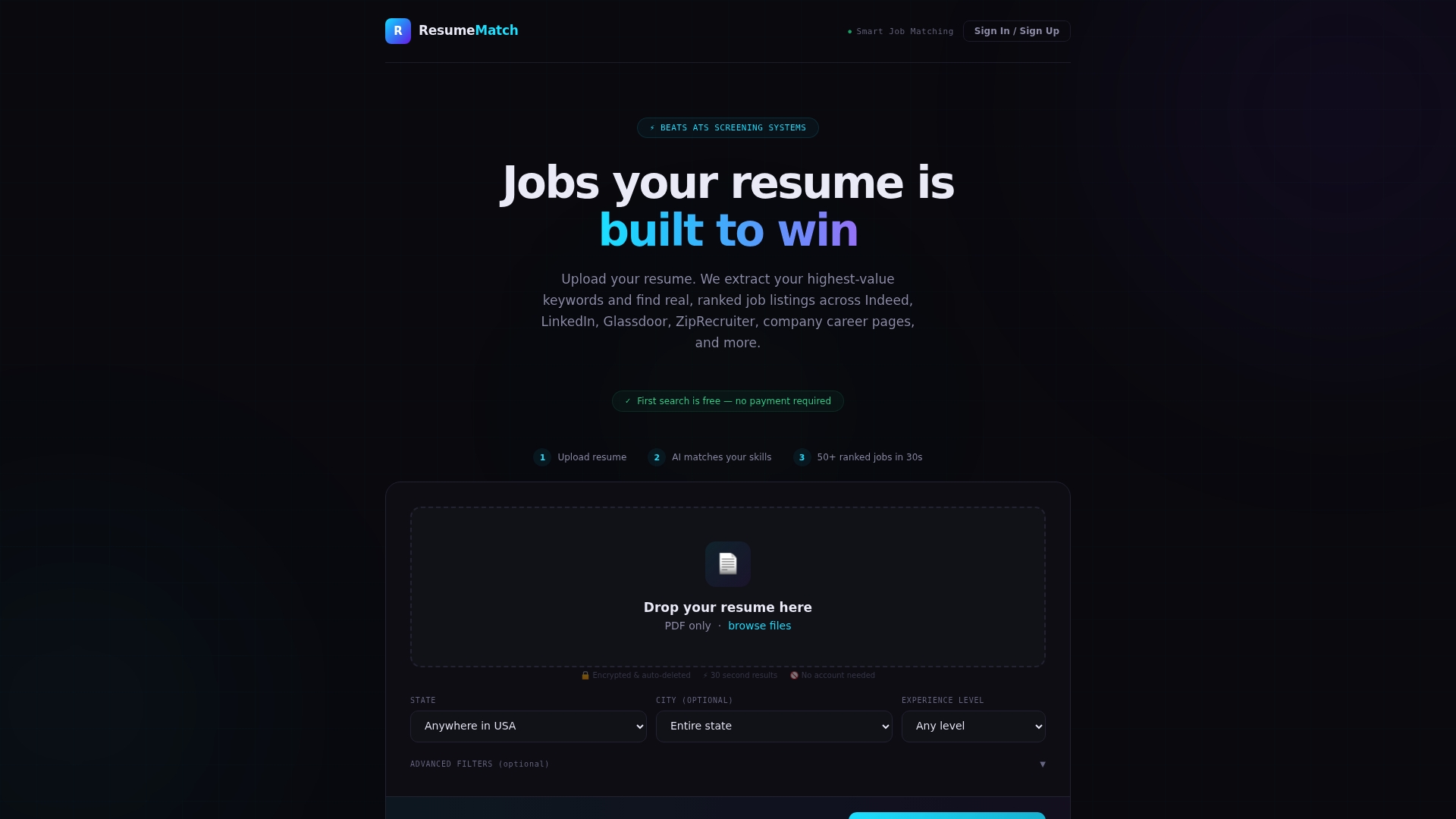
The 72-hour free trial lets you generate your Career Probability Report and see exactly which roles you’re competitive for right now, before you spend weeks applying to the wrong ones. That report functions as a personalized version of the skills-gap method in this article, built from your actual resume data.
Start your free trial at Resume-match and get a clear picture of where you stand and what to do next.