
Fix Employment Gaps on a Resume: U.S. Rules and 30–45s Scripts
Fix Employment Gaps on a Resume: U.S. Rules and 30–45s Scripts

If your gap is under six months, drop the months and list years only. If it’s longer or more recent, name it with a short titled entry and back it with several activity bullets. Either way, save the fuller story for your cover letter and a 30 to 45 second interview answer, not your resume header.
TL;DR:
- Short gaps under six months generally do not require explanation, especially if listed with years-only formatting and consistent resume style.
- Gaps longer than a year should be documented as titled entries with specific dates and outcome-driven activities, such as certifications or freelance work.
- Explaining recent or pattern-breaking gaps is essential, while older gaps can often be omitted if your recent work history appears continuous.
- Use a reason, resolution, and bridge structure in brief cover letter and interview responses to clearly relate your gap to your current readiness and skills.
- An AI resume check can identify missing or inconsistent date entries and suggest effective wording to accurately describe your employment gaps.
Table of Contents
- When Do You Need to Explain an Employment Gaps Resume Issue?
- How to Format Short Resume Gaps
- How to Present a Longer Career Break
- What to Say in Your Cover Letter and Interview
- Best Practices and Red Flags to Avoid
- How an AI Resume Check Can Catch Gap Problems Before Recruiters Do
- Tailoring Gap Explanations by Industry and Employer
- An Editorial Take on Employment Gaps
- Let ResumeMatch Handle the Gap Wording for You
- Sources
- FAQ
When Do You Need to Explain an Employment Gaps Resume Issue?
Not every gap needs a spotlight. The real question is duration, timing, and whether it breaks a pattern recruiters expect to see.
Career experts generally define short-term gaps as 3 to 6 months and long-term gaps as 27 weeks or more, which is a useful dividing line when you’re deciding how much explanation is warranted. A gap of a few months between jobs rarely raises questions. A gap longer than about a year right before your most recent role almost always will.
Use these general guidelines:
- Explain gaps that are recent (within your last two positions), longer than several months, or that interrupt an otherwise steady work history.
- Older gaps, especially those several years back, can often be left alone entirely if you trim your resume to a recent window.
- A layoff usually needs less framing than a voluntary break, as recruiters expect layoffs happen. Recruiters know layoffs happen; they’re more curious about what you did with unplanned time off.
The cause of the gap shapes your explanation more than its length does. A six-month layoff followed by a certification course reads very differently than six months with no listed activity at all.
How to Format Short Resume Gaps
Short gaps are the easiest fix on your resume, and the fix is almost entirely visual. Instead of writing “March 2021 to September 2021,” write “2020 to 2022.” University career offices consistently recommend this years-only approach for exactly this reason: it removes the sharp edges without hiding anything.
A few formatting moves that help:
- Swap month/year date formats for year-only formats across your entire resume, not just the gap, so the change doesn’t stand out.
- Stick with a chronological or hybrid resume format. Fully functional, skills-first resumes can confuse applicant tracking systems that parse dates and titles, which can hurt you more than the gap would.
- Add a one-line note only if the gap is under a year and slightly noticeable, something neutral like “Relocated for family; resumed job search in 2023.”
Pro Tip: Before you change a single date format, run your resume through both a plain text copy and the actual PDF you plan to submit. Some formatting tricks that look clean visually get mangled by ATS parsing, which can do more damage than the gap itself.
How to Present a Longer Career Break
A gap of a year or more reads very differently when it has a title and dates, versus when it’s just missing. Turning that time into a labeled entry is the single most effective format change you can make.
Here’s how to build it:
- Give it an honest, specific title: “Career Break: Caregiving,” “Professional Development and Freelance Projects,” or “Independent Consulting.”
- Add the date range using the same format as the rest of your resume.
- Write two to four bullets describing what you actually did, focused on outcomes rather than tasks.
- Quantify wherever you can: certificates completed, freelance clients served, volunteer hours logged, or specific projects finished.
A weak bullet says “Took time off to care for a family member.” A strong bullet says “Managed household finances, coordinated care schedules for two family members, and completed a project management certificate during evenings.” One is a gap. The other is a set of transferable skills.
Longer gaps benefit from more concrete evidence of activities, not just more words. Documented activities like coursework, freelance projects, or volunteer results carry more weight than a vague description of staying busy. If you freelanced during your break, turning that work into a proper case study can strengthen this section considerably. Resources on case study marketing for freelancers walk through how to frame that kind of project work for a hiring audience.
What to Say in Your Cover Letter and Interview
Your resume states the gap plainly. Your cover letter and interview are where you explain it, and both should stay brief.
For the cover letter, use one paragraph that does three things in order: names the gap honestly, confirms it’s resolved or explains your current status, then pivots directly to why you’re a fit for the role. Don’t apologize for the gap. State it and move forward.
For the interview, a short script beats a long one. Structure your answer in three beats and keep the whole thing under 45 seconds:
- Reason: what caused the gap, stated factually.
- Resolution: what’s changed or what you accomplished during it.
- Bridge: how that time connects to the value you bring to this role.
That same structure works for caregiving (“I stepped away to care for a parent; I stayed current through online coursework and I’m ready to return full-time”) or upskilling (“I took a deliberate break to complete a coding bootcamp; I’m now applying those skills directly”). Consistency across your resume, cover letter, and spoken answer matters more than any single word choice. If you’re managing multiple applications while refining this pitch, a structured application workflow keeps your story straight across every submission.
Best Practices and Red Flags to Avoid
Recruiters aren’t looking for a perfect resume. They’re looking for consistency and evidence you kept moving forward.
Do this:
- Keep gap explanations short. One sentence on the resume, one paragraph in the cover letter.
- Use active language: “completed,” “managed,” “built,” not “tried to” or “attempted.”
- Quantify anything you can, even informal work like freelance clients or volunteer hours.
Avoid this:
- Never invent or fudge dates to disguise a gap. Inconsistent dates between your resume, LinkedIn, and application forms are one of the fastest ways to lose trust.
- Don’t overshare sensitive personal details. A health issue or family emergency can be summarized as “a personal matter” without medical specifics.
- Don’t over-apologize. Recruiters respond better to ownership and forward momentum than to excessive justification.
Weak: “I was unemployed for a while due to personal issues.” Strong: “I took a planned break to manage a family matter and returned to the workforce with an updated certification in hand.” Same gap, completely different signal.
How an AI Resume Check Can Catch Gap Problems Before Recruiters Do
Automated resume scans typically flag date discontinuities, missing entries between jobs, and resumes where activity during a gap isn’t documented anywhere. Those are exactly the issues a human reviewer notices in the first ten seconds.
A Career Probability Report goes a step further by combining that gap analysis with:
- Wording suggestions for how to phrase a career break entry based on what you actually did during it.
- Job matches weighted against your current skill profile, gaps included, so you see roles that fit rather than roles you’d need to explain your way into.
- Salary insight tied to your experience level, adjusted for the activities you list during the gap.
Run the check after you’ve added your gap entry and bullets, apply the suggested keyword fixes, then let the job matching show you where you actually stand.
Tailoring Gap Explanations by Industry and Employer
Gaps of several months rarely raise concern in fields like tech, where layoffs and project-based work are common. In healthcare, finance, or education, the same gap can trigger more scrutiny around licensing, compliance, or continuity of care, so employers in those fields often expect a more direct explanation upfront.
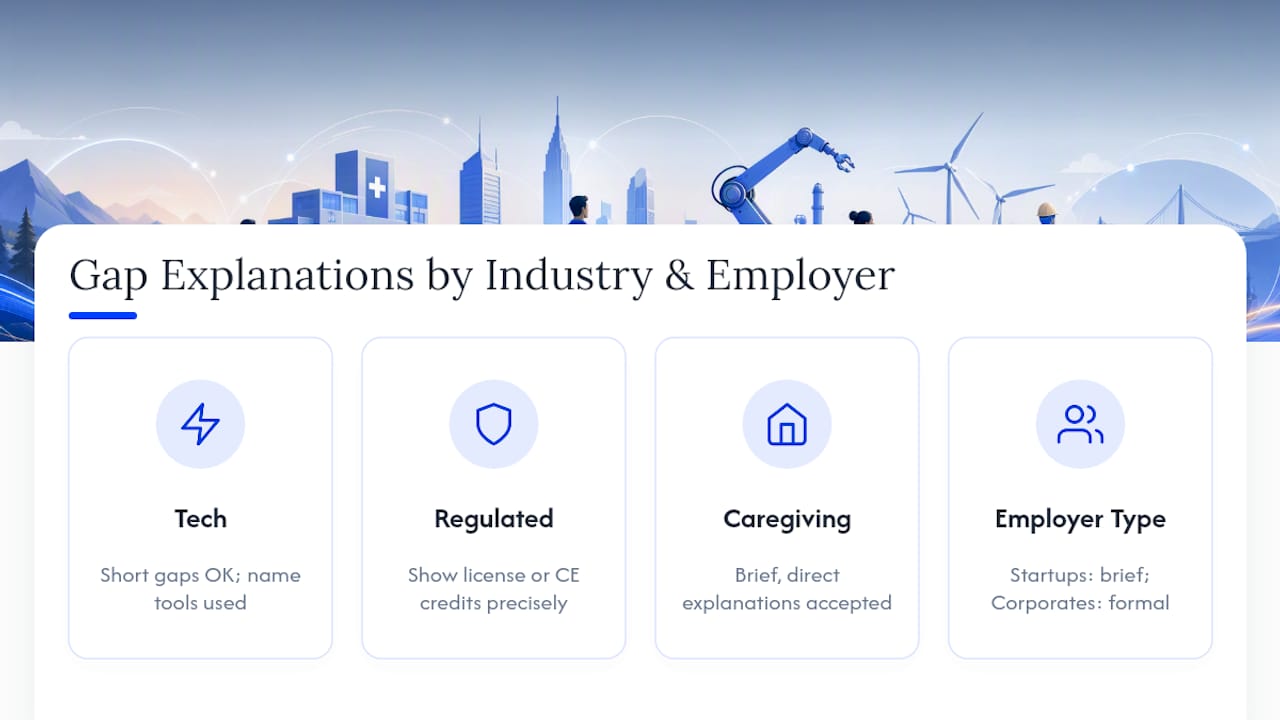
In fast-moving fields like software or marketing, hiring managers care most about whether your skills are current. A gap filled with coursework, certifications, or freelance projects using current tools usually satisfies that concern without much elaboration. Naming specific platforms or frameworks you used during the break does more work than a vague “stayed current with industry trends.”
In regulated industries like healthcare, finance, or law, employers care more about licensing status, continuing education credits, and whether any compliance issue caused the gap. Be precise about what stayed active during your break, such as a license renewal or required coursework, because vagueness reads as a red flag in these fields specifically.
For caregiving or family-related gaps, most industries have grown more comfortable with direct, brief explanations, partly because remote work and family leave have become far more normalized since 2020. Smaller companies and startups tend to want a shorter, more conversational version of your explanation, while larger corporations with formal HR screening processes often prefer a version that maps cleanly onto standard resume sections. Adjust the depth of your explanation to match the formality of the employer, not the sensitivity of the reason.
If your gap involved something you’d rather address later in the process, such as a legal matter or a difficult termination, it’s reasonable to keep the resume version general and save specifics for a later interview stage once you’ve built some rapport with the interviewer.
An Editorial Take on Employment Gaps
Hiring managers rarely care about a perfect timeline. They want to know two things: is whatever caused the gap resolved, and did you stay current while it happened? A named entry with outcome-focused bullets answers both questions before anyone has to ask. Keep your resume, cover letter, and LinkedIn saying the same thing, in the same order, every time.
— Resume
Let ResumeMatch Handle the Gap Wording for You
An AI-powered tool can help you fix a resume gap without guessing at the right phrasing yourself. Run a scan and it flags date discontinuities and missing activity entries, then suggests concise wording you can paste directly into your career break section instead of drafting it from scratch.
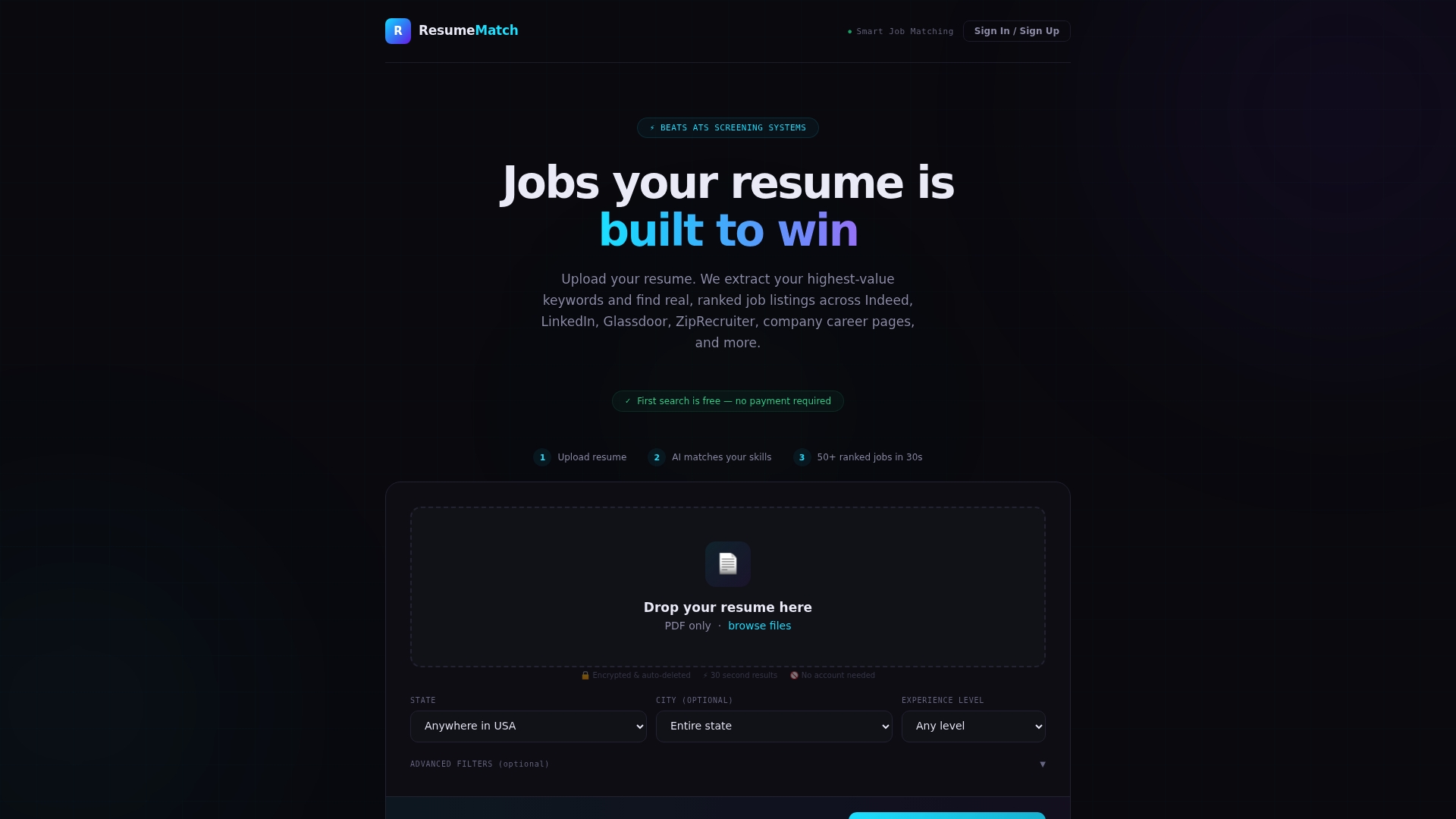
The Career Probability Report takes it further, showing how the activities you list during your gap, whether that’s freelance work, coursework, or caregiving, map to real job matches and salary expectations for your profile. That means you’re not just filling a blank line; you’re seeing which roles your gap-era skills actually qualify you for. If you freelanced during your break, pairing your resume update with a look at freelancing resources can help you translate that work into stronger bullets too. Once your resume reflects your full story, keeping every application organized matters just as much, and a simple job application tracker keeps your outreach consistent while you follow up. Start a free scan at Resume-match and see your suggested wording and matched roles in about 30 seconds.
Sources
- Gaps in employment — Coursera (How to address employment gaps)
- How to explain a gap in your resume — Harvard Business Review
- How to explain gaps in work history — CareerReload
- How Do I Explain Employment Gaps on My Resume? — University of Arizona Career Services
FAQ
How Should I Format My Resume to Include Gaps?
For gaps under about six months, list years only instead of months and keep a chronological or hybrid layout. For longer gaps, add a titled entry with dates and two to four outcome-focused bullets describing what you did.
What Is the Best Answer for a Gap in Employment?
The strongest answers are short and follow a reason, resolution, bridge structure: state what caused the gap, confirm it’s resolved, then connect it directly to the value you bring to the role.
How Long of a Gap Is Okay on a Resume?
Gaps under 3 to 6 months typically need no explanation at all. Gaps of 27 weeks or longer usually warrant a titled entry and a brief note in your cover letter.
How Do I Explain a Two Year Gap in Employment?
Give it a specific title like “Career Break” or “Independent Consulting,” list the dates, and add three to four bullets showing coursework, freelance work, or caregiving responsibilities with measurable outcomes where possible. Keep your interview explanation under 45 seconds using the reason, resolution, bridge format.
Can an AI Resume Tool Help Me Explain a Gap?
Yes. A tool like ResumeMatch can flag date discontinuities on your resume and suggest concise wording for a career break entry based on the activities you add.