
Reverse Chronological Resume: Format, Example and When to Use It
Reverse Chronological Resume: Format, Example and When to Use It

A reverse chronological resume lists your jobs from newest to oldest, so the role you hold now or held most recently sits at the top of your experience section. It is the default format in the US, and for most job seekers with a steady work history it is the right one. If your history has gaps, you are changing fields, or you have little paid experience, a hybrid format may serve you better. This guide covers both.
TL;DR
- Reverse chronological means newest first: current or most recent job at the top, your earliest role at the bottom. Education follows the same rule.
- It works best when your recent jobs relate to the role you want. It is also the format CareerOneStop says most employers prefer.
- “Chronological resume” and “reverse chronological resume” describe the same layout.
- Career changers, new graduates and people with gaps can use a hybrid (combination) resume: a skills section first, then a dated work history.
- Keep it to one or two pages, in one column, with consistent dates and achievement-focused bullets.
Table of Contents
- What a reverse chronological resume is
- What reverse chronological order looks like in an example
- How to write one, section by section
- Formatting rules that keep it readable
- When a reverse chronological resume is the right choice
- When a different format helps
- What a hybrid resume example looks like
- How to handle gaps, short stints and a thin work history
- Our perspective
- Try your resume against real job listings
- A quick checklist before you send it
- FAQ
- Sources
What a reverse chronological resume is
The idea is simple. Under your Experience heading, you place your most recent position first and work backward. The New Jersey Department of Labor describes the chronological format as listing jobs from your most recent position back to your first, with duties and accomplishments under each job.
You may see the format called chronological, reverse-chronological or “reverse chronological order.” They all mean the same thing. CareerOneStop defines a chronological resume as one that starts with your current or most recent job and proceeds in reverse chronological order. The “reverse” part just reminds you that the order runs from today backward, not from your first job forward.

The format is common for a reason. York College (CUNY) notes that reverse chronological resumes are among the most commonly used types. Recruiters scan a resume quickly, and they usually want to see what you are doing now before they look at what you did years ago. Newest-first answers that question in the first few lines.
What reverse chronological order looks like in an example
Here is a short example of an experience section for a marketing coordinator. Notice that the order runs by date, not by importance or by employer size.
Experience
Marketing Coordinator, Brightside Outdoor Co., Denver, CO March 2023 to Present
- Grew email subscribers from 8,000 to 14,500 in 12 months by redesigning the welcome series.
- Managed a $40,000 annual paid social budget and cut cost per lead by 18%.
Marketing Assistant, Brightside Outdoor Co., Denver, CO June 2021 to February 2023
- Scheduled and reported on 20+ social posts per week across three channels.
- Wrote product copy for 150 new items during a catalog launch.
Sales Associate, Mile High Gear, Denver, CO August 2019 to May 2021
- Trained six new hires on point-of-sale and inventory procedures.
The employer, role and figures above are made up for illustration. The structure is the point: the current job is first, the dates are consistent, and every bullet shows what changed because you were there.
For a real-world model, the University of Washington English department shows a reverse-chronological sample with dated Editorial Intern and Editorial Staff entries. Education works the same way. NYU Tisch advises listing your most recent education first, too.
How to write one, section by section
1. Header
Put your name, phone number, professional email, and city and state at the top. You do not need a full street address. The New Jersey guidance says the heading is the one part that is typically centered. The rest is left-aligned.
2. Professional summary (optional but useful)
Two or three sentences that name your field, your strongest results and the kind of role you want. Some career offices treat an objective as optional. A summary is more helpful when it is tied to the job you are applying for. If you are switching fields, our guide to a career change resume with a short professional summary shows how to write one.
3. Experience
This is the core. The Queensborough Community College guidebook lists what each entry needs:
- Employer name
- Location (city and state only)
- Job title
- Dates of employment, with “Present” for a current job
- Bullets on your skills and results
Start bullets with action verbs. The UW School of Public Health recommends action verbs and steering clear of the phrase “responsibilities include.” Show what you did and what happened as a result. Numbers help: revenue, time saved, people trained, volume handled.
4. Education
List your degree, school, and graduation date, newest first. Recent graduates can put education above experience and add relevant coursework, honors or activities. NYU Tisch lists these as common categories.
5. Skills
A short, honest list of tools, software and skills that appear in the job posting and that you really have. This is also where keyword matching matters, because many employers screen resumes with applicant tracking systems. Our parse test for ATS friendly design shows how to check that your layout reads cleanly.
Formatting rules that keep it readable
Good formatting is invisible. Bad formatting makes a reader stop. Pull these from career offices:
| Element | Guidance | Source |
|---|---|---|
| Length | One to two pages in most circumstances | New Jersey Dept. of Labor |
| Margins | One inch on top, bottom and sides | New Jersey Dept. of Labor |
| Font size | 10 to 12 point, section titles up to 14 | New Jersey Dept. of Labor |
| Columns | One column | University of Michigan-Dearborn |
| Consistency | Same font style, size and date format throughout | University of Michigan-Dearborn |
Two more habits pay off. First, pick one date format and use it everywhere: “March 2023” in one place and “3/23” in another looks careless. Second, save the file with a clean name. We cover that in our guide to resume file naming.
When a reverse chronological resume is the right choice
Use it when your recent jobs are close to the job you want. DePaul University’s Career Center says the chronological format suits candidates with deep experience in roles directly related to what they are seeking. The University of Washington English department says the same: it is a good style for people with professional experience who are looking for a new job in the same field.
The Department of Labor’s Resume Essentials guide points out that it gives employers a clear timeline of employment and a consistent career focus. If your story is “I have grown steadily in this field,” this format tells it best.
It is a strong fit if you:
- Have held two or more related jobs in a row
- Are moving up within the same field
- Have steady dates with no long breaks
- Are applying for roles where employers expect a traditional resume, including most corporate and government-adjacent hiring
For federal jobs, the rules are different. See our federal resume format guide.
When a different format helps
So, should every resume be reverse chronological? Not always. CareerOneStop lists the weak spots: the format emphasizes gaps, and it is a poor match when you have no work history or have changed jobs or careers often. You have options in those cases.
Functional (skills-based) resume
This leads with skills grouped by theme and de-emphasizes dates. CareerOneStop says it fits people who built skills outside of work and may be changing careers. The tradeoff is that many employers like to see a clear timeline, so a pure functional resume can leave a reader wondering where and when you used those skills. That is why most people who need flexibility choose the next option.
Combination or hybrid resume
The two names mean the same thing. The Department of Labor guide describes a combination resume as mixing features of the chronological and functional styles. It shows both your skills and your work history, and it helps you show skills gained from volunteering or training. UN Women describes it as skills and accomplishments first, followed by employment history.
Think of it as a reverse chronological resume with a skills section on top.
What a hybrid resume example looks like
The usual layout, based on Indeed’s hybrid resume template, is a header, then a skills summary where each skill has bullets that prove it, then your work history. Here is an example for someone moving from bartending to account management. The details are invented for illustration.
Alex Rivera | alex.rivera@email.com | Austin, TX
Professional summary Customer-focused team lead with five years of hospitality experience in high-volume settings, now moving into account management.
Skills summary
Client relationships
- Built a base of 60+ regular customers through personal follow-up and event invitations.
- Resolved complaints on the spot, keeping reviews above 4.5 stars.
Team leadership
- Scheduled and coached a team of eight, and trained four new hires.
Budget and inventory
- Managed a $12,000 monthly ordering budget and reduced waste by 15%.
Work history
Lead Bartender, The Copper Door, Austin, TX | April 2022 to Present Bartender, Riverside Tavern, Austin, TX | May 2019 to March 2022
See the logic? A bartender who manages a team and a budget already has the skills an account manager uses. The job title does not say so, but the skills section does. Your dates are still there, newest first, so a recruiter sees the full timeline. This is the kind of mismatch between titles and skills we built ResumeMatch to catch.
If you also want to add a short video introduction to your application, these video resume scripts give you a practice plan.
How to handle gaps, short stints and a thin work history
Gaps. Do not hide them with a format trick. Harvard’s career office advises avoiding information gaps, such as a missing summer. Fill them with what you actually did: freelance work, caregiving, coursework, volunteering, certifications. DePaul notes that a chronological format is not ideal for gaps from life events like time off to raise a child or long unemployment, so a hybrid layout is worth considering. Our guide to employment gaps on a resume has short scripts you can use when asked about it.
Career changes. Keep the reverse chronological order, but put a summary and a skills section above it, and rewrite bullets in the language of the new field. The career change resume format guide goes deeper.
First job. Recent graduates can lead with education, then list internships, part-time jobs, projects and campus activities, each newest first. The University of Michigan-Dearborn page notes that you should present your history to fit the job you are applying for. A class project with a measurable result belongs on the page.
Our perspective
We built ResumeMatch because a resume format is only half the problem. The other half is knowing which jobs your resume actually fits. Plenty of people have the right skills with the wrong job titles, and a keyword scan or a quick glance by a recruiter will miss them.
Our view: pick the format that tells your story honestly, then test it against real postings. Reverse chronological is a great starting point. When you add a skills section on top, you give both people and software something to match against.
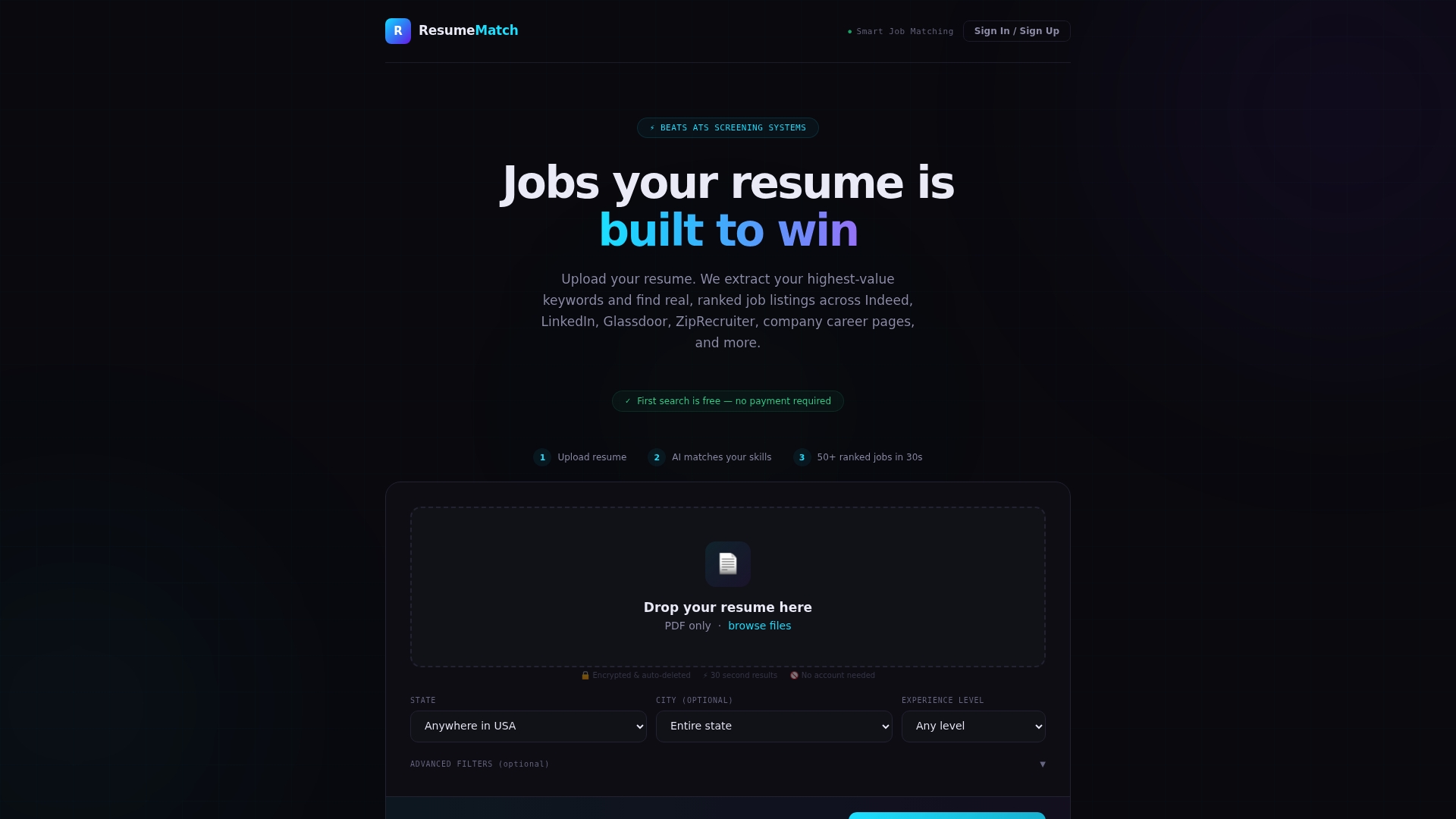
That is why our AI scores your resume against your real skills, not just keywords, and matches you to live listings across multiple job boards in about 30 seconds. Our Career Probability Report then shows competitive job matches, salary insights and gaps in your resume, so you know what to fix before you apply.
We wish we’d had that when we were job hunting. You do not have to guess anymore.
Resume
Try your resume against real job listings
Once your resume is formatted, the next question is where it fits. ResumeMatch reads your resume, pulls out the skills and keywords that matter, and matches you with tailored listings. It also builds a Career Probability Report with salary insights, a resume gap analysis, a career strategy, application tracking, interview preparation and recruiter outreach templates.
You start with a 72-hour free trial. The ResumeMatch Membership then costs $15 per month. If you would rather hand off the applying, Let Us Apply For You is a one-time $50 service where agents apply to jobs on your behalf, with a guaranteed minimum number of personalized applications.
Start with ResumeMatch and see which jobs your resume matches today.
A quick checklist before you send it
- Your newest job is first, and every date is in the same format.
- Each job shows employer, city and state, title and dates.
- Bullets start with action verbs and show results.
- Education is newest first.
- The layout is one column, one to two pages, with a readable font.
- Your skills section uses words from the job posting that honestly describe you.
- You have tailored it to this role, not sent the same file to every employer.
FAQ
What is a reverse chronological resume format?
It is a resume that lists your work experience from the most recent job to the oldest, with duties and achievements under each role. Education usually follows the same newest-first order. It is the same as a chronological resume.
Should resumes be reverse chronological?
For most people with steady, related experience, yes. CareerOneStop says most employers prefer it. If you have gaps, no work history or are changing careers, consider a hybrid format that leads with skills and still lists your jobs newest first.
What is the difference between a combination and a hybrid resume?
There is none. Both terms describe a resume that blends the skills focus of a functional resume with the dated work history of a chronological one. You put a skills section first, then list jobs in reverse chronological order.
How far back should my experience go?
Show the roles that are relevant to the job you want, and keep the resume to one or two pages. Older or unrelated jobs can be shortened to a single line, but avoid leaving unexplained gaps in the timeline.
Sources
- CareerOneStop: Resume styles
- New Jersey Department of Labor: Resume Writing Guidance
- York College (CUNY): Sample Reverse Chronological Resume
- University of Washington English: Résumé Formats
- NYU Tisch: Resume Guidelines and Samples
- Queensborough Community College: Resume Guidebook
- UW School of Public Health: Resume Guide
- University of Michigan-Dearborn: Resumes and Cover Letters
- DePaul University Career Center: Resumes, Just Your Type
- U.S. Department of Labor: Resume Essentials Participant Guide
- UN Women: Preparing Resumes and Writing Cover Letters
- Indeed: How To Write a Hybrid Resume
- Harvard College: Guide to Creating a Strong Resume
- ProNoto: Video resume scripts