
Get Interviews: Resume Objective or Summary — 5 Scenarios (U.S.)
Get Interviews: Resume Objective or Summary — 5 Scenarios (U.S.)

Use a resume summary if you have relevant, measurable experience to show. Use a resume objective if that experience is thin, or if you’re pivoting into a new field and need to state your target role up front. Both get parsed by an applicant tracking system, or ATS, so both need real keywords from the job post. A tool like ResumeMatch can help you spot which keywords you may be missing either way.
TL;DR:
- Use a resume summary if you have measurable results and proven experience, otherwise opt for a clear, targeted objective.
- Tailor both objectives and summaries with keywords directly from the job posting to improve ATS matching and visibility.
- Focus on including one to two relevant skills and concrete numbers or results to strengthen your opening statement.
- Avoid generic language, personal pronouns, and lengthy paragraphs; keep openings concise, specific, and role-focused.
- Use AI tools to verify keyword density and relevance before submitting applications to maximize your resume’s effectiveness.
Table of Contents
- Resume Objective vs Summary: A Quick Comparison
- When Should You Use an Objective Instead of a Summary?
- How Do You Write a Strong Resume Objective?
- How Do You Write a Resume Summary That Gets Noticed?
- How Does an ATS Read Your Objective or Summary?
- What Do Before-and-After Resume Openings Look Like?
- What Mistakes Should You Avoid in Your Resume Opening?
- What Does Resume Objective vs Summary Data Actually Tell Job Seekers?
- Try ResumeMatch to Test Your Opening Before You Apply
- Sources
Resume Objective vs Summary: A Quick Comparison
A summary looks backward at what you’ve already proven. An objective looks forward at what you’re aiming for. This distinction explains most other differences between them.
Here’s the breakdown side by side:
- Purpose: Summary showcases past results; objective states your target and intent.
- Tone: Summary is confident and results driven; objective is direct and forward looking.
- Length: Summary runs 2 to 3 sentences with real numbers; objective stays to 1 to 2 sentences.
- Best for: Summary suits experienced professionals and career switchers with transferable wins; objective suits students, interns, and first-time job seekers.
- ATS note: Both are scanned for keywords, so pull language straight from the posting.
Neither format is inherently better. The right one just depends on what you can currently prove.
When Should You Use an Objective Instead of a Summary?
The decision rule is simpler than most job seekers expect. If you have measurable results from a job, internship, or major project, lead with a summary. If you don’t, or if you’re changing direction entirely, lead with an objective that names the role you want.
Five scenarios cover almost everyone:
- Internship seekers: Use an objective. You likely lack a work history with metrics, so state your target and your relevant coursework or skills instead.
- First job out of college: Use an objective, unless you had a strong co-op or internship with quantifiable results, in which case a short summary works.
- Career changers: Use an objective that names your new target role and the transferable skill that makes you credible.
- Returning to the workforce: Use an objective if your last role predates recent industry changes; use a summary if your prior results still speak for themselves.
- Senior hires with a track record: Use a summary, always. Recruiters want your proof, not your intentions.
One caution: never run both. Career centers consistently advise picking one opening, not stacking them. If you genuinely need to show both skills and short wins, a bulleted “career profile” under a single header handles that better than two competing openers.
How Do You Write a Strong Resume Objective?
The formula is short by design: target role + one or two relevant skills + what you’ll contribute. That’s it. An objective is not the place for your life story; it’s a one-breath pitch.
Keep it to 1 to 2 sentences, roughly 25 to 40 words, and drop personal pronouns like “I” or “my.” Career-services guidance is consistent on this: omit “I” and “my” and let action verbs carry the sentence instead.
Pro Tip: Read your objective out loud without the word “I” in front of it. If it still makes sense as a sentence, you’ve written it correctly.
Three examples across common situations:
- College student, internship: “Marketing student seeking a summer internship to apply skills in social media analytics and content strategy gained through university coursework and a student-run publication.”
- Career changer, into tech: “Former high school teacher pivoting into UX design, bringing strong communication skills and a completed UX certificate to entry-level design roles.”
- Returning professional: “Operations coordinator returning to the workforce after a caregiving leave, ready to apply eight years of scheduling and vendor management experience to a logistics support role.”
Before you submit, check each objective against the actual job posting. Objectives with no job-specific keywords are still parsed by ATS, just less effectively.
How Do You Write a Resume Summary That Gets Noticed?
The formula here is: professional identity + two or three accomplishments with numbers + a value statement tied to the target role. Numbers do the heavy lifting.
Aim for 2 to 3 sentences, about 40 to 60 words, and prioritize quantified wins over job duties.
Pro Tip: If a sentence in your summary describes what you were responsible for rather than what happened because of you, cut it or rewrite it as a result.
Four annotated examples:
- Early-career, with metrics: “Customer support specialist who resolved over 200 tickets weekly with a 96% satisfaction rating, seeking to bring the same efficiency to a fast-growing SaaS support team.”
- Mid-career, technical: “Backend developer with 5 years of experience building APIs that reduced page load times by 40%, now looking to apply that optimization mindset to a senior engineering role.”
- Manager, leadership impact: “Retail operations manager who grew regional sales 18% year over year while cutting staff turnover in half through a redesigned onboarding program.”
- Hybrid role: “Bilingual project coordinator who has delivered 30-plus client projects on time and under budget, combining bilingual fluency with hands-on scheduling and vendor negotiation.”
Quantified openings tend to advance further in screening than ones built entirely from adjectives, so treat every accomplishment sentence as a chance to insert a real number.
How Does an ATS Read Your Objective or Summary?
An applicant tracking system doesn’t care whether you labeled your opening “Objective” or “Summary.” It scans both the same way, pulling out nouns and phrases that match the job description. What matters is whether the job title and required skills from the posting actually appear near the top of your resume.
The practical move is to mirror the posting’s own language. If the listing says “cross-functional stakeholder management,” don’t write “worked with different teams.” Use the posting’s exact phrase where it’s true and natural.
- Pull the job title from the posting and use it, or a close variant, in your first sentence.
- Copy two or three required skills verbatim from the “requirements” section.
- Keep the standard label (“Summary” or “Objective”) so both human readers and parsing software know what section they’re in.
- Avoid repeating the same keyword three times in one paragraph; that reads as stuffing to a recruiter even when a bot tolerates it.
Pro Tip: Open the job posting and your resume side by side. If you can’t find at least two exact-match phrases from the posting in your opening lines, you’re leaving ATS points on the table. A resource on project manager keywords shows how specific this mapping can get for one common role.
What Do Before-and-After Resume Openings Look Like?
Seeing a weak opening turned into a strong one teaches the formula faster than any rule does.
-
College student: Before: “Hardworking student looking for a marketing job.” After: “Marketing student seeking a digital marketing internship, bringing hands-on experience managing a 5,000-follower Instagram account for a campus organization.” The fix adds a specific role, a real number, and a concrete skill.
-
Career changer: Before: “Experienced professional looking for a new challenge in tech.” After: “Former retail manager transitioning into data analytics, bringing a completed SQL certification and five years of experience interpreting sales data to drive decisions.” The fix names the destination role instead of hiding behind “a new challenge.”
-
Technical specialist: Before: “Skilled software developer with strong coding abilities.” After: “Full-stack developer who shipped 12 features in the past year, cutting average deployment time by 30% through improved CI/CD pipelines.” Vague adjectives get replaced with a shipped number, and this kind of technical framing is echoed in application development guidance from Amazing Devs as well.
-
People manager: Before: “Experienced leader who manages teams well.” After: “Operations manager who led a 15-person team to a 22% increase in on-time delivery rates over 12 months.” Numbers replace opinion.
What Mistakes Should You Avoid in Your Resume Opening?
Most weak openings share the same handful of problems, and every one of them has a fast fix.
- Generic language (“hardworking,” “team player”): Replace with a specific skill or result tied to the target role.
- Using both an objective and a summary: Pick one. Two competing openers just confuse the reader about your experience level.
- Personal pronouns (“I am,” “my goal”): Cut them; start directly with your title or a strong action word.
- Long paragraph intros: Trim to the sentence counts above. If it runs past four lines, it’s too long.
- Failing to tailor to the specific posting: Rewrite the opening for every application; a generic opener signals a generic candidate.
Run this checklist before you hit submit: length within range, at least two keywords from the posting, one number if you’re using a summary, correct label used, and language matched to this specific job, not your last one.
What Does Resume Objective vs Summary Data Actually Tell Job Seekers?
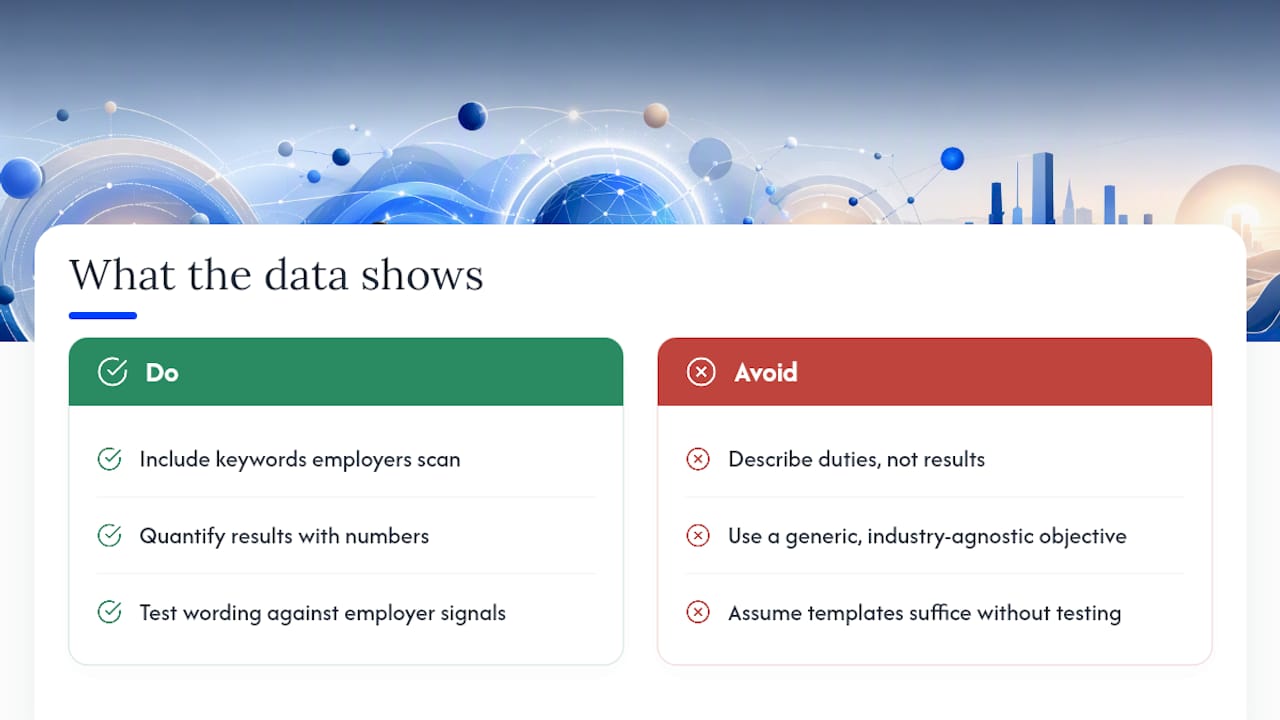
Across the resumes we analyze, one pattern shows up constantly: openings that skip both keywords and numbers. Candidates often describe responsibilities instead of results, or write an objective so generic it could apply to any company in any industry.
That gap is exactly what our AI keyword extraction and Career Probability Report are built to catch. We’re not saying the formulas above won’t work on their own. They will. We’re saying most people write them once and never test whether the wording actually matches what employers are scanning for.
— Resume
Try ResumeMatch to Test Your Opening Before You Apply
The formulas and examples above work whether or not you ever use a dedicated tool. But if you want a faster way to check your objective or summary against real job postings, some AI tools analyze your resume, extract the keywords that matter, and match you to tailored listings across multiple job boards quickly.
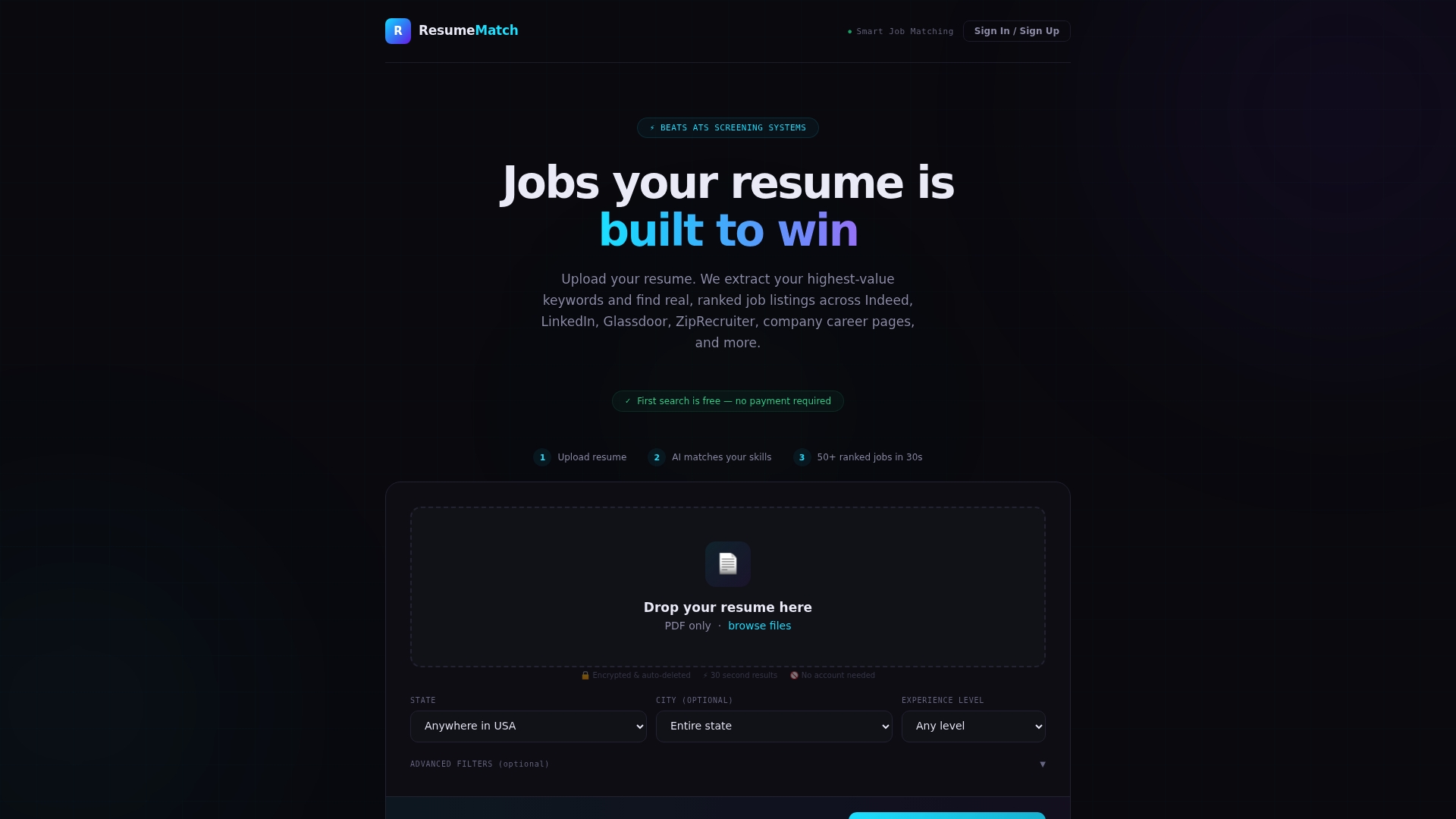
The Career Probability Report goes further, flagging missing keywords, estimating salary range, and mapping out a career strategy based on your actual resume, not a generic template. It’s a useful second opinion on a summary or objective you’ve already drafted using the guidance here. If you want to see where your current opening stands, start a free trial on ResumeMatch and run your resume through it before your next application.
Sources
- Resume summary vs. resume objective: What are the differences? | Indeed
- Resume Objective vs Summary: Which One Do You Need? | Extern
- What’s the Difference? Objectives, Summaries, and Profiles Explained | Engineering Career Services (Ohio State)