
The Best Resume Keywords for Project Managers in 2026
The Best Resume Keywords for Project Managers in 2026

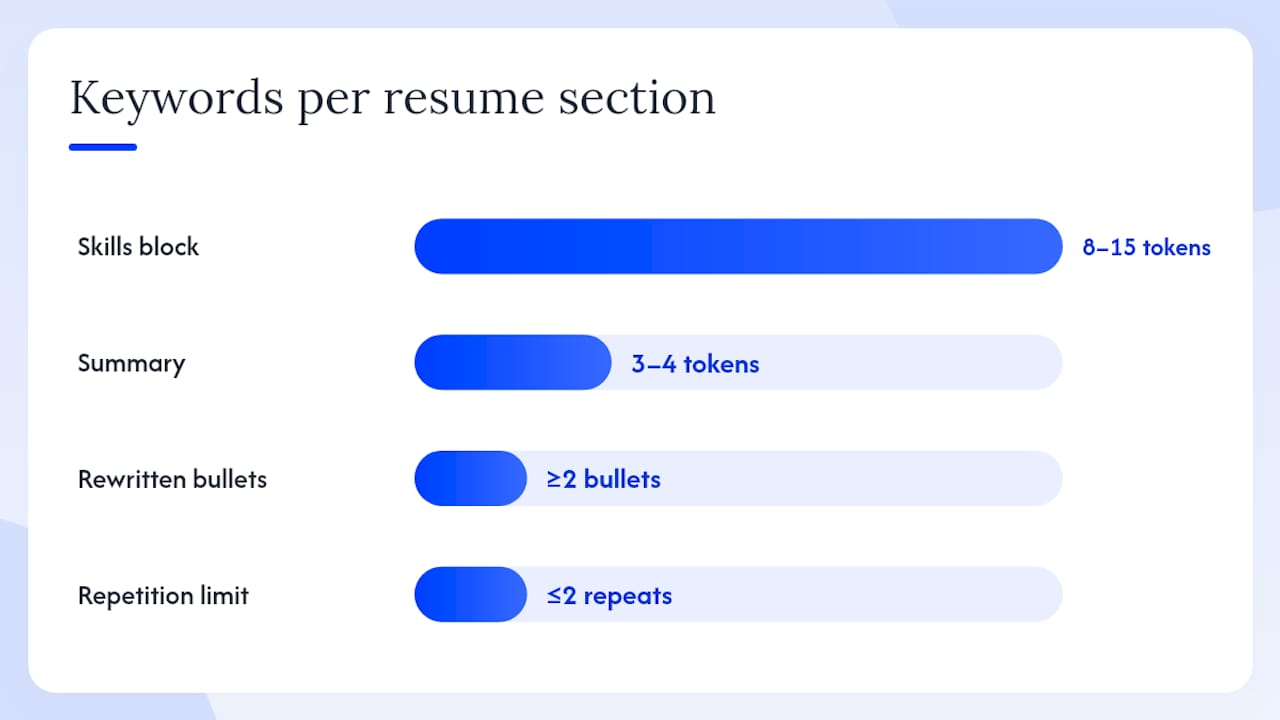
Prioritize 8–15 role-matched keywords, then place them in your summary, skills block, and at least two experience bullets. That single move does more for your ATS score than any other resume change you can make.
The three keyword clusters every project manager resume needs right now:
- Methodology tokens: Agile, Scrum, Waterfall, SAFe, PMBOK, PRINCE2 (match the exact methodology the JD names)
- Delivery scope terms: Budget management, Scope management, Schedule management, Risk management, Stakeholder communication
- Tool names: Jira, Microsoft Project, Smartsheet, Asana, Trello, Confluence
Your immediate next step: open the job description, highlight every methodology, tool, and scope term you see, then pick the 8–15 that honestly match your experience. Those are your keywords.
Key Takeaways
The most effective project manager resume strategy is to match 8–15 honest, role-specific keywords to the JD, place them in your summary and skills block first, and back every keyword with a proof bullet that includes a metric.
| Point | Details |
|---|---|
| Use 8–15 targeted keywords | A focused shortlist outperforms a 30-term dump; parsers weight placement and relevance. |
| Foundation tokens are non-negotiable | Risk management, stakeholder communication, and project lifecycle appear in 90%+ of PM job descriptions. |
| Match methodology to the JD | Use Agile or Waterfall vocabulary precisely; a diluted multi-methodology list lowers ATS relevance. |
| Format for ATS parsing | Submit .docx or ATS-safe PDF; avoid tables, images, and multi-column layouts that break parsers. |
| Resume-match for keyword extraction | Resume-match’s AI analysis surfaces gaps, ranks keywords by role fit, and delivers a Career Probability Report. |
Table of Contents
- What project manager resume keywords are and why they matter
- The best project manager resume keywords, organized by category
- How to extract keywords from a job description and add them to your resume
- ATS and formatting checklist: what breaks parsing and what doesn’t
- Copyable resume snippets that show keywords in context
- Project management certifications to feature and where to place them
- Pre-apply checklist: confirm your resume is ready
- How AI keyword extractors help you get this right faster
- How to tailor your keywords to different industries
- What hiring teams actually look for in those first six seconds
- Resume-match speeds up keyword extraction and verification
- Sources
What project manager resume keywords are and why they matter
Resume keywords for project managers are the specific terms, phrases, and tool names that applicant tracking systems (ATS) scan for before a human ever reads your file. Think of them as the vocabulary shared between your resume and the job description. When they match, you move forward. When they don’t, the system filters you out regardless of your actual experience.
Two systems read your resume before a hiring manager does:
- ATS parsers (Workday, Greenhouse, Lever, iCIMS) score your file against the JD’s required terms. Missing a core phrase like “risk management” or “stakeholder communication” can drop your match score below the threshold.
- Recruiter triage follows a six-second skim. Recruiters look for familiar signals at the top of the page: a certification abbreviation, a methodology name, a dollar figure. If those signals aren’t visible in the first third of your resume, the file often gets passed over.
According to Indeed, placing keywords in your Summary, Employment History, and Skills section improves both ATS matching and recruiter attention. The order matters too.
Pro Tip: Place your highest-value tokens (PMP, Agile, budget size) in your header or professional summary. Many ATS configurations and recruiter skims give higher weight to terms that appear near the top of the file.
The best project manager resume keywords, organized by category
The goal isn’t a long list. It’s the right list, mapped to real experience. Foundation tokens like project planning, risk management, stakeholder communication, status reporting, and project lifecycle appear in roughly 90%+ of sampled PM job descriptions, making them a non-negotiable floor for any PM resume.
Hard skills and delivery terms
These are the scope-ownership phrases that tell an ATS you can run a project end to end:
- Project planning
- Scope management
- Schedule management
- Budget management
- Risk management
- Project lifecycle
- Status reporting
- Change control
- Earned Value Management (EVM)
- RAID log
A ranked set of core PM skills compiled from 2026 postings confirms that Project Management, Scope Management, Schedule Management, Budget Management, Risk Management, and Stakeholder Communication recur most consistently across listings. Start there.
Methodologies and frameworks
This is where tailoring matters most. Methodology mismatch between Agile and Waterfall is a high-impact ATS signal, so match the exact methodology vocabulary the JD uses rather than listing every framework you’ve ever touched.
- Agile
- Scrum
- Waterfall
- Hybrid
- SAFe (Scaled Agile Framework)
- PRINCE2
- PMBOK
- Sprint planning
- Backlog management
- Velocity tracking
The Agile Manifesto defines the canonical Agile vocabulary. Use the exact terms: sprint, backlog, velocity, retrospective. Recruiters and parsers both recognize precision.
Tools and software
Tool names are literal tokens for many parsers. Microsoft Project, Jira, Smartsheet, and Asana function as exact ATS keywords and should appear precisely as listed in the JD. “MS Project” and “Microsoft Project” are not always treated as the same string by every parser, so use both if space allows.
- Jira
- Microsoft Project
- Smartsheet
- Asana
- Trello
- Confluence
- Monday.com
- Salesforce (for PM roles with CRM overlap)
Leadership and communication terms
- Stakeholder communication
- Executive reporting
- Cross-functional coordination
- Team leadership
- Vendor management
- Resource allocation
- Program management
Action verbs and metric phrases
Verbs and numbers together create the proof-plus-metric format that recruiters respond to. Strong openers:
- Led, Delivered, Managed, Coordinated, Reduced, Increased, Launched, Executed
- “Managed $X budget,” “Reduced schedule variance by X%,” “Led a team of X across X departments”
Certification tokens
Use these as exact strings on your resume:
- PMP (Project Management Professional)
- CSM (Certified ScrumMaster)
- CAPM (Certified Associate in Project Management)
- PMI-ACP (PMI Agile Certified Practitioner)
- Six Sigma (Green Belt or Black Belt)
- PRINCE2 Practitioner
Grouping keywords into clusters (methodology, scope/leadership, governance, stakeholder management, tools) and mapping each to a proof bullet is the structure that converts keyword presence into recruiter interest.
Pro Tip: Cap your skills section at 8–15 keywords. A list of 30 dilutes the signal. Parsers weight frequency and placement, so fewer, well-placed tokens outperform a wall of buzzwords every time.
How to extract keywords from a job description and add them to your resume
The process takes about 15 minutes per application and pays off in every submission.
- Read the JD twice. First pass: highlight every methodology, tool, and scope term. Second pass: note any repeated phrase. Repetition in a JD signals priority.
- Build a shortlist of 8–15 tokens that honestly match your experience. Never add a keyword you can’t back up with a real example.
- Map each token to a resume location. Summary gets your top 3–4 (methodology, certification, scope). Skills block gets the full shortlist. Experience bullets get the proof.
- Rewrite at least two bullets using the keyword + artifact + metric format (see examples below).
- Check for exact phrasing. If the JD says “Agile methodology,” use that phrase, not just “Agile.”
Here’s what that mapping looks like in practice:
JD phrase: “Experience managing cross-functional teams in an Agile environment” Resume bullet before: “Worked with different teams on software projects.”
JD phrase: “Budget oversight and financial reporting to executive stakeholders” Resume bullet before: “Handled project budgets and reported to leadership.”
JD phrase: “Risk management and RAID log maintenance” Resume bullet before: “Identified and tracked project risks.” Resume bullet after: “Maintained a live RAID log across a 22-person program team, resolving 18 of 24 flagged risks before escalation.”
Pro Tip: Avoid repeating the same keyword more than twice in your bullets. Some parsers penalize high-frequency repetition as stuffing, and recruiters notice it too. One strong, specific use beats three generic mentions.
ATS and formatting checklist: what breaks parsing and what doesn’t
Your keywords can be perfect and still fail if the file format confuses the parser. Workday, Greenhouse, Lever, and iCIMS each have slightly different parsing engines, but they share common failure points.
Do these:
- Submit as .docx or ATS-safe PDF (not a scanned image PDF)
- Use standard section headings: “Work Experience,” “Skills,” “Certifications,” “Education”
- Keep a single-column layout
- Place your name, title, and top keywords in the header area
- Use plain bullet points (not custom icons or graphics)
Avoid these:
- Tables and multi-column layouts (parsers often read columns left-to-right across the row, scrambling your content)
- Text boxes and headers/footers (many parsers skip them entirely)
- Images, logos, or infographic-style skill bars
- Fancy fonts or colored text that may not render in parsed plain text
- Saving as .pages or .odt (low compatibility)
Keyword placement within the file matters beyond just presence. Terms in your professional summary and the first skills row carry more parse weight than the same terms buried in a third-page bullet. ATS Verification’s keyword research confirms that top-of-file placement improves match scoring.
Pro Tip: Before you apply, paste your resume text into a plain-text editor. If the layout falls apart or words run together, the ATS parser will see the same mess. Fix the structure first.
Copyable resume snippets that show keywords in context
These examples show the keyword-in-context structure at two experience levels. Adapt the numbers and tools to your own history.
Entry-level / project coordinator summary
"Detail-oriented project coordinator with experience in Agile sprint planning, Jira task tracking, and cross-functional coordination. CAPM candidate (exam scheduled Q3 2026).
Mid-to-senior project manager summary
“PMP-certified project manager with 8 years delivering Agile and Waterfall programs in financial services. Proficient in Microsoft Project, Jira, and Smartsheet.”
Experience bullets (copy and adapt)
- “Executed scope management and change control processes for a $1.8M infrastructure upgrade, preventing scope creep on 100% of change requests.”
- “Led Scrum ceremonies (sprint planning, daily standups, retrospectives) for a 9-person development team, improving sprint velocity by 22% over two quarters.”
- “Delivered executive reporting to a 5-member steering committee, translating RAID log findings into prioritized risk mitigation plans.”
- “Coordinated vendor management across 4 third-party contractors, negotiating delivery timelines that saved an estimated 3 weeks on the critical path.”
To personalize these without breaking ATS patterns: swap the dollar figure, team size, and tool name for your own, but keep the verb + keyword + artifact + metric structure intact. That structure is what both parsers and recruiters are trained to recognize.
Project management certifications to feature and where to place them
Certifications aren’t just credentials. On a resume, they’re high-value keyword tokens that ATS parsers match against JD requirements. Here’s the short list with the exact strings to use:
- PMP (Project Management Professional) — the most widely required credential in U.S. PM job postings
- CSM (Certified ScrumMaster) — signals Agile fluency; high value for tech and product roles
- CAPM (Certified Associate in Project Management) — strong for entry-level candidates
- PMI-ACP (PMI Agile Certified Practitioner) — valued for hybrid and Agile-heavy roles
- PRINCE2 Practitioner — more common in government and enterprise environments
- Six Sigma Green Belt / Black Belt — relevant for operations, manufacturing, and process-improvement roles
Formal project management programs also teach the artifact vocabulary (WBS, project charter, scope baseline) that functions as exact tokens on resumes, so listing relevant coursework or a degree in project management can reinforce your keyword set.
Placement guidance:
If you’re scheduled to sit an exam, note it as “PMP candidate (exam scheduled Q3 2026).” It signals intent and keeps the token in play for ATS matching.
For mid-career applicants planning a certification timeline alongside a resume update, the career transition timeline guide on the Resume-match blog walks through how to sequence both.
Pre-apply checklist: confirm your resume is ready
Run through this before every submission:
- [ ] Primary keywords appear in the Summary, Skills block, and at least two experience bullets
- [ ] Methodology vocabulary matches the JD exactly (Agile vs. Waterfall, not both if the role is one)
- [ ] Tool names are spelled exactly as listed in the JD (Jira, not JIRA; Microsoft Project, not MS Project unless the JD uses that)
- [ ] File is saved as .docx or ATS-safe PDF
- [ ] No tables, text boxes, images, or multi-column layout
- [ ] Certifications appear in both the header (if PMP or equivalent) and a dedicated Certifications section
- [ ] At least two bullets include a dollar figure, team size, or percentage metric
- [ ] Keyword count in the Skills section is 8–15 (not 30+)
- [ ] You’ve run the resume through an ATS checker or keyword extractor
For new job seekers working through the full application process, the job search workflow guide covers the steps from resume prep through follow-up.
How AI keyword extractors help you get this right faster
An AI keyword extractor does three things a manual JD review often misses: it scores keyword frequency across the full JD, flags seniority-tier signals (budget size, team scale, program vs. project scope), and surfaces synonyms you might not think to include.
Here’s how to use the output well:
- Take the shortlist, not the full dump. A good extractor gives you a ranked list. Use the top 8–15, not all 40.
- Map every keyword to real experience. If the tool surfaces “EVM” but you’ve never used Earned Value Management, don’t add it. Keyword accuracy matters; keyword honesty matters more.
- Check for exact-string matches. The extractor should flag whether your resume uses “Microsoft Project” or “MS Project” and whether the JD uses the same string.
- Use the Career Probability Report output as a gap analysis. If the tool shows your resume scores low on governance terms (RAID log, change control), that’s a signal to add a bullet from a real project where you used those processes.
Resume-match’s AI analysis goes beyond a simple keyword count. It extracts the terms that matter most for your specific target role, matches your resume against live job listings, and generates a Career Probability Report that includes salary insights and resume gap analysis. The skills-based job matching guide explains how that matching process works in practice.
Pro Tip: AI extractors are a starting point, not a final answer. Always read the JD yourself after reviewing the tool output. Parsers miss context; you won’t.
How to tailor your keywords to different industries
Project management vocabulary shifts meaningfully across sectors, and a resume optimized for a tech PM role won’t land the same way for a construction or healthcare PM opening. The core delivery terms stay consistent, but the surrounding vocabulary needs to reflect the industry’s own language.
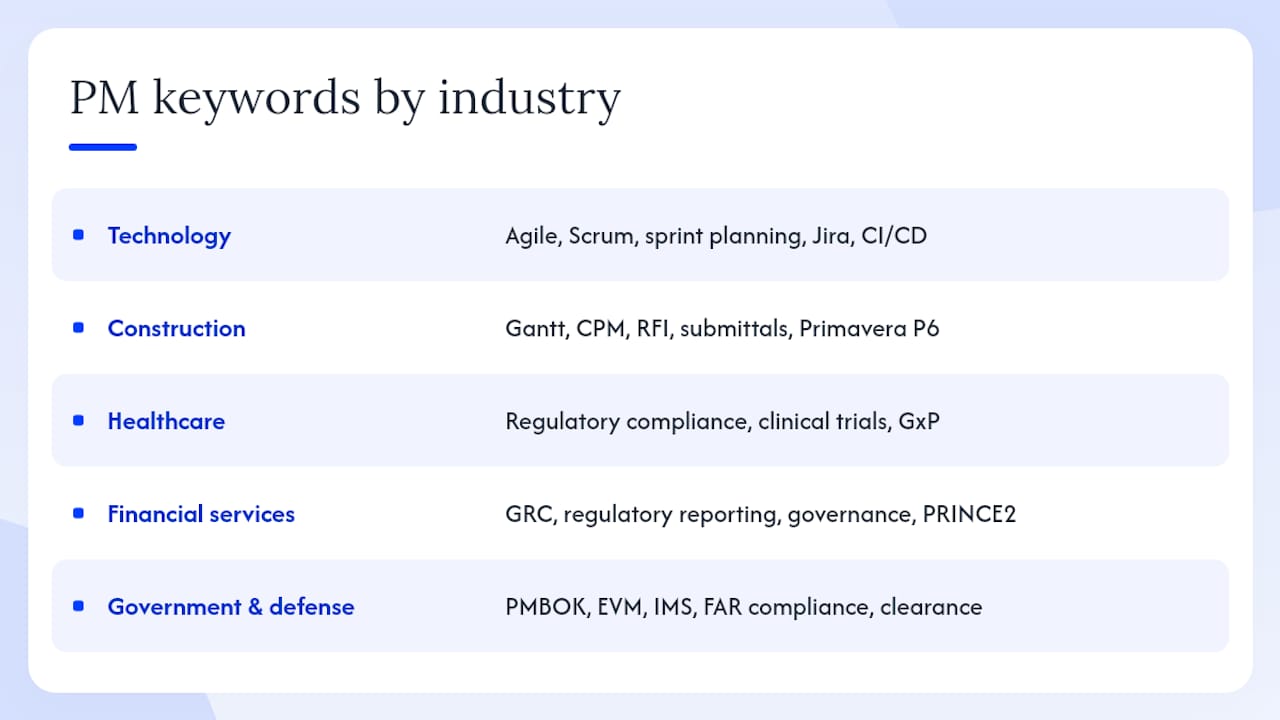
Technology and software: Lead with Agile, Scrum, sprint planning, backlog management, and Jira. Add product roadmap, release management, and CI/CD awareness if the role touches engineering. Velocity and burn-down rate are recognized signals for Scrum-heavy teams.
Construction and infrastructure: Shift to Gantt chart, critical path method (CPM), RFI management, submittal tracking, and subcontractor coordination. Budget terms here often reference cost codes and earned value. Procore and Primavera P6 are the tool tokens that matter.
Healthcare and life sciences: Regulatory compliance, clinical trial management, FDA submission timelines, and cross-functional coordination with clinical and regulatory teams carry weight. GxP and SOPs are recognized tokens in this space.
Financial services: Emphasis falls on governance, risk and compliance (GRC), regulatory reporting, change management, and audit readiness. PRINCE2 and PMBOK are more commonly cited here than SAFe.
Government and defense: PMBOK, Earned Value Management (EVM), Integrated Master Schedule (IMS), and FAR compliance are high-value tokens. Clearance levels (Secret, TS/SCI) belong in the header if applicable.
The underlying principle is the same across all of them: read the JD for the industry’s own vocabulary, then replace generic PM terms with the sector-specific equivalents wherever you have real experience to back them up. Skills-based matching works the same way — the closer your keyword vocabulary mirrors the role’s language, the stronger the match signal.
What hiring teams actually look for in those first six seconds
The six-second skim is real, and it’s not random. Hiring managers scan the top third of a resume for three signals: a recognizable methodology (Agile or Waterfall, not “various”), a scope indicator (budget size or team count), and a certification abbreviation. If those three things aren’t visible before the fold, the resume often gets set aside.
What stands out isn’t a long skills list. It’s a specific artifact paired with a number. “Managed a $3M budget” reads faster and lands harder than “strong budget management skills.” The artifact proves the keyword is real. The number tells the hiring team which seniority tier you belong in.
The other thing worth saying plainly: mass-sending the same resume to 50 roles doesn’t work as well as sending a tailored resume to 10. Every application where you’ve matched the methodology vocabulary, updated the tool names, and swapped in the JD’s exact scope language is an application that actually competes. The extra 15 minutes per submission is where the results come from.
Resume-match speeds up keyword extraction and verification
Getting the keyword list right is the hardest part of tailoring a resume, especially when you’re applying to multiple roles at once. Resume-match analyzes your resume against live job listings, extracts the keywords that matter most for your target role, and delivers a Career Probability Report that shows where your resume is strong and where it has gaps — including salary benchmarks and personalized career strategy.
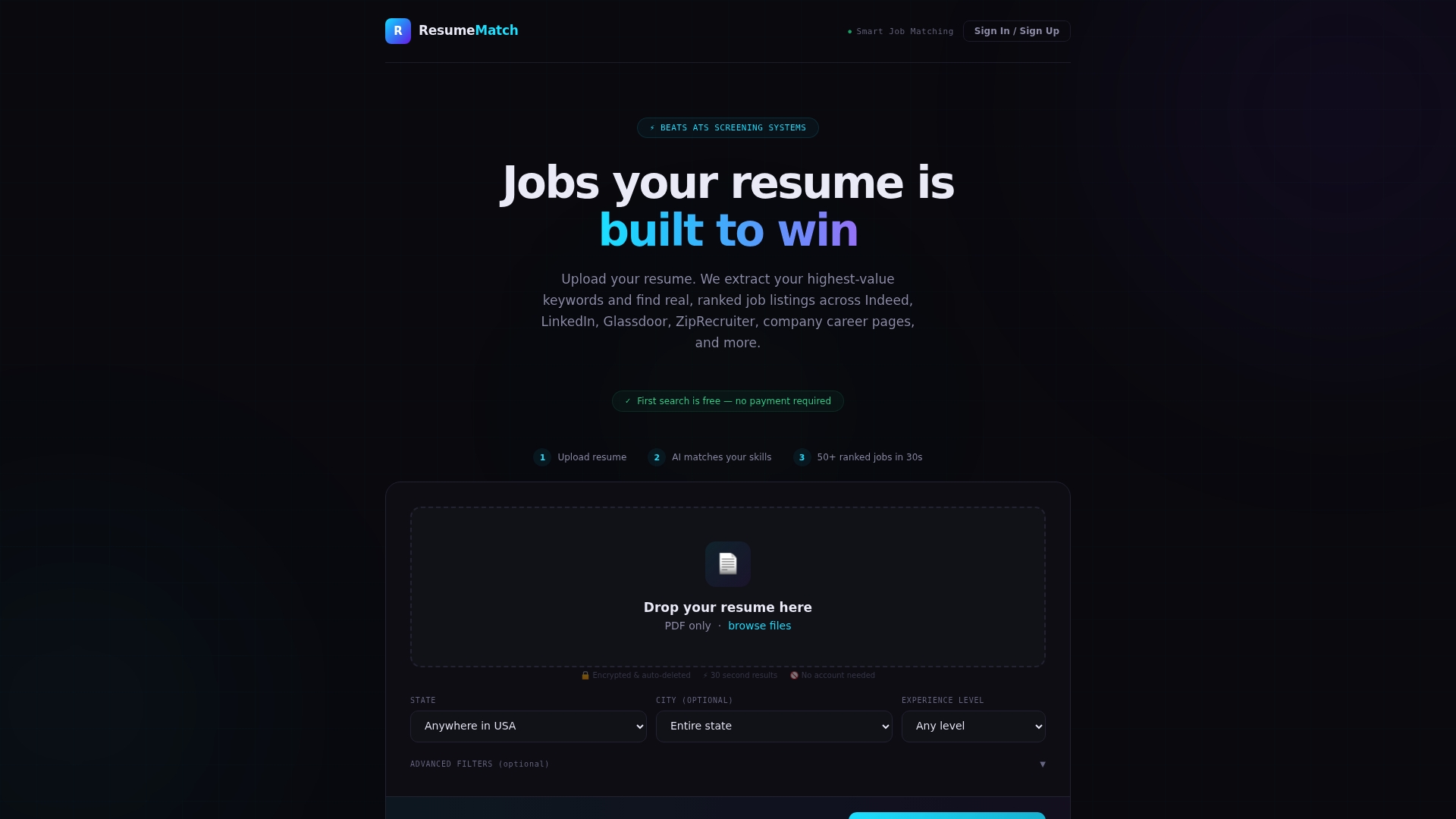
The free trial takes 30 seconds to run. Upload your resume, paste the job description, and get a ranked keyword shortlist you can act on immediately. For job seekers who want to go further, Resume-match’s agent service applies to roles on your behalf using your tailored resume. One note: the tool aids tailoring and surfaces gaps, but human proofreading of the final file is still your responsibility before you submit.
Start your free trial at Resume-match and see which keywords your resume is missing for the roles you actually want.