
Phone Screen Questions: What Recruiters Ask and How to Answer
Phone Screen Questions: What Recruiters Ask and How to Answer

A phone screen is a short first conversation, usually with a recruiter or HR contact, to check that your background, interest, and logistics fit the role before anyone schedules a longer interview. Expect questions about your resume, why you want the job, your skills for the main duties, pay, location, and when you could start. You can prepare for nearly all of them in an evening.
This guide walks through the questions that come up most, how to shape an answer to each, what to ask back, and how to adjust if you are a recent graduate or changing careers.
TL;DR
- Recruiters usually cover the same ground: a resume overview, why this role, fit with the duties, and logistics such as location, schedule, pay, and start date.
- Keep your opening answer to “Tell me about yourself” to two to three minutes, and build it around skills relevant to the job.
- Have your resume and notes in front of you, but talk instead of reading.
- Plan your own questions. Leave real time for them, and ask about the next steps and timeline.
- Graduates and career changers can use the SARA method (Situation, Action, Result, Application) to turn any experience into evidence.
Table of Contents
- What a phone screen is really checking
- The most common phone screen questions and how to answer them
- Sample answers by situation
- Questions to ask the recruiter
- How to prepare in one evening
- Tips for the call itself
- What happens after the call
- Get matched to jobs worth a phone screen
- FAQ
- Sources
What a phone screen is really checking
The phone screen is a filter, but a friendly one. The person on the other end has a list of things to confirm so they can tell the hiring manager whether you are worth more of their time.
Northwestern University’s HR office, which publishes a phone screening question framework for its hiring managers, shows the typical shape. It covers a resume overview, your interest in the opportunity, fit with the duties, work authorization and sponsorship, location or travel, schedule, salary expectations, start date, and your own questions. It also advises screeners to pick one or two required competencies and ask specific questions about them.
That tells you what to prepare. There are three buckets:
- Your story: who you are professionally and how your resume connects to this job.
- Your fit: why this role, why this company, and proof you can do the core work.
- Your logistics: where you can work, when you can start, whether you need sponsorship, and what pay you expect.
Phone interviews are also not always a throwaway step. Harvard’s career center notes that phone interviews are increasingly used beyond a simple pre-screen and encourages candidates to prepare as they would for any interview. Treat the call as a real interview that happens to be short.
The most common phone screen questions and how to answer them
“Tell me about yourself”
This is the most common opener, and it trips people up because it feels open-ended. It is not. The recruiter wants a short, relevant summary, not your life story.

UCSF’s career office, in its guide to phone interviewing well, advises outlining your relevant skills and interest in the position and keeping the answer to roughly two to three minutes. A simple structure is present, past, future, which ClickUp’s phone interview guide describes as a core strength, career wins, and your vision for what comes next.
Here is how that sounds for a marketing coordinator role:
“I’m a marketing coordinator who runs email and social campaigns for a small retail brand. Over the past three years I grew our newsletter list and built the reporting we now use every Monday. Before that I studied communications and ran events for a campus nonprofit. I’m looking for a role with a bigger team and more channels to work across, which is why this one caught my eye.”
That answer runs about 30 seconds and leaves room for follow-up. You do not need to fill the full three minutes. Treat that number as a ceiling.
“Why are you interested in this role?”
This is a test of whether you read the job description and thought about it. Generic answers (“it looks like a great opportunity”) blend together. Specific ones stand out.
Columbia Career Education suggests a brief story about what shaped your interest and motivation, using relevant experience. Try this formula: one thing about the work itself, one thing about the company, one piece of your background that connects them.
For example: “I’ve spent two years handling customer onboarding, and the part I enjoy most is helping new users get to their first win. Your job posting puts onboarding at the center of the role, and I noticed your team recently expanded its self-serve help center. That’s the kind of work I want to do more of.”
“What do you know about our company?”
Spend 20 minutes before the call on the company’s website, a recent news item, and the job posting. ClickUp’s guide claims that half of candidates miss opportunities because they do not take the initiative to learn about the company or position. Whatever the exact figure, the point holds: a little research separates you from people who did none.
Share two or three facts and tie one to your interest. Skip reciting the “About us” page.
“Walk me through your resume”
The resume overview shows up in Northwestern’s list of phone-screen topics. Keep it chronological and focused on the last one or two roles. For each, name what you did, one result, and why you moved on. Do not narrate every bullet.
If your resume and the job posting use different words for the same skills, fix that before the call. Recruiters often skim for the language in the posting, and so do applicant tracking systems. Our guide on getting personalized job matches that actually fit shows how to line up your skills with real listings.
“Why are you leaving your current job?”
Keep it forward-looking and professional. Howard Community College’s career services recommends focusing on accomplishments, contribution, and how your skills and goals relate to the job, and avoiding negative remarks about your current employer.
A good answer sounds like: “I’ve learned a lot in my current role and I’m proud of what I built. I’m ready for more scope, and this position adds [specific thing].” If you were laid off, say so plainly and move to what you are looking for next.
Questions about your skills
Because screeners are advised to home in on one or two required competencies, expect a question like “Tell me about your experience with budgeting” or “How much have you used SQL?” Look at the top three requirements in the posting and prepare a one-minute example for each.
A short structure works well: what the situation was, what you did, what happened. For a longer, story-style question, see our list of behavioral interview questions.
Logistics: location, schedule, sponsorship, start date
These are quick, factual questions. Northwestern’s framework lists location or travel, schedule, work authorization and sponsorship, and start date. Know your answers before you dial in:
- Location and travel: Are you in the area, willing to relocate, comfortable with the travel the posting mentions?
- Schedule: Can you work the hours, shifts, or on-site days required?
- Work authorization: Do you need sponsorship now or in the future? Answer directly.
- Start date: How much notice do you need to give? Two weeks is common, but say what is true for you.
“What are your salary expectations?”
This one makes people nervous, but you can handle it calmly. Howard Community College recommends researching market salaries, deferring a definite answer until you know more about the position, and, if asked about your current salary, asking for the employer’s range instead. It also suggests considering other benefits.
In practice:
- Research the range for the title and city before the call.
- If the range is not posted, you can say, “I’d like to learn more about the full scope first. Could you share the range budgeted for this role?”
- If you give a number, give a range grounded in your research, and mention that you are weighing the whole package.
The Career Probability Report in ResumeMatch includes salary insights alongside your matches, so you can walk in with a number that reflects your skills.
Sample answers by situation
The same questions land differently depending on where you are in your career. Here is how to adjust.
If you are a recent graduate
You may feel you have nothing to say. You do. Columbia points out that graduates can draw on classes, internships or jobs, school activities, leadership, or volunteering. It recommends the SARA method:
- Situation: the context.
- Action: what you did.
- Result: what happened.
- Application: how the skill carries over to this job.
Example: “In my senior project, our team of four had to deliver a market analysis in six weeks (situation). I built the survey and cleaned the data (action), and our report was chosen for the department showcase (result). That’s the kind of analysis I’d bring to your research associate role (application).”
If you are changing careers
Your job titles may not match the new field, but your skills often do. A bartender who schedules staff and handles complaints has real experience for a coordinator or account role. Say that out loud, using the language of the new field.
Lead your “Tell me about yourself” answer with the transferable skills, then explain the shift in one sentence: what pulled you toward this field. Apply SARA to examples that show the skill, not the old title. Our guide on a career change resume with a short professional summary helps make sure your resume tells the same story as your call.
If you are mid-career and changing industries
Expect “Why this move now?” Have an honest, positive answer ready, and show you have done homework: talked to people in the field, taken a course, or done a project. Recruiters want to see commitment, not just curiosity.
Questions to ask the recruiter
At the end, you will almost always hear, “Do you have any questions for me?” Say yes. Coursera’s guide to questions to ask a recruiter during a phone screen suggests leaving at least five minutes for your questions, which is worth planning around.
The topics it recommends asking about are:
- What qualities and outcomes define success in the role.
- What the day-to-day work and the team are like.
- Why the position is open.
- What training or growth is available.
- What the next interview steps and timeline are.
It also says it is acceptable to ask for the salary range if compensation has not come up.
Pick three that fit. A sharp set might be:
- “What would a strong first 90 days look like?”
- “Why is this role open?”
- “What are the next steps, and when should I expect to hear back?”
Avoid questions you could answer with a quick search, and avoid opening with vacation days or perks. Those can wait until you have an offer in sight.
How to prepare in one evening
You do not need days. Here is a plan that fits in one evening.
- Read the posting twice. Highlight the top three requirements and any repeated words.
- Write short answers. Use bullet points, not scripts. One for your intro, one for why this role, one for why you are leaving, and one example per key requirement.
- Research the company. Two or three facts, plus one recent development.
- Look up pay. Know a range for the title and location.
- Prepare your questions. Three is plenty.
- Set up your space. Charge your phone, find a quiet room with good reception, and keep water nearby.
Columbia Career Education advises that you keep your resume and notes nearby for reference, but do not read from them. Prepare beforehand so you can speak conversationally. Bullets on a page help. A written script makes you sound flat.
Tips for the call itself
- Smile and sit up. It sounds silly, but it changes your voice.
- Pause before and after answers. UCSF’s guidance says you can allow 5 to 10 seconds of silence after answering, since the interviewer may be taking notes or absorbing what you said. You do not need to fill every gap.
- Keep answers focused. Aim for one to two minutes on most questions, and use the opening answer’s two-to-three-minute limit as a ceiling.
- Take notes. Write down names, details, and next steps.
- Close clearly. Thank them, restate your interest, and confirm the timeline.
Afterward, send a short thank-you email within a day. Our piece on the best time to email a recruiter covers timing and wording. Then log the call and next steps so nothing slips; our guide to tracking job applications gets you set up in about ten minutes.
What happens after the call
The usual outcomes are a second interview with the hiring manager, a skills assessment or panel, or a polite decline. Recruiters often cannot decide on the spot, which is why asking about the timeline matters. If the date passes with no word, a brief follow-up is fine.
Do not read too much into a short call. Phone screens can be quick because the recruiter has a full schedule, not because you did poorly. And if you do not move forward, treat it as practice. Even experienced job seekers submit many applications for each offer, as we explain in our look at the job application success rate.
Our take: confidence comes from fit
We built ResumeMatch because we saw how many capable people get stuck, not because they lack skills, but because their resumes and their target jobs do not speak the same language. A phone screen is where that gap shows up fastest.
Here is what we believe: the best phone screen preparation starts before the call, with applying to roles that truly match your skills. When you are matched with live listings based on your real experience, not just keywords, your answers come easily, because the job is one you can actually talk about.
That is why our Career Probability Report looks at competitive job matches, resume gaps, salary insights, and a career strategy together. You walk into the call knowing where you are strong, what to emphasize, and what a fair offer looks like. We also include interview prep, recruiter outreach templates, and application tracking, so the whole process lives in one place instead of ten browser tabs.
If you are feeling overwhelmed, that is normal. You do not have to do it all at once. Start with one good match and one good story.
Resume
Get matched to jobs worth a phone screen
If you would rather spend your energy on interviews than on scrolling job boards, ResumeMatch can help. Upload your resume and our AI pulls out your key skills, then matches you with tailored listings across multiple job boards in about 30 seconds. Every membership starts with a 72-hour free trial, and it is $15 per month after that.
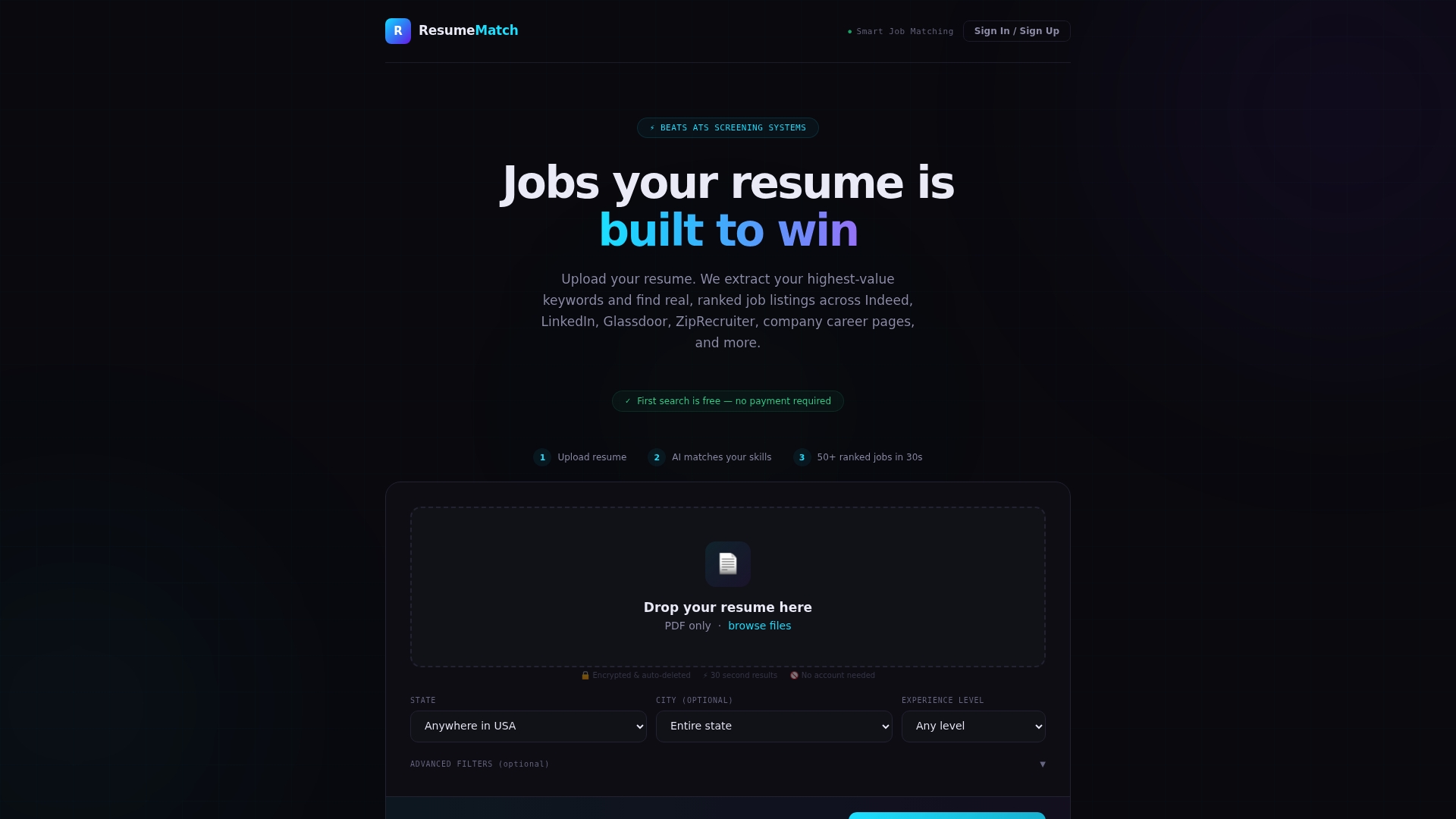
Want a hand with the applications themselves? Our Let Us Apply For You service is a one-off $50, where agents apply to jobs on your behalf. You can start with ResumeMatch and see your matches today.
FAQ
How long does a phone screen usually last?
Most phone screens are short, often around 15 to 30 minutes, though the length varies by company. Plan your answers to be concise so there is time for the recruiter’s list and your own questions. Coursera recommends leaving at least five minutes for yours.
What should I have in front of me during a phone interview?
Keep your resume, the job posting, and brief notes within reach. Columbia Career Education recommends using them for reference without reading from them. Bullet points work better than full scripts, because they let you sound natural.
Is it okay to ask about salary on a phone screen?
Yes. If the recruiter has not brought up compensation, Coursera says it is acceptable to ask for the role’s salary range. If they ask for your expectations first, research market pay beforehand and consider giving a range, as Howard Community College advises.
What if I get a question I cannot answer?
Pause, then say you would like a moment to think. UCSF notes that short silences are fine. If you truly lack the experience, be honest and describe the closest related example, or how you would learn quickly. Recruiters value candor more than a bluff.
How do I answer “Tell me about yourself” as a career changer?
Start with the skills that carry over, give one or two proof points from past work using the SARA method, and explain in one sentence why you are moving into this field. Keep the whole answer under about two to three minutes.
Sources
- Phone Screening Questions, Northwestern University Human Resources
- Professional Communication Skills: Phone Interviewing Well, UCSF Career Office
- Interview with Confidence, Columbia Career Education
- How to Prepare for Virtual and Phone Interviews, Columbia Career Education
- Interviewing, Harvard FAS Mignone Center for Career Success
- How To Answer Questions In An Interview, Howard Community College
- 9 Useful Questions to Ask a Recruiter During a Phone Screen, Coursera
- 20 Common Phone Interview Questions and How to Answer Them, ClickUp