
Build Six to Eight STAR Stories to Ace Behavioral Interview Questions
Build Six to Eight STAR Stories to Ace Behavioral Interview Questions

Behavioral interview questions ask you to prove your skills with a real story, not a hypothetical. The single best way to answer them is the STAR method: Situation, Task, Action, Result, capped at 60 to 90 seconds, with a measurable outcome at the end. Walk in with six to eight stories mapped to the job description, and you will have an answer ready no matter how the question is phrased.
TL;DR:
- Spreading your stories across multiple questions by emphasizing different aspects can make one example answer cover several categories effectively.
- Rehearsing your stories out loud and timing them ensures concise, impactful responses within the recommended 60 to 90 seconds.
- Building a small inventory of six to eight tailored stories, linked to the job description, increases readiness for various behavioral prompts.
- Using AI resume analysis tools can help turn your resume achievements into concrete, measurable results suitable for STAR interview responses.
- Focusing on clear ownership of actions and specific results from your experiences resonates most with recruiters and demonstrates genuine competency.
Table of Contents
- What Are Behavioral Interview Questions and Why Do Interviewers Ask Them?
- The STAR Method: Structure, Timing, and the Rules That Keep You Sharp
- Common Categories of Behavioral Interview Questions and Sample Prompts
- Sample STAR Answers You Can Adapt to Your Own Experience
- How to Prepare: Build Your Story Inventory and Practice on the Clock
- Reusing Stories Across Roles and Handling Follow-Up Questions
- Turning Resume Metrics Into STAR Results
- What Recruiters Actually Listen For
- Try ResumeMatch to Turn Your Resume Into Interview-Ready Stories
- A Few More Places to Practice
- Sources
What Are Behavioral Interview Questions and Why Do Interviewers Ask Them?
Behavioral interview questions ask you to describe something you actually did, not something you would theoretically do. You will recognize them instantly: “Tell me about a time when…”, “Give me an example of…”, “Describe a situation where…” These prompts force you off the script of rehearsed opinions and into the territory of evidence.
Interviewers rely on them because past behavior predicts future behavior better than a confident answer to “How would you handle a difficult coworker?” A hypothetical question invites you to describe your best self. A behavioral question makes you produce a receipt. That distinction is why hiring teams have leaned so heavily on this format for decades, and why it shows up at nearly every company you will interview with this year.
It helps to know the difference between the two formats, because candidates often blur them:
- Behavioral questions ask about the past: “Tell me about a time you missed a deadline.”
- Situational questions ask about a hypothetical: “What would you do if you missed a deadline?”
- Behavioral answers require a real story with real details. Situational answers allow more improvisation, though a strong candidate still grounds the answer in past experience.
The competencies behind these questions repeat across almost every industry. WGU Career Services notes that behavioral questions typically assess around ten core themes, with coworker conflict, handling ambiguity, and learning from failure among the most common. You will also see teamwork, problem-solving, adaptability, leadership, and communication tested again and again, sometimes in the same interview under different wording. Once you recognize the theme behind the question, you stop reacting and start retrieving.
The STAR Method: Structure, Timing, and the Rules That Keep You Sharp
STAR stands for Situation, Task, Action, Result. Some career coaches use START, which adds a fifth step, Takeaway, to close the story with an explicit lesson learned. Either version works. What matters is that you follow a structure instead of rambling, because an unstructured answer is the fastest way to lose an interviewer’s attention.
Here is how each part functions:
- Situation. Set the scene in one or two sentences. Name the company, team, or project, but do not over-explain.
- Task. State what you were responsible for or what problem needed solving. This should take one sentence.
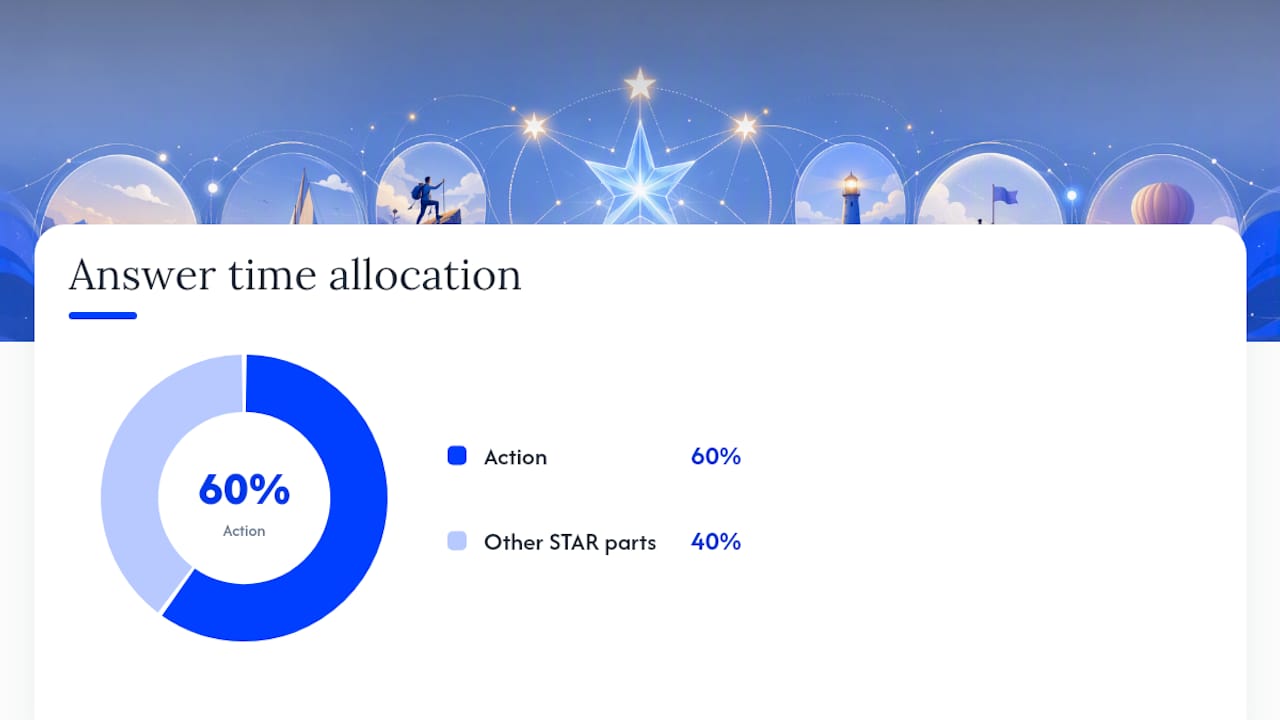
- Action. Describe exactly what you did, step by step. Use “I,” not “we,” even if you worked on a team. This is the part interviewers are actually listening for, and it should take up roughly 60% of your answer, according to UW Career Services.
- Result. Close with what happened, ideally with a measurable outcome. For example, a significant increase in sign-ups or a noticeable drop in scheduling conflicts tells the interviewer something a vague “it went well” cannot.
- Takeaway (optional but effective). For failure or learning questions especially, a short line about what you took from the experience shows growth instead of just closure.
Pro Tip: Time yourself out loud at least once. Most candidates think their answers run 45 seconds and discover, once they hit record, that they are closer to three minutes. Aim for 60 to 90 seconds and trim ruthlessly.
A few pitfalls show up constantly, and they are easy to fix once you know to watch for them:
- Talking in “we” the entire time. Interviewers cannot evaluate a team. They need to know what you specifically contributed.
- Spending too long on the Situation. If your setup runs 45 seconds, you have already lost half your time before reaching the part that matters.
- Skipping the Result. An answer that ends with “and then we finished the project” tells the interviewer nothing about impact.
- Choosing a story with no real conflict or challenge. If nothing was hard about it, it will not demonstrate a competency.
- Reciting instead of speaking. A story you have memorized word for word tends to sound stiff. Know the beats, not the script.
Career resources consistently point back to this same structure because it gives hiring teams something they can actually score against a rubric, rather than a subjective impression of whether you sounded likable.
Common Categories of Behavioral Interview Questions and Sample Prompts
Most behavioral questions fall into a manageable number of categories. Once you know the categories, you can prepare one strong story per bucket instead of trying to guess the exact wording an interviewer will use.
Teamwork and conflict questions test whether you can navigate friction without becoming defensive.
- “Tell me about a time you disagreed with a coworker.”
- “Describe a situation where you had to work with someone difficult.”
- “Give an example of resolving a conflict on your team.” Competency assessed: collaboration under friction.
Leadership questions matter even if you have never had “manager” in your title.
- “Tell me about a time you led a project without formal authority.”
- “Describe how you motivated a team through a tough deadline.”
- “Give an example of delegating work effectively.” Competency assessed: influence and accountability.
Problem-solving questions look for how you think, not just what you concluded.
- “Tell me about a complex problem you solved.”
- “Describe a time you found a creative solution with limited resources.”
- “Walk me through how you diagnosed an unexpected issue.” Competency assessed: analytical reasoning.
Decision-making questions probe judgment under uncertainty.
- “Tell me about a difficult decision you made with incomplete information.”
- “Describe a time you had to choose between two good options.” Competency assessed: judgment.
Time management questions reveal how you prioritize under pressure.
- “Tell me about a time you juggled multiple deadlines.”
- “Describe how you handled an unexpected priority shift.” Competency assessed: prioritization.
Initiative and ownership questions separate order-takers from self-starters.
- “Tell me about a time you identified a problem no one asked you to fix.”
- “Describe a project you started on your own initiative.” Competency assessed: proactivity.
Failure and learning questions are less about the mistake and more about what came after it.
- “Tell me about a time you failed at something.”
- “Describe a mistake you made and what you learned.” Competency assessed: self-awareness and growth.
Communication questions test clarity, not charisma.
- “Tell me about a time you had to explain something complex to a non-expert.”
- “Describe a time your communication style had to adapt to your audience.” Competency assessed: clarity across contexts.
Remote work and ambiguity questions have grown more common since hybrid schedules became standard.
- “Tell me about a time you worked through unclear instructions.”
- “Describe how you stayed accountable while working remotely.” Competency assessed: independence and self-direction.
You do not need a separate story for every single prompt in every category. Most candidates can cover this entire list with six to eight well-chosen stories, because a single strong example often satisfies two or three categories depending on which part of it you emphasize.
Sample STAR Answers You Can Adapt to Your Own Experience
Reading a strong STAR interview example is often the fastest way to understand pacing, because it shows you exactly where each part starts and ends. Below are compact samples across different role types. Notice how each Result carries either a number or a specific, concrete outcome.
-
Teamwork (retail/customer service): Situation: “During a holiday rush, my coworker and I disagreed on how to handle a returns backlog.” Task: “I needed to keep the line moving without ignoring the backlog.” Action: “I split the task, took the returns myself, and asked her to stay on checkout, then flagged the imbalance to our manager for the next shift.” Result: “We cleared the backlog within the hour and cut average wait time by roughly 40%.” Takeaway: “I learned to split responsibilities before frustration builds, not after.”
-
Leadership (project coordination): Situation: “Our team lead left mid-project with three weeks left before launch.” Task: “Someone needed to keep the remaining milestones on track.” Action: “I volunteered to run daily check-ins, reassigned two tasks based on bandwidth, and flagged risks to leadership early.” Result: “We launched on the original date with no missed deliverables.”
-
Problem-solving (software/IT): Situation: “A recurring bug was causing checkout failures for about 5% of users.” Task: “I was asked to find the root cause within a week.” Action: “I isolated the issue to a caching conflict, wrote a patch, and set up monitoring to catch similar issues earlier.” Result: “Checkout failures dropped to under 0.5%.” Readers in technical roles can find more IT-specific STAR examples with metrics for further practice.
-
Decision-making (sales): Situation: “I had two leads competing for limited inventory before quarter close.” Task: “I had to decide which deal to prioritize with incomplete forecast data.” Action: “I called both clients, was transparent about the constraint, and prioritized the one with a signed intent letter.” Result: “I closed both deals across two weeks instead of losing one.”
-
Time management (administrative): Situation: “I was covering for two colleagues during a staffing gap.” Task: “I had to manage double my normal workload without missing deadlines.” Action: “I built a triage system ranking tasks by deadline and dependency, and communicated realistic timelines upfront.” Result: “Every deadline was met, and my manager adopted my triage system for the whole team.”
-
Initiative (marketing): Situation: “I noticed our email open rates had quietly dropped over two months.” Task: “No one had assigned me to investigate, but I flagged it.” Action: “I ran an audit, found a subject line pattern that was underperforming, and proposed A/B testing.” Result: “Open rates rose by 18% within a month.”
-
Failure and learning (finance): Situation: “I once submitted a report with a formula error that overstated projected revenue.” Task: “I had to correct it before it reached leadership.” Action: “I caught it during a routine check, corrected the figure, and built a peer-review step into the process.” Result: “The corrected report went out on time, and the review step caught two more errors that quarter.” Takeaway: “I stopped trusting my own first pass and built in a second set of eyes.”
-
Communication (healthcare/admin): Situation: “A patient’s family did not understand a scheduling change.” Task: “I needed to explain it clearly without adding to their stress.” Action: “I walked through the change in plain language, avoided jargon, and confirmed they understood before ending the call.” Result: “The family rescheduled without escalation, and my supervisor asked me to train two new hires on patient communication.”
Pro Tip: If your resume already lists a metric, that number belongs directly in your Result line. If it does not, describe the outcome in specific, time-bound terms instead of vague praise, like “cut onboarding time by three days” rather than “made onboarding better.”
How to Prepare: Build Your Story Inventory and Practice on the Clock
Preparation for behavioral interview questions is not about memorizing answers to every possible prompt. It is about building a small set of flexible stories and rehearsing them until timing feels natural.
- Audit your resume for measurable accomplishments. Go bullet by bullet and pull out anything with a number, a before/after comparison, or a concrete outcome. If a bullet says you “improved onboarding,” dig for how much faster, how many fewer errors, or how many more people completed it on time.
- Build a six to eight story inventory. Each story should be tagged with the competency it demonstrates (leadership, conflict, initiative) and the metric or outcome attached to it. Write these on index cards or in a simple spreadsheet so you can scan them the morning of an interview.
- Map your stories to the actual job description. Highlight the skills and priorities the posting repeats most, then match your strongest stories to those specific words. A posting that says “cross-functional collaboration” three times is telling you exactly which story to lead with.
- Practice with a method that mimics real pressure. Record yourself answering out loud, do a mock interview with a friend, or use a free behavioral question generator to get random prompts thrown at you the way a real interviewer would. Time every answer.
If you do not have a perfect example for a specific prompt, do not panic and do not invent one. Pull the closest related experience, even from a volunteer role, school project, or part-time job, and say so honestly: “I haven’t faced this exact situation, but here’s a comparable one where I handled a similar challenge.” Interviewers respect a transparent bridge far more than a story that sounds rehearsed to the point of unbelievable.
Pro Tip: Keep your story inventory in the same document where you track applications, so you know which stories you already used with which interviewer. Reusing a story is fine. Repeating the exact same one to the same panel is not. A simple application tracking system makes this easy to maintain without extra spreadsheets.
Reusing Stories Across Roles and Handling Follow-Up Questions
A single well-told story can answer three or four different behavioral prompts, and reusing it is not a shortcut, it is smart preparation. The trick is shifting emphasis rather than repeating the exact same version every time.
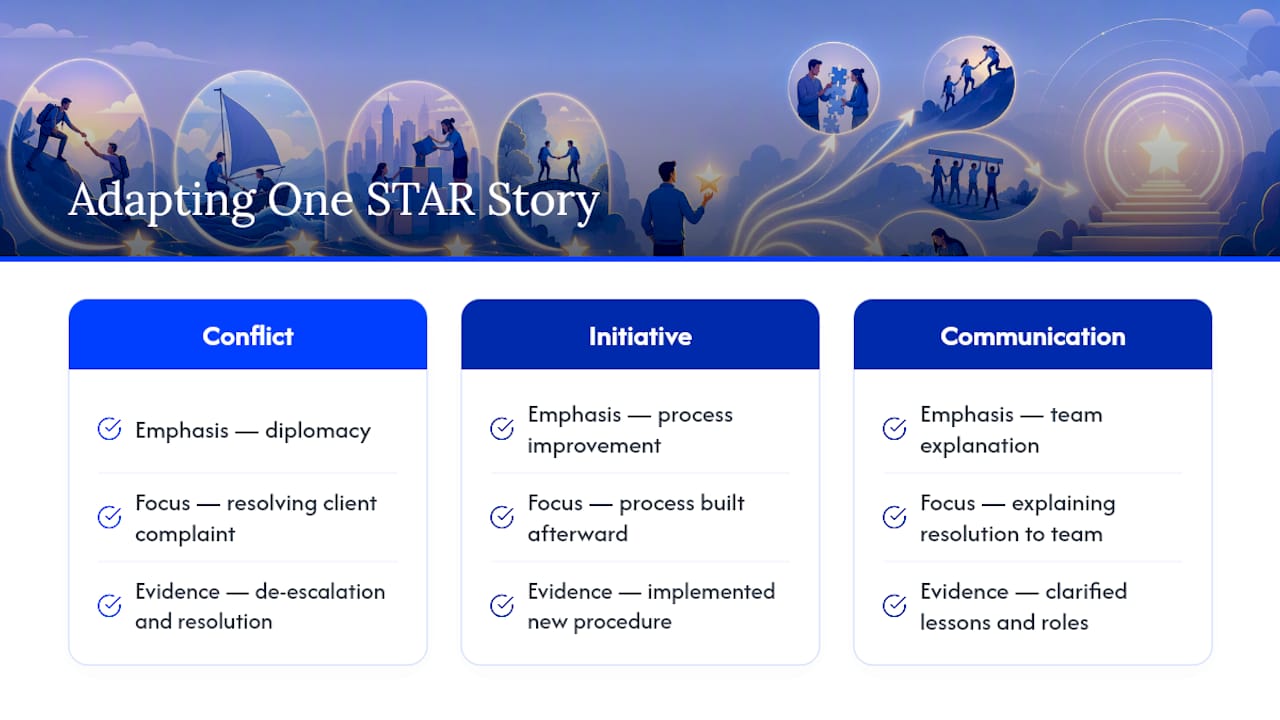
Take a story about resolving a client complaint. Emphasize the diplomacy and you have answered a conflict question. Emphasize the process you built afterward and you have answered an initiative question. Emphasize how you explained the resolution to your team and you have answered a communication question. University career-service guidance backs this approach directly: adapting emphasis is preferable to manufacturing new stories for every possible question.
Reuse becomes a problem only when you are interviewing with the same panel across multiple rounds and repeat the identical story word for word. In that case, diversify. Save your strongest example for the most important round and bring a slightly less polished but still solid second story for earlier conversations.
Follow-up questions are where interviewers separate real experience from a rehearsed script. When someone asks “What would you have done differently?” or “How did your team react?”, resist the urge to shrink your answer. Add a layer: more context on the constraint you faced, a fuller picture of the action you took, or an honest note on what you would adjust next time. A candidate who can go deeper on the same story without contradicting themselves is far more convincing than one who can only recite the surface version once.
Turning Resume Metrics Into STAR Results
Most candidates struggle with the Result step of STAR because their resume bullets were never written with interviews in mind. This is exactly the gap a tool built around resume analysis can close.
AI resume analysis pulls out the keywords and accomplishments already sitting in your resume, then a career report translates them into a fuller picture, including salary insights and gap analysis, that you can mine directly for interview material. If your resume bullet already reads “reduced processing time,” the report can help you sharpen that into the specific, time-bound Result line an interviewer wants to hear.
A few ways to put this to work:
- Treat any metric your resume analysis surfaces as your Result line, word for word if it is specific enough.
- Pull your three strongest accomplishments per past role and turn each into a separate STAR story.
- If a bullet has no number, convert the outcome into specific language anyway. “Cut onboarding time by several days by introducing a new checklist” works even without a percentage.
- Cross-reference your career strategy resources to see how your accomplishments align with the roles you are targeting.
What Recruiters Actually Listen For
Clarity beats polish every time. Recruiters are not scoring you on charisma. They are listening for ownership, a clear sequence of actions, and a result they can actually picture. A candidate who says “I noticed the problem, made a specific change, and here’s what happened” will consistently outperform someone who tells a longer, vaguer story with more impressive-sounding words.
Ownership matters more than most candidates realize. Saying “I” instead of “we” is not about taking credit away from a team, it is about giving the interviewer something to evaluate. They cannot hire “we.”
The one habit worth building starting tonight: spend ten minutes a day running through one story out loud, timing it, and cutting anything that does not serve the Result. Do this for a week before your interview and your delivery will sound sharper without sounding memorized.
— Resume
Try ResumeMatch to Turn Your Resume Into Interview-Ready Stories
If you have been staring at your resume trying to figure out which bullets actually deserve a spot in your STAR story inventory, some AI-powered tools can take that guesswork off your plate. They analyze your resume rapidly, extract the keywords and accomplishments that matter, and match you to relevant listings across multiple job boards, while providing career reports that lay out salary insights, resume gaps, and personalized career strategies you can pull metrics from directly.
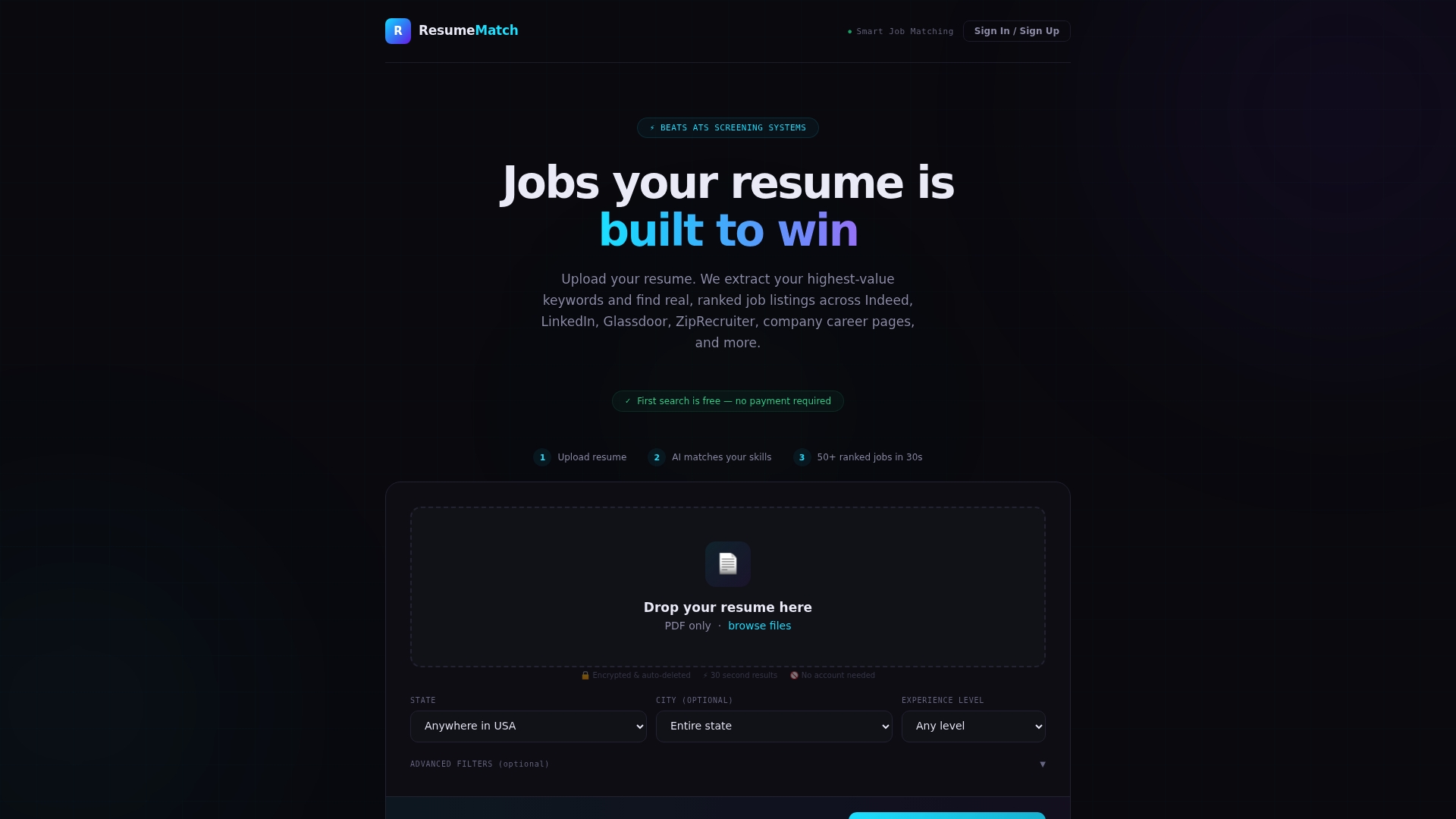
That report becomes a shortcut for the exact prep work covered above: instead of manually digging through old resumes for numbers, you get a structured breakdown of your strongest accomplishments ready to slot into a Result line. Run a free resume analysis on Resume-match and start building your story inventory from what it surfaces, rather than starting from a blank page the night before your interview.
A Few More Places to Practice
For structured guidance beyond this guide, UW Career Services’ STAR method page breaks down timing and phrasing in more depth. The free question generator from NueCareer is useful for randomized practice drills that mimic real interview pacing. And Big Interview’s STAR resource offers a solid breakdown of the START variant if you want to build explicit takeaways into your failure stories.
Sources
- Behavioral Interviews | WGU Career Services
- The STAR method of interviewing | UW Career Services
- Behavioral interview questions | Indeed