
Job Description Analysis: How to Decode Any Posting
Job Description Analysis: How to Decode Any Posting

Job description analysis means reading a posting the way an employer wrote it: separating the must-haves from the nice-to-haves, pulling out the keywords that matter, checking the pay and red flags, and comparing all of it with your own experience. Done well, it tells you in a few minutes whether to apply, what to put at the top of your resume and what to say in the interview. We built ResumeMatch around this idea, and below is the full routine so you can do it on any posting.
TL;DR
- Read the whole posting once, then sort every line into three piles: required, general and preferred. You can usually apply when you meet most of the required list.
- Prioritize keywords that repeat and that name tools, skills, certifications and core duties. Skip filler like “team player.”
- The order of a posting is a clue. What comes first is usually what the employer cares about most.
- Check pay, vague duties and payment requests before you invest time. Real employers do not charge you to apply or to start.
- Use a T-chart (requirements on the left, your proof on the right) to decide, then tailor honestly. Never stuff keywords.
Table of Contents
- What job description analysis means for a job seeker
- Step 1: Read the whole posting before you highlight anything
- Step 2: Sort the requirements into three piles
- Step 3: Read the order and the verbs
- Step 4: Pull out the keywords that count
- Step 5: Compare the posting with your experience
- Step 6: Look for pay and market-value clues
- Step 7: Check for red flags before you apply
- Using an AI assistant for the first pass
- Doing this across dozens of postings
- Our perspective
- Put the analysis to work
- FAQ
- Sources
What job description analysis means for a job seeker
You will see “job analysis” in the top search results. That is something different. The U.S. Office of Personnel Management describes job analysis as a systematic procedure that identifies the competencies a job needs, documents its content and context, and links tasks to those competencies. Employers and HR teams run it to set pay, write fair hiring tests and plan training.
The job description is the short public result of that work. It summarizes duties, qualifications and sometimes pay so that candidates can decide whether to apply. TestGorilla’s comparison draws the same line: job analysis is the internal, in-depth process, and the description is the concise document for applicants.

So when you analyze a job description, you are working backward. You take the short public document and try to recover what the employer actually needs, what they will screen for and whether you are a realistic match. You do not need HR training for this. You need a method.
Step 1: Read the whole posting before you highlight anything
The U.S. Department of Labor’s Veterans’ Employment and Training Service tells job seekers to read the entire posting, print it and highlight keywords in the qualifications, skills and experience sections. Printing is optional. What matters is that you read to the end first. Many people skim the title and the first bullets, then miss the line near the bottom that says the role is on-site five days a week or requires a license.
On the first pass, answer four plain questions:
- What will I actually do all day?
- What must I already know how to do?
- Who will I work with, and who will I report to?
- What does the company say about pay, schedule and location?
If the posting cannot answer the first question, that is already useful information. Vague duties often mean the employer has not decided what the job is.
Step 2: Sort the requirements into three piles
Not every line in a posting weighs the same. The University of Nebraska’s Business Career Center separates qualifications into three groups:
| Pile | What it means | How to treat it |
|---|---|---|
| Required or minimum | The core requirements to be considered | Aim to meet most of them, not necessarily every one |
| General | Skills the employer values, such as communication or teamwork | Show them with classes, jobs, student organizations or volunteering |
| Preferred | Nice-to-haves | Missing one does not disqualify you |
The Department of Labor guide agrees on the last point: the word “preferred” usually means you can still apply if you lack that skill but have other qualifications.
Here is a quick example. Say a posting for a marketing coordinator lists these lines:
- Required: 1+ year of experience managing social media accounts; strong writing skills
- Preferred: Experience with an email platform; familiarity with analytics dashboards
- General: Works well in a fast-paced team
A recent graduate who ran a student organization’s Instagram for two years has the required pile covered, can speak to the general pile with a story and can mention a class project that used analytics. That is a reasonable application, even without the email platform.
Step 3: Read the order and the verbs
Postings are not random lists. Columbia University’s career education team points out that the order of information signals what matters to the employer. The first three responsibilities are usually the heart of the job. The last bullet, often something like “other duties as assigned,” is usually not.
Columbia also suggests three habits worth borrowing:
- Group words into competency categories. Put “budgeting,” “forecasting” and “vendor management” under one heading, such as financial oversight, so you see the pattern.
- Highlight the adjectives. Words like “collaborative” or “independent” hint at the culture and the working style.
- List the verbs. “Coordinate,” “train,” “negotiate” and “analyze” point to transferable skills you can back with examples from past jobs, classes or projects.
The verbs matter most if you are changing careers. A bartender who manages a shift, trains new hires and settles disputes has already done what the posting calls “supervising a team.” The job title is different. The skill is the same. Our guide to transferable skills examples for a career change resume shows how to turn those verbs into resume lines.
Step 4: Pull out the keywords that count
Keywords are the specific words a recruiter or an applicant tracking system (the software many employers use to store and search applications) looks for. Not all keywords are equal. Barriers to Employment advises prioritizing repeated terms tied to tools, technical skills, industry terminology, certifications and core responsibilities over generic phrases like “team player.”
A simple way to find them:
- Count repeats. A term that shows up in the summary, the duties and the requirements is a priority.
- Mark hard skills first: software, methods, licenses, certifications.
- Note the exact wording. If the posting says “customer success” and your resume says “client support,” a human will connect the dots, but a search filter might not.
- Write each keyword next to a real example from your experience.
That last step is what keeps you honest. The same Barriers to Employment guide warns against copying the description word for word without verifiable experience behind each claim. The AAGLA career center says the same: incorporate relevant keywords naturally and mirror the language of the posting rather than stuffing it in.
Why hidden-text tricks backfire
You may have heard of pasting keywords in white text so only software sees them. A 2026 guide on AI screening says modern parsers extract all text regardless of color, and a human who opens the file may read you as someone who cheats. Put your keywords where they belong: in your summary, your skills list and your bullet points, each tied to something you did.
If you are targeting a specific field, field-specific keyword lists help. Our guide to resume keywords for project managers is one example of how to read a keyword list for a role. For LinkedIn, the profile keywords and recruiter fields guide shows where those terms belong on your profile.
Step 5: Compare the posting with your experience
This is where the analysis turns into a decision. The Department of Labor guide uses a T-chart: draw a line down a page, put the posting’s keywords and requirements on the left and your qualifications on the right. Then ask whether you are qualified, whether the job helps your goals, whether the description interests you and whether you can see yourself doing it eight hours a day.
Here is a filled-in example for a first job:
| Posting says | Your proof |
|---|---|
| Data entry and spreadsheets | Built a budget tracker in a class project; managed club finances |
| Customer communication | Two summers at a retail counter; handled returns and complaints |
| Attention to detail | Proofread the campus newspaper; zero-error inventory counts at work |
| Experience with a CRM | Gap: no direct experience |
The gap in the last row is not the end. The University of Nebraska suggests addressing gaps through coursework, projects, campus involvement or internships. For a first job, evidence from classes, student organizations and volunteering counts as proof of general qualifications.
If you are switching industries, the chart does something else. It shows which of your past duties map to the new role, so your resume can lead with them instead of with an old job title. Our career change resume format guide walks through how to lay that out.
Technology roles are a good test of this method, because their postings often list long stacks of tools. If you are weighing a software role and want a gut check on how your strengths line up, an assessment for software engineering fit can add one more data point alongside your T-chart.
Step 6: Look for pay and market-value clues
A good posting states salary, hours and working conditions. Many do not. The Strommen Center at Augsburg University notes that asking the company directly for salary information may not get a clear answer and could even hurt your chances of being considered. Their advice is to check what similar roles at that company pay on LinkedIn or Glassdoor, then prepare to negotiate based on the role and comparable positions.
When you read a posting for pay clues, look at:
- Seniority language. “Lead,” “own” and “strategy” signal a higher level than “assist” and “support.”
- Scope. The more duties and tools listed, the more the employer expects from one person.
- Location and schedule. On-site, hybrid and remote roles can pay differently for the same title.
Pay ranges change often, so treat any number you find as a snapshot and check it again before you negotiate.
Step 7: Check for red flags before you apply
Some postings are poorly written. A few are scams. Barriers to Employment lists signs to watch for:
- Vague or contradictory responsibilities
- Senior-level expectations paired with entry-level pay
- Missing salary or benefits information
- Excessive availability expectations
- Requests for payment for applications, interviews or mandatory equipment from unknown vendors
- Background checks through suspicious payment channels
- Companies or recruiters you cannot verify
- Pressure to accept immediately
The Department of Labor adds a clear rule of thumb: be wary of postings that ask you to pay for training or to buy kits or training materials as a condition of employment.
To check a posting, look for the company’s official website and compare the recruiter’s name, email domain, address and phone number with what the company shows online. If the details do not line up, skip the posting. Trade and technical postings deserve the same scrutiny. If you are looking at skilled-trades work, reading how HVAC contractors recruit technicians shows what a normal hiring process looks like, which makes odd ones easier to spot.
Not every red flag means a scam. A vague posting may simply be a busy hiring manager’s first draft. Use the flags to decide how much research to do before you apply.
Using an AI assistant for the first pass
AI tools can speed up the reading. Paste in a posting and ask for a list of duties, required skills, preferred skills and repeated keywords, grouped by category. Then paste in your resume and ask where the overlap is.
Treat the output as a draft, not a verdict:
- Check every keyword against the original text. Make sure it is really in the posting and not a guess.
- Remove any skill you cannot back with a real example. The T-chart rule still applies.
- Rewrite anything it suggests in your own words so it sounds like you.
The point is the same as with the paper method: you end up with a short list of what the employer wants and an honest picture of where you stand.
Doing this across dozens of postings
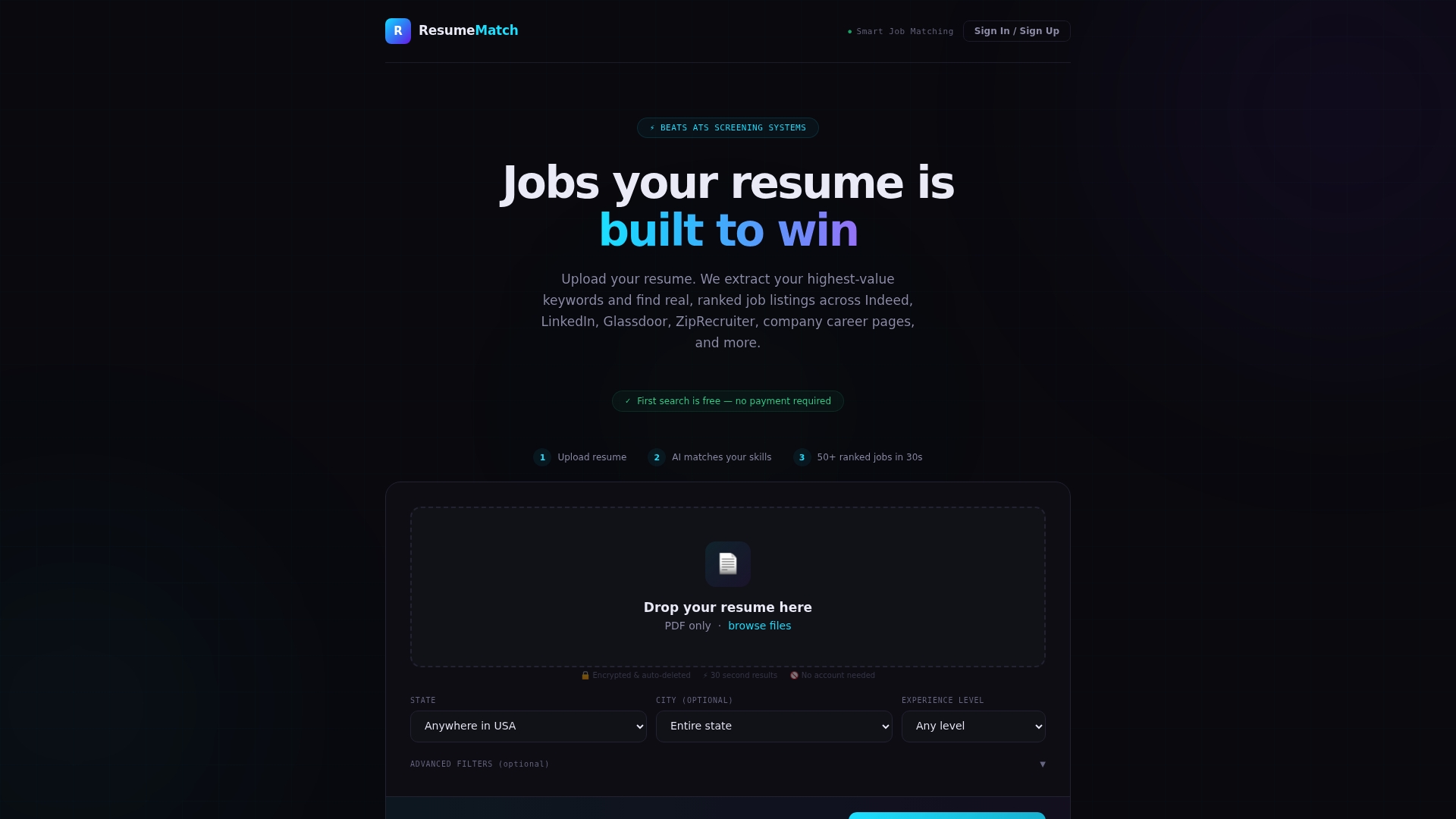
One posting takes ten or fifteen minutes by hand. Twenty postings take a weekend, and that is where many people burn out. We built ResumeMatch for this part. It analyzes your resume, extracts the vital keywords and matches you to tailored listings across multiple job boards in about 30 seconds. Our scoring is designed to compare your real skills with a role, not only count keywords.
The Career Probability Report goes further. It includes competitive job matches, a resume gap analysis, salary insights and a career strategy. That covers Steps 5 and 6 above for every match, so you spend your time on the applications that fit. If you want to see how the skills-first approach works, read our 2026 guide to skills-based job matching.
Our perspective
We built ResumeMatch because we kept seeing capable people get screened out by a job title. Someone who ran a bar, led a team and handled a budget does not see themselves in an account manager posting, so they never apply. The skills match. The labels do not.
That is why we think job description analysis is the most underrated part of a search. When you read a posting for what it needs, not what it calls itself, you find roles you are ready for. That is the idea behind our AI scoring, which looks at real skills and not only keywords.
A strong search also does not stop at a match. It needs a gap analysis, a salary picture, outreach, tracking and interview prep in one place. That is the full workflow we put into the platform, so you can move from reading a posting to applying with confidence.
Resume
Put the analysis to work
If you would like the analysis done for you, ResumeMatch Membership is $15 per month and starts with a 72-hour free trial. It gives you ranked job matches, resume gap analysis, outreach templates, application tracking and interview prep in one place.
If you would rather skip the applying too, Let Us Apply For You is a one-off $50 service in which agents apply to jobs on your behalf. It guarantees a minimum number of personalized applications.
FAQ
What is the difference between job analysis and job description analysis?
Job analysis is the employer’s internal process of studying a role’s tasks, skills and conditions, often to set pay and training. Job description analysis is what you do as an applicant: you read the finished posting to work out its priorities, keywords and fit.
What are the most important parts of a job description to read?
Start with the responsibilities and the required qualifications, because they tell you what the job is and what you must already be able to do. Then look at the order of the bullets, the repeated keywords, and the pay, schedule and location lines.
Should I apply if I do not meet every requirement?
Often yes. The University of Nebraska advises focusing on meeting most of the core requirements, and the Department of Labor says “preferred” skills usually do not rule you out. Use your T-chart to show the proof you do have for the rest.
How many keywords should I use from the posting?
Use the ones that are repeated and tied to real skills, tools and duties, and only where you can back them with experience. Place them naturally in your summary, skills and bullet points. Copying the whole description or hiding text can hurt you.
How do I know if a job posting is a scam?
Watch for requests to pay for applications, training or equipment, vague duties, pressure to accept fast and contact details that do not match the company’s official site. Verify the recruiter and the company domain before you share personal information.
Sources
- What is a job analysis? (U.S. Office of Personnel Management)
- Difference between a job analysis and a job description (TestGorilla)
- Understanding Resume Essentials (U.S. Department of Labor, VETS, January 2022)
- How to Analyze A Job Description (University of Nebraska Business Career Center)
- Close Reading for Analyzing Job Descriptions (Columbia University Center for Career Education)
- How to Read a Job Description (Barriers to Employment)
- Decoding Job Descriptions (AAGLA Career Center)
- Get Hired When Everyone Uses AI (2026 guide)
- Understanding Job Descriptions (Augsburg University Strommen Center)
- Am I Smart Enough to Be a Software Engineer? (IQ Career Lab)
- HVAC Technician Recruitment (The HVAC Mafia)