
16 U.S. Pay Transparency Laws in 2026: Which 13 Require Posted Ranges
16 U.S. Pay Transparency Laws in 2026: Which 13 Require Posted Ranges

Pay transparency laws now cover 16 states and DC, but only 13 of them force employers to put an actual salary range in the job posting itself. The rest trigger disclosure at other moments: when a candidate asks, after an interview, or when a current employee requests it. If you’re hiring, the first move is checking where your candidate or employee actually sits, then matching your posting or disclosure practice to that state’s specific trigger. If you’re job hunting, favor listings with real numbers and ask for a range early.
TL;DR:
- Over half of the states with pay transparency laws require employers to include a salary range directly in job postings, but thresholds and specifics vary significantly.
- Many states trigger disclosure only upon request, after an interview, or to current employees, so employers must understand local timing obligations precisely.
- Non-compliance can lead to substantial fines, with California fining violations up to $10,000 per instance and Virginia allowing private lawsuits with penalties up to $5,000.
- Employers should establish a clear process to identify applicable laws, audit current postings, set defensible salary ranges, and train staff annually for ongoing compliance.
- For job seekers, understanding the tightness or wideness of posted ranges helps assess role fit and bargaining position, while platforms can match candidates to roles based on actual salary expectations.
Table of Contents
- What Do Pay Transparency Laws Actually Require?
- Which States Require A Salary Range In Job Postings?
- When Do States Require Disclosure Only On Request?
- Salary-History Bans Are Not The Same As Disclosure Laws
- A Five-Step Compliance Checklist For Employers
- How Should Job Seekers Read A Posted Salary Range?
- Do Pay Transparency Laws Apply To Remote Workers?
- What Happens If An Employer Doesn’t Comply?
- Why Pay Transparency Changes Who Applies, Not Just What You Pay
- Find Roles That Actually Match Your Target Salary
- Sources
- FAQ
What Do Pay Transparency Laws Actually Require?
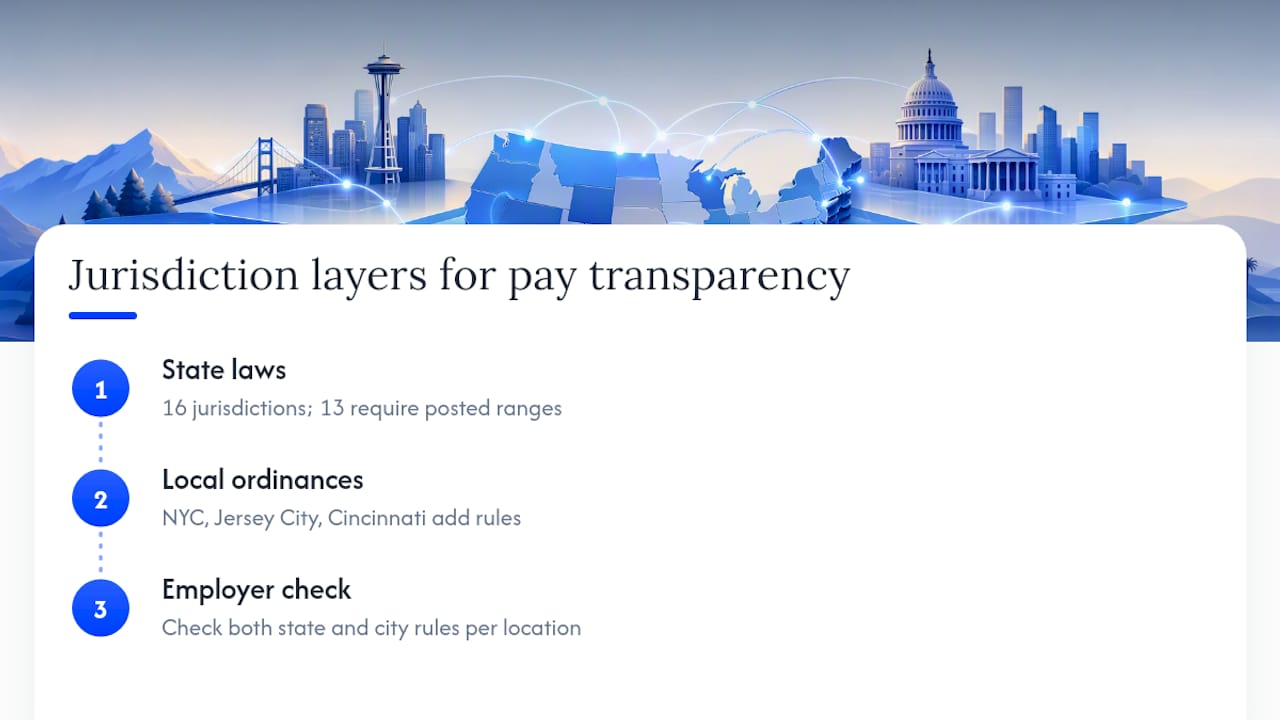
Pay transparency laws are state and local statutes that force employers to share compensation information at some point in the hiring process, sometimes in the job ad itself, sometimes only when asked. They’re separate from equal pay legislation, which addresses pay discrimination directly, though the two often work together to push wage transparency standards forward. As of mid-2026, 16 jurisdictions have some form of pay transparency law on the books, and 13 of them require a salary range in the initial posting.
The remaining states split into a few buckets. Some require disclosure only when a candidate requests it. Others trigger the duty after an interview or once an offer is extended. A handful only require disclosure to current employees, not applicants. And several states have salary-history bans but no posting or disclosure mandate at all, which is where a lot of confusion starts.
Here’s a snapshot of where major states land:
| Posting required | California, Colorado, New York, Washington | Range must appear in the job ad | Colorado: —. | Posting required | Massachusetts, New Jersey, Minnesota | Range must appear in the job ad | Massachusetts: October 2025. | On request / after interview | Rhode Island, Connecticut, Nevada | Disclosed when asked or after an interview | Rhode Island: —. | Employee-only disclosure | Maine | Disclosed to current employees on request | Maine: salary-history provisions. | Posting required (2026) | Virginia | Range required in public and internal postings | Virginia: July 1, 2026. | Salary-history ban only | Maryland | No posting duty, but employers can’t ask about pay history | Varies by provision.
Local ordinances complicate this further. Cities like New York City, Jersey City, and Cincinnati layer their own rules on top of state law, so a company with offices in multiple cities within the same state can face different obligations depending on where the role is based. If you operate in more than one city, don’t assume state compliance covers you at the municipal level too. Check both.
Which States Require A Salary Range In Job Postings?
California, Colorado, New York, Washington, Massachusetts, New Jersey, and Minnesota are among the states that generally require salary ranges in job postings, though thresholds and exact wording differ. Some apply to any employer with a single employee in the state; others kick in only above a certain headcount.
A compliant range isn’t just any number range; it should be based on best practices outlined in resources like Tech Workforce Diversity Challenges: A Leader’s Guide that intersect with fair hiring and compensation disclosure. It has to reflect what you’d actually pay, based on your budget, market data, or what current employees in the role earn. Slapping “$40,000 to $200,000” on a posting to technically check the box is the kind of move regulators call bad faith, and documenting how you set the range (pay band data, market comps, budgeted amount) is your best defense if a range gets challenged.
A few practical notes for HR teams updating templates:
- Replace “DOE” or “Competitive salary” with an actual numeric range. Vague language doesn’t satisfy posting-required statutes and many employers get this wrong by assuming a qualitative label counts as disclosure.
- Include the range even for internal job boards if your state’s law covers internal postings.
- Keep ranges tight enough to be meaningful. A $30,000 spread on a $50,000 role tells candidates nothing useful.
- Note any additional compensation (bonus, commission, equity) separately if your state requires it.
Pro Tip: Write one master range per level (not per req), tied to your actual pay bands. It’s faster to update annually and keeps every posting for the same role consistent across recruiters.
When Do States Require Disclosure Only On Request?
Not every state makes you post a number. Rhode Island and Connecticut require disclosure when a candidate asks or before an offer is made. Nevada ties the obligation to after an interview, which means recruiters need a clear internal rule for exactly when that clock starts.
These “softer” laws still carry real obligations, and treating “no posting duty” as “no disclosure duty” is a common and costly mistake. Build these checkpoints into your process:
- Train recruiters to volunteer the range at the first substantive conversation, not just wait to be asked.
- Log the date and channel (email, phone, ATS note) when a range was disclosed, in case of a dispute later.
- Apply the same rule to internal transfers if your state’s law extends to current employees requesting range information.
Salary-History Bans Are Not The Same As Disclosure Laws
Salary-history bans stop employers from asking candidates what they currently earn or used to earn. More than 20 jurisdictions have some form of this ban, including Oregon, and it’s one of the most misunderstood rules in this space. A ban on asking about salary history does not automatically mean you have to disclose your own range unless a separate pay-transparency statute in that state says so.
The exception: if a candidate volunteers their salary history unprompted, most states allow you to consider it, but you still can’t ask follow-up questions to confirm or expand on it.
To avoid tripping over this distinction:
- Strip salary-history fields from job applications entirely, even in states without a formal ban, since it’s easy to standardize once.
- Train hiring managers on the specific script difference between “asking about pay history” (often banned) and “sharing our range” (often required).
- Review offer-letter templates for language that references “matching” or “beating” a candidate’s prior pay.
A Five-Step Compliance Checklist For Employers
Getting ahead of pay transparency laws is less about memorizing every state’s rule and more about building a repeatable process. Here’s the order that works:
- Determine which laws apply. Base this on where the employee or candidate is physically located, not your company’s headquarters, and check headcount thresholds since California generally applies its posting duty at 15+ employees, while other states set the line lower.
- Audit existing postings and ATS fields. Pull every live job ad and flag any missing a numeric range, especially templates reused across multiple states.
- Set defensible ranges. Base them on budgeted amount, market data, and current incumbent pay, then write down how you got there. That documentation is what protects you later.
- Update templates and scripts. Fix job description templates, ATS default fields, recruiter talking points, and hiring-manager guidance all at once, not piecemeal.
- Train staff and set a review cadence. Revisit ranges at least annually or whenever a law changes, and keep records for as long as your state requires.
Pro Tip: Assign one person, not a committee, to own the quarterly law-check. Pay transparency laws move fast, and shared ownership usually means nobody actually checks.
How Should Job Seekers Read A Posted Salary Range?
A posted range tells you more than the number itself. A tight range, say $75,000 to $85,000, usually signals a well-defined level with less room to negotiate. A wide range, like $60,000 to $110,000, often means the employer hasn’t nailed down the level yet or is leaving room for experience, so ask which end fits your background.
When you’re ready to talk numbers:
- Ask directly what factors move a candidate toward the top of the range (certifications, years of experience, specific skills).
- Bring it up early, ideally in the first recruiter call, since most transparency laws let you ask before you’ve invested hours in interviews.
- Remember salary-history bans work in your favor here. You’re not obligated to share what you currently make, even if a range on the posting seems tied to it.
Matching your resume against the qualifications tied to the top of a range, rather than the bottom, is one of the more overlooked parts of using skills-based job matching to your advantage.
Do Pay Transparency Laws Apply To Remote Workers?
Yes, and this trips up more employers than any other part of these laws. Most statutes apply based on where the employee could perform the job, not where your company is based, so a remote posting open to Colorado, California, or New York residents needs a compliant range even if your office sits in a state with no such law.
The safest approach for multistate hiring:
- Add a location field to every application so you know which state’s rule applies before an offer goes out.
- Include a range on every remote-eligible posting where the role could be filled from a covered state, rather than trying to guess.
- Treat “remote, anywhere in the U.S.” postings as if the strictest applicable state law governs, since that’s usually the safest default.
What Happens If An Employer Doesn’t Comply?
Penalties vary widely, but they’re no longer symbolic. California’s civil penalties for posting violations run from $100 to $10,000 per violation, and cities like New York City add their own fines on top of state exposure. Virginia’s 2026 law goes further, allowing a private right of action with penalties reaching $1,000 to $5,000 depending on the violation, plus other available relief.
Some states offer a notice-and-cure window before penalties apply; others don’t, and go straight to fines or litigation.
Pay transparency litigation is rising fast, and newer laws with private rights of action, like Washington’s and Virginia’s, have already pushed more employers toward faster compliance simply to avoid the legal exposure rather than wait for an agency to come knocking.
- California: $100 to $10,000 per violation, escalating for repeat offenses.
- Virginia: private right of action, $1,000 to $5,000 in statutory penalties.
- NYC and other localities: separate municipal fines layered on top of state exposure.
Why Pay Transparency Changes Who Applies, Not Just What You Pay
Publishing real ranges changes candidate behavior before a single interview happens. Job seekers self-select into roles that actually fit their target compensation, which means employers see fewer mismatched applications and candidates waste less time chasing jobs that were never going to pay what they needed. That shift also nudges employer brand in a good direction: companies that lead with a number, instead of “competitive salary,” read as more confident about their own pay structure.
For job seekers, this is exactly why platforms that surface range-matched roles instead of generic keyword matches are worth using early in a search, not after weeks of guessing.
— Resume
Find Roles That Actually Match Your Target Salary
Reading a posted range is only half the work. Knowing whether your resume and experience actually put you near the top or bottom of that range is the harder part, and some platforms aim to answer this. Uploading your resume to some services allows analysis against live job listings in a short time, matching you to roles where your skills fit the range instead of just the job title.

Some platforms offer comprehensive reports with salary insights, resume gap analysis, and personalized career strategies to help clarify which salary range might suit you. If you’re tired of applying blind and want to see where you genuinely stand, start your free trial with Resume-match and get matched to jobs built around your resume, not just your job title.
Sources
This guide draws on state statutes, labor agency guidance, and HR compliance publishers including Rippling, the National Law Review, Brightmine, and Seyfarth Shaw, cross-checked and updated at least quarterly as new laws take effect.
- Pay transparency laws: A state-by-state guide
- 16 States + DC Have Pay Transparency, What Does That Mean?
- Pay Transparency Laws by State: Only 13 Require a Range in the Posting
- US Pay transparency laws by state and locality | 50-state chart
- Pay transparency — Carta learn center
- Pay transparency - wage range disclosure compendium (Seyfarth, 2025)
FAQ
Which states have pay transparency laws in 2026?
As of mid-2026, 16 states plus DC have pay transparency laws, including California, Colorado, New York, Washington, Virginia, Maine, Massachusetts, New Jersey, Minnesota, Maryland, Rhode Island, and Nevada, though only 13 require a range in the actual job posting.
In what states is it illegal to not disclose salary?
States including California, Colorado, New York, Washington, Massachusetts, New Jersey, Minnesota, and Virginia (effective July 1, 2026) legally require a salary range in job postings, while states like Rhode Island and Nevada require disclosure on request or after an interview instead.
What are the requirements for pay transparency in Oregon?
Oregon’s main compensation rule is a salary-history ban, which stops employers from asking about past pay, rather than a posting-required pay transparency law like California’s or Colorado’s.
Can my employer tell me not to discuss my salary?
No. Federal law under the National Labor Relations Act generally protects most private-sector employees’ right to discuss pay with coworkers, and employers cannot lawfully prohibit that conversation.
How do pay transparency laws interact with federal rules?
There’s no single federal pay transparency law covering private employers, so federal protections mostly come through equal pay legislation and NLRA rights to discuss wages, while the specific posting and disclosure duties come entirely from state and local statutes.