
Greatest Weakness Answer: How to Say It and Sound Hired
Greatest Weakness Answer: How to Say It and Sound Hired

The best answer to “What is your greatest weakness?” is a real, minor, work-related skill gap, stated in a sentence or two, followed by the specific steps you are taking to close it. That is it. Interviewers are not hunting for a flaw that sinks you. They want to hear that you know yourself and that you improve when you find a gap. If you have been dreading this question, you can relax a little: it is one of the most preparable questions in any interview.
Below, we walk through why it gets asked, how to pick a weakness that is honest but safe, a simple structure to say it, sample answers for first-job seekers and career changers, and the answers to skip.
TL;DR
- Pick one real weakness that is a skill or experience gap, not a core requirement of the job and not a personality flaw.
- Spend about 10% of your answer naming it and about 90% on what you are doing about it.
- Give proof: a course, a tool, a habit, or a small result that shows progress.
- Skip “I’m a perfectionist” and “I work too hard.” Interviewers hear them constantly and read them as dodges.
- Prepare two or three versions, and match each to the job description before the interview.
Table of Contents
- What interviewers are really asking
- How to choose a weakness that is honest and safe
- A simple structure for your answer
- Weakness examples you can adapt
- What to avoid
- If you are a recent graduate
- If you are changing careers
- If your interview is on video
- Our perspective
- Find the gaps before the interviewer does
- FAQ
- Sources
What interviewers are really asking
On the surface, the question asks for a negative. Underneath, it is a test of self-awareness and learning. Princeton’s Center for Career Development says interviewers want employees who can honestly assess what they still need to learn and show a plan to learn it.
Recruiter Gimbel, speaking to CNBC, puts it bluntly: the real question is what your solution is, not what the weakness is. Tulane Career Services makes a related point: candidates treat the question as a trap, but the part interviewers listen for is what you did after something did not go perfectly.
So you are not being asked to confess. You are being asked to show how you handle feedback, and that is a skill you can demonstrate in under a minute.
How to choose a weakness that is honest and safe
You want a weakness that passes three tests: it is true, it is fixable, and it does not sit at the center of the role.
Start with your real history
Look back at your last job, internship, class projects or volunteer work. Think about feedback you have received: a manager who said your updates ran long, a group project where you waited too long to ask for help, a presentation that left you shaking. Real moments make your answer specific, and specific answers sound honest.
Yale’s Office of Career Strategy suggests preparing two or three answers with examples and choosing an attribute you are actively developing, such as building team consensus or patience with long-term projects.
Keep it away from the core of the job
Read the job posting and underline the three or four skills it stresses. Your weakness should not be on that list. CNBC’s career expert Mann says to share a weakness that is real, specific and actionable but not core to the job, and warns that an accountant who says they hate Excel will get disqualified immediately.
A useful gut check: if the interviewer took your weakness as completely true, would it rule you out? If yes, pick another one.
Choose a skill gap, not a personality flaw
Columbia Career Education recommends choosing a skill deficit or lack of experience and showing how you are improving, rather than confessing a major personality flaw or using a disguised strength. Skills can be learned, and that is the story you want to tell.
Forbes adds that your weakness should be one you are working to overcome, not something career-ending or something that would take years to conquer. Gather specifics about the actions you have already started.
A simple structure for your answer
Most strong answers follow the same three beats.
- Name it plainly. One sentence. No long wind-up.
- Show where it appeared. One or two sentences about a real situation and its effect.
- Show what you do about it. Two or three concrete actions and the progress you have seen.
Tulane recommends this shape: a real area you have struggled with, two or three things you have done to address it, and the progress you have made. Landing Point describes a similar three-part flow: identify it, explain how you recognized it, and describe the steps you are taking.
The 10/90 split
A handy rule from the career world is to spend roughly 10% of the answer on the weakness and 90% on how you are addressing it. Dr. Tim Sandle’s Digital Journal piece cites this ten: ninety rule from a career expert. In practice, that is a 45 to 60 second answer where the weakness takes one sentence.

Make the improvement concrete
“I’m trying to get better” is not an answer. Forbes’ Murphy points to specifics like daily prioritizing, project-management tools and regular check-ins with your boss as the kind of actions that show a growth mindset. A habit, a tool, a class, a person you ask for feedback: any of these gives the interviewer something to picture.
The VA’s careers site offers a clean model. Its sample answer says the speaker used to struggle with public speaking, then joined a local Toastmasters group and volunteered to lead more team meetings, and that it is still a work in progress. It is honest, specific and finishes on progress.
Stop when you are done
Edmonds College’s Career Action Center gives three steps: be brief, turn it into a positive, and then stop talking about it. It also says to give only one weakness even if asked for several. If an interviewer asks for more, you can share a second, but prepare it in advance.
Weakness examples you can adapt
The samples below are written as models. Change the details so they match your real experience, because an answer you have borrowed word for word will not survive a follow-up question.
| Weakness | Why it works | Sample line |
|---|---|---|
| Public speaking confidence | A skill gap with obvious practice routes | “I used to freeze in front of groups. I now volunteer to present at our weekly meeting and ask a teammate for feedback afterward. My last presentation was much smoother.” |
| Delegating | Common as you take on more responsibility | “I tended to keep tasks myself to make sure they were right. I now write a short brief for each handoff and check in at set points, and my projects finish faster.” |
| Estimating time | Fits early-career roles | “I underestimated how long tasks take. I break work into steps, add a buffer, and flag risks early.” |
| Asking for help late | Honest, and fixable with a rule | “I used to wait too long before asking questions. Now I give myself 30 minutes, then I ask.” |
| Saying yes too quickly | Shows you care, and shows a system | “I used to accept every request. Now I check priorities with my manager before I add something new.” |
| Limited experience with one tool | A skill gap with a clear plan | “I have not used that analytics tool much yet. I am taking an online course and building a small project to practice.” |
For more ideas, Cedarville University’s Career Services Office has a list of sample weaknesses and their underlying causes, including trouble delegating, difficulty saying no, impatience, lack of organization and fear of public speaking.
A full answer, start to finish
Here is how the pieces sound together:
“One thing I am working on is delegating. In my last role, I led a small project and kept too many tasks myself because I wanted them done right. It slowed us down. Since then I write a short brief for each task, agree on a check-in time, and give feedback instead of redoing the work. On my most recent project, we delivered two days early and my teammates told me they felt more ownership.”
That is five sentences, and the weakness itself takes one of them. Swap in your own details, and make sure any result you mention is true.
What to avoid
Disguised strengths. Forbes warns against weaknesses that are not weaknesses, such as “I care too much,” “I work too hard” or “I’m a perfectionist.” Mann tells CNBC that interviewers can usually detect these glib answers. Yale’s career office also advises against perfectionism and against cute lines like “my weakness is chocolate.”
Deal-breakers. If the job is a sales role that lists excellent verbal communication, do not say you struggle on the phone. Pick something that does not hit the core of the work.
Blame. A weakness that is really someone else’s fault (“my old manager never gave me direction”) sounds like an excuse, not self-awareness.
Nothing at all. Saying you have no weaknesses fails the exact test the question sets. Everyone has a gap they are working on.
Rambling. A long confession puts the spotlight on the weakness. Keep it short, show your action, and move on.

If you are a recent graduate
You are not expected to have years of examples. Employers hiring for entry-level roles tend to care about how fast you learn and whether you follow through. Good weaknesses for you are often experience gaps: limited exposure to a tool, nerves when presenting, or trouble estimating time.
Use school, internships, clubs and part-time jobs as your material. A group project where you waited too long to speak up is a perfectly good story, especially if you describe the rule you set for yourself afterward. Pair the weakness with something you have already done, even a small step like a free course, a practice presentation for friends, or a time-tracking habit.
If you want to rehearse out loud, our guide to behavioral interview questions shows how to build stories that answer several questions at once.
If you are changing careers
Career changers face a slightly different challenge. Your obvious gap is often industry experience, and you may be tempted to hide it. Do the opposite, but frame it as a gap you are closing. Pick a specific area, say what you have done to ramp up, and connect it to the transferable skills you already bring.
For example: “I am newer to project management software than some candidates. I have completed a certification course and run my team’s last two projects in a tracking tool, so I am comfortable with the basics and learning fast.”
The same idea applies to your whole job search. Your past job titles may not match the job postings, but your skills often do. Our guide to skills-based job matching explains how to look at roles through the lens of what you can do.
If your interview is on video
The weakness question lands the same way on a screen, but delivery matters more. Look at the camera, keep your answer to about a minute, and practice with a timer so you do not trail off. If you are recording answers or preparing for a remote screening, these video interview prep tips cover setup and sample answers.
Whether it is video or in person, a short practice routine helps. Say your answer aloud three times, once to a mirror or recording, and trim any sentence that does not add something new. Our interview prep checklist walks through what to do before, during and after the conversation.
Our perspective
We built ResumeMatch because job hunting can feel like a pile of small tasks that never ends, and the weakness question is a good example of how that pressure builds. People spend hours worrying about one answer while they are also tailoring resumes, scanning job boards and tracking applications.
Here is what we believe: the strongest weakness answers come from the same place as a strong resume. They are grounded in your real skills, they are specific, and they show where you are headed. A candidate who knows their gaps and has a plan is easier to believe than one who claims to have none.
That is also why we focus on skills rather than job titles. A bartender who manages a team has skills an account manager role needs, even if the titles do not match. Knowing where you are strong and where you have a gap makes both your resume and your interview answers sharper. Our Career Probability Report includes a resume gap analysis, career strategy and interview preparation for that reason: seeing your gaps clearly is the first step toward closing them.
We want every job seeker, especially anyone feeling overwhelmed, to walk into the interview with a clear story and a little more confidence.
Resume
Find the gaps before the interviewer does
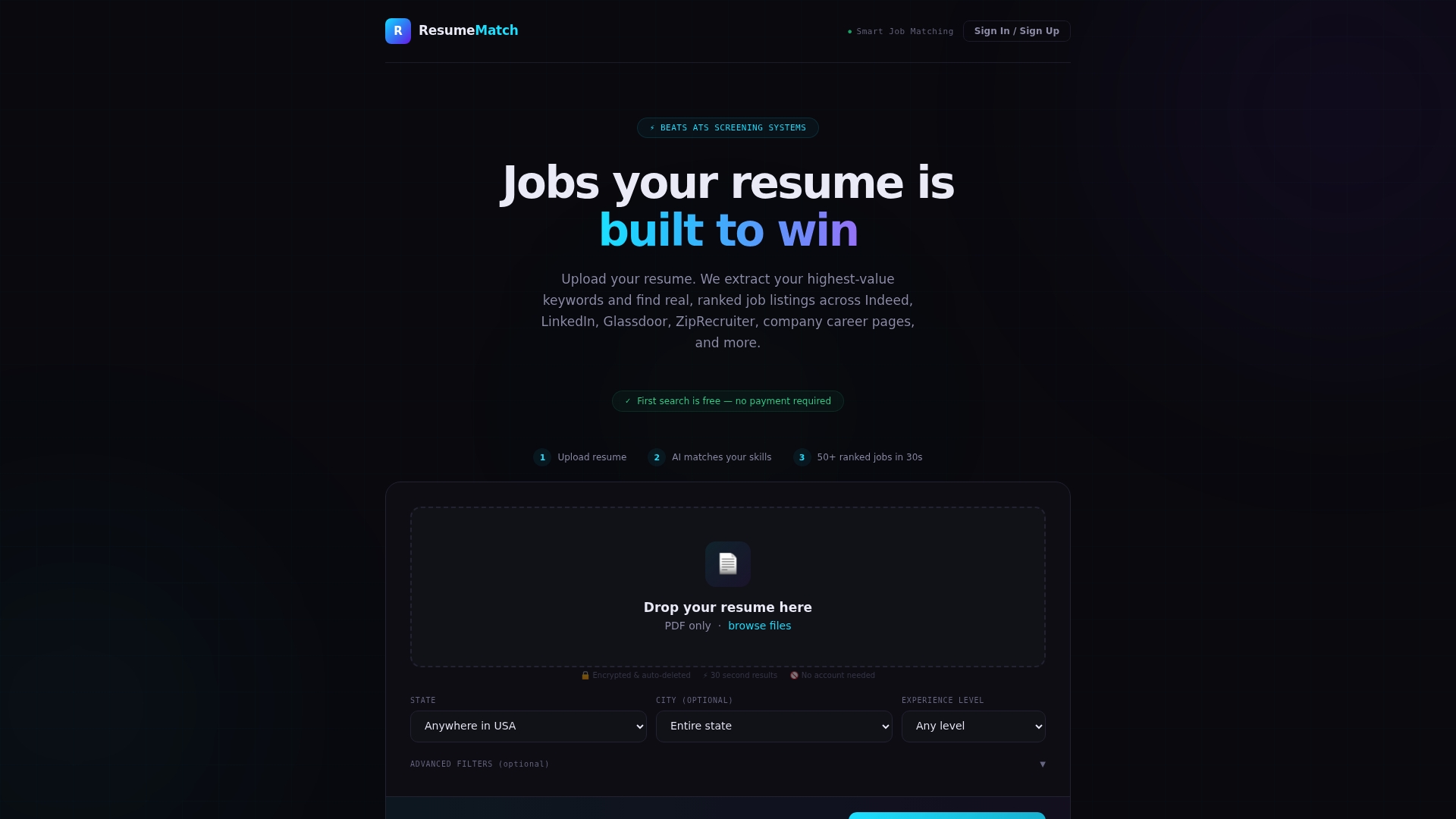
A good weakness answer starts with knowing where you stand against the jobs you want. ResumeMatch analyzes your resume, matches you to tailored listings across multiple job boards in about 30 seconds, and gives you a Career Probability Report with competitive job matches, salary insights, resume gap analysis, career strategy and interview preparation. The gap analysis can help you spot an honest, non-core weakness to prepare and the strengths to lead with.
The ResumeMatch Membership is $15 per month, after a 72-hour free trial. If you would rather hand off the applications, Let Us Apply For You is a $50 one-off service where agents apply to jobs on your behalf. You can start on the ResumeMatch site.
For a deeper look at practicing, see how AI interview prep can help you rehearse answers before the real thing.
FAQ
What is the best answer to “What is your greatest weakness?”
The best answer names one real, minor skill gap that is not central to the job, then spends most of the time on what you are doing to improve. Include one concrete action and one sign of progress. Keep the whole answer to around a minute.
How many weaknesses should I mention?
One, unless the interviewer asks for more. Edmonds College’s Career Action Center advises giving only one even if asked for several. Prepare a second answer in advance in case a follow-up comes.
Is it okay to say “I’m a perfectionist”?
It is better to avoid it. Yale’s career office and CNBC’s Mann both caution that interviewers can spot disguised strengths. A real skill gap, paired with your improvement steps, builds more trust.
What if my real weakness could cost me the job?
Choose a different true weakness for the interview, one that is not central to the role, and keep working on the harder one in your own time. For example, if you are still ramping up in a key skill, describe what you have already done to learn it quickly rather than calling it a flaw.
How long should my answer be?
About 45 to 90 seconds. The weakness itself should take a sentence or two, and the rest should cover the situation, your actions and your progress.
Sources
- Decoding Interview Questions, Princeton Center for Career Development
- The worst way to answer “What are your weaknesses?”, CNBC
- Interview Prep: Reframing the Weakness Question, Tulane Career Services
- The Behavioral Interview, Yale Office of Career Strategy
- How to answer “What is your biggest weakness?”, CNBC
- Common Interview Questions and How to Answer Them, Columbia Career Education
- How To Answer “What Are Your Weaknesses?”, Forbes
- Landing Point: Tips for Responding When Asked About Your Weaknesses
- Small lies, big outcomes, Digital Journal
- Tackling tough interview questions with confidence, VA Careers
- Career Action Center: How to Answer Interview Questions, Edmonds College
- Interview Questions and Weaknesses Samples, Cedarville University
- Video Interviews for Job Seekers: Prep, Tips, and Sample Answers