
AI Interview Prep: How to Practice Smarter and Walk In Ready
AI Interview Prep: How to Practice Smarter and Walk In Ready

AI interview prep means using AI to research the role, generate likely questions, run mock interviews and give you feedback before the real conversation. It works best when you feed it your resume and the job description, answer one question at a time, and rewrite what you learn in your own words. Below is the routine we recommend, what to look for in a tool, and how to protect your data while you practice.
If job hunting feels overwhelming right now, you are in good company. Interviews are the step where preparation pays off most, and AI gives you a patient practice partner at any hour. You still bring the real material: your experience.
TL;DR
- AI interview prep covers research, question generation, mock interviews and feedback. It is different from an employer’s AI screening you.
- Start with your resume and the job description, so the practice questions match the role and your actual experience.
- Practice one answer at a time, ask for short feedback, revise, and repeat. Never memorize an AI-written script.
- Compare tools on question quality, feedback depth, formats, privacy and price before you commit.
- ResumeMatch ties interview prep to your job matches, resume gaps and application tracking in one place.
Table of Contents
- What AI interview prep actually means
- How AI mock interviews work
- A step-by-step routine for a specific role
- Use AI feedback without sounding scripted
- Choosing an AI interview tool: what to compare
- Privacy: know where your answers go
- Our perspective
- Where ResumeMatch fits
- How much practice is enough
- Common mistakes to avoid
- FAQ
- Sources
What AI interview prep actually means
Two very different things get called AI interviews, and mixing them up leads to the wrong preparation.
Practicing with AI. You use a chatbot or a dedicated coaching app to simulate an interview. You ask for questions, answer them, and get feedback. You are in control, and nothing you say affects a hiring decision.
Being interviewed by an employer’s AI. Some companies use conversational AI agents for early screening. Built In explains that these interviews usually happen early in the hiring process, may evaluate speech patterns and facial expressions, give you a set response window (typically two minutes), and produce a scorecard for the hiring team.
A third category sometimes shows up: tools that listen during a live interview and suggest answers in real time. That is not preparation. It is a different use, and it can leave you stuck when a follow-up question goes off script. This guide is about the first category: building real skill before the interview.
The good news is that practicing with AI also prepares you for an employer’s AI screen. Both reward the same habits: clear structure, relevant examples, steady pacing and a calm voice.

How AI mock interviews work
Most AI mock interview tools follow the same loop. They generate questions from your resume, a job description or a role template. You answer by typing or speaking aloud. The system transcribes your words and scores them against a rubric. Then it gives you feedback.
The formats you will see:
- Text chat: the easiest way to start, and good for testing the content of your answers.
- Voice: better for pacing, filler words and confidence, because you practice saying the words out loud.
- Video or avatar: closest to a real screen, useful once your answers are solid.
The questions can be behavioral (tell me about a time you led a team), technical, case-based or role-specific. If behavioral questions are your weak spot, our guide to behavioral interview questions is a good companion, and our STAR format examples show how to structure the stories.
What good feedback looks like
Feedback is only useful if you can act on it. Look for comments on whether your answer was relevant to the question, whether it had a clear structure, how long it ran, and how often you used filler words. A single number out of 100 tells you little. A note such as “your result was missing, add what changed and by how much” tells you exactly what to fix.

Also treat any score as a coaching signal, not a forecast. No tool knows how a particular hiring manager will rate you.
A step-by-step routine for a specific role
Generic practice produces generic answers. Here is a routine that keeps your prep tied to the job in front of you. It follows the approach recommended by university career offices.
- Gather your inputs. Paste in your resume and the full job description. MIT Career Advising recommends using both to match your experience to what the employer is looking for.
- Research the employer. Ask AI to summarize the company, its products and the skills the posting stresses. Brown University CareerLAB lists employer research and identifying key skills from a job description among the useful AI tasks. Then verify the facts on the company’s own site, since AI can state wrong information with confidence.
- Generate questions. Ask for ten likely questions: a few about your background, a few behavioral, a few specific to the role.
- Answer one at a time. Do not request a full interview and then a long review. Answer a single question and ask for brief feedback: what worked, the one most important improvement, and whether any part of STAR (situation, task, action, result) is missing. That feedback format is the one MIT suggests.
- Revise and repeat. Change the answer and say it again. Aim for each pass to be more specific than the last.
- Run a full mock. Once your key stories are in shape, do a complete session in voice mode, ideally with a timer.
- Draft a follow-up note. AI can also help draft a thank-you email afterward, which Brown lists among its uses. Edit it so it sounds like you.
A quick example
Say you worked as a bartender and supervised a team of four on busy weekends. You are applying for an account coordinator role. Ask the AI to translate that experience into the language of the job: managing competing priorities, handling difficult customers, training new people. Then practice the story in STAR form. The skills transfer even when the job titles do not, and your answer should show that.
Use AI feedback without sounding scripted
The most common trap is polishing an answer until it is perfect on the page and stiff in the room. MIT warns that memorizing answers word for word makes you sound robotic and leaves you unable to adapt when the interviewer asks something slightly different. Harvard’s Mignone Center for Career Success gives similar advice: use AI to brainstorm and to evaluate answers in STAR format, and do not memorize them.
Here is how to keep your voice:
- Write the bullets, not the script. Keep a short list of key points for each story: the situation, your action, the measurable result.
- Say it differently each time. If you can tell the story three ways, you understand it.
- Ask for follow-ups. Tell the AI to challenge your answer with a probing question, just as a real interviewer would.
- Keep your real numbers. If AI suggests a stronger-sounding result you did not achieve, ignore it. Interviewers ask follow-ups, and invented details fall apart.
- Check the facts. Harvard cautions that AI can generate factually incorrect information, so confirm anything about the employer or industry yourself.
The University of Manchester’s careers service (in the UK) adds a useful point: AI cannot research the role and organization as effectively as you can, and it cannot give fully personalized, informed feedback. It recommends using the employer’s own advice about its interview process as your primary source, and looking at platforms like LinkedIn or Glassdoor for accounts from people who have interviewed there.
One more habit matters: a completed mock interview is not the same as a productive one. If you repeat the same vague answer five times, you simply get more comfortable with a vague answer. Change something with each round.
Choosing an AI interview tool: what to compare
The market is crowded with apps, from general chatbots to dedicated coaches. Rather than chase a ranking, compare tools on what affects your results.
| What to compare | Why it matters | What to look for |
|---|---|---|
| Question source | Generic questions give generic practice | Questions built from your resume and a specific job description |
| Practice formats | You need both content and delivery practice | Text for drafting, voice for pacing and filler words |
| Feedback depth | Scores alone do not tell you what to change | Written comments per answer, plus patterns across sessions |
| Framework support | Behavioral answers need structure | STAR checks that flag a missing situation, action or result |
| Role coverage | A technical interview differs from a sales one | Behavioral, technical or case practice that matches your target roles |
| Privacy | You are sharing your voice and work history | Clear policy on audio, transcripts and deletion |
| Price and trial | Costs range from free to monthly subscriptions | A free trial and a clear cancellation path |
| Connection to your search | Prep is stronger when tied to real postings | Links between matched jobs, resume gaps and interview practice |
The last row is easy to overlook. If a tool knows which jobs you are applying to, it can prepare you for those interviews rather than for a made-up one.
Free versus paid
Free chatbots are a fine place to start, especially for brainstorming questions and rewriting weak answers. Paid tools usually add voice analysis, saved history and role templates. Pick based on how many interviews you have coming up and how much structure you want, not on the longest feature list. Pricing changes often, so check each provider’s own page for the current plan before you subscribe.
Privacy: know where your answers go
Interview practice involves sensitive material: your voice, your work history, sometimes details about a current employer. Before you use any tool, find answers to a few questions in its privacy policy:
- Is audio sent to a server, and is it stored?
- Where are transcripts kept, and for how long?
- What happens to your data if you delete your account?
- Is your content used to train AI models?
Also avoid pasting confidential employer information, client names or anything covered by a non-disclosure agreement into any AI tool. You can describe a project in general terms and still tell a strong story.
Our perspective
We built ResumeMatch because we saw how many capable people lose out, not because they lack skills, but because their experience is described in the wrong words. A bartender who manages a team is doing account management work, and the same gap shows up in interviews. People know their stories but struggle to frame them for the role in front of them.
That is why we think interview prep should start from the job, not from a list of generic questions. When your resume, your matched jobs and your practice all point at the same role, you spend less time guessing and more time improving. Our approach is designed to connect those pieces: ranked job matches, resume gap analysis, application tracking and interview prep in one workflow.
We also believe AI should make you sound more like yourself, not less. Use it to find the missing result in a story, to spot a skill you forgot to mention, and to rehearse out loud. Then walk in with your own words. That is the kind of confidence we want every job seeker to feel.
Resume
Where ResumeMatch fits
If you want interview prep that starts from real openings, ResumeMatch is built for that. Our AI analyzes your resume, extracts the keywords and skills that matter, and matches you with live job listings across multiple job boards in about 30 seconds. Your Career Probability Report then goes further, with a critical analysis of your resume, salary insights and a personalized career strategy. Interview preparation, application tracking and recruiter outreach templates sit in the same workflow.
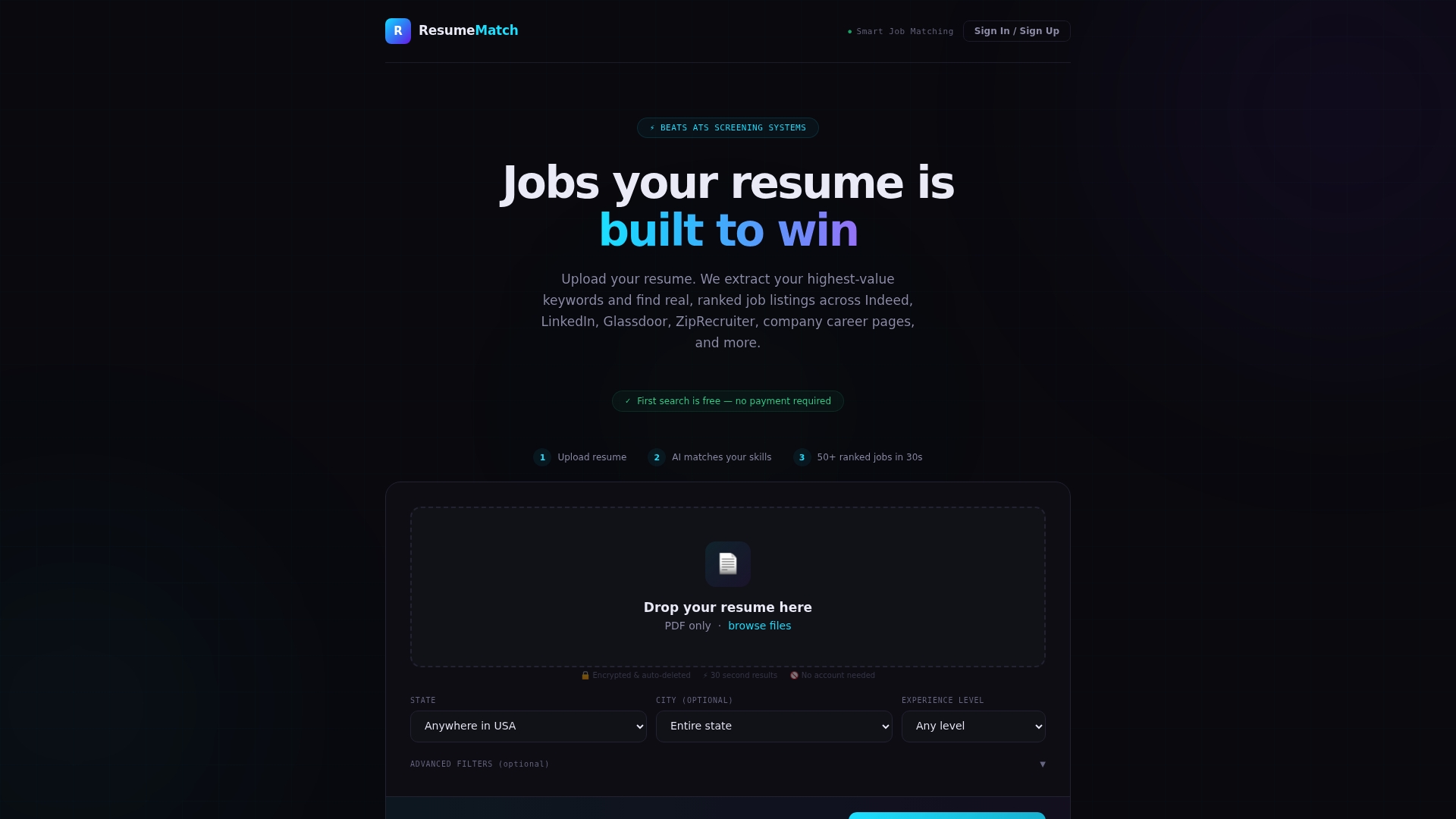
The ResumeMatch Membership is $15 per month, and you can start with a 72-hour free trial. If you would rather hand off the applications, Let Us Apply For You is a $50 one-off service where agents apply to jobs on your behalf. See ResumeMatch plans and the agent service and start with the jobs you actually want to interview for.
If you want to understand how the matching works first, read our guides on personalized job matches and skills-based job matching.
How much practice is enough
There is no magic number, but a simple structure works for most people. Plan three layers of practice before an important interview:
- Two or three sessions on content. Use text mode to build your stories and tighten each answer.
- Two or three sessions on delivery. Use voice mode to reduce filler words, fix pacing and sound natural.
- One full mock run. Do it the day before or two days before, then stop. Overpracticing can make you sound rehearsed.
Tailor the emphasis to your situation.
Recent graduates. You may not have much formal experience, so build stories from internships, class projects, part-time jobs and campus roles. Practice the common opener, tell me about yourself, until it takes about a minute and ends with why this role.
Career changers. Your main task is translation. Ask AI to map your past responsibilities to the target role’s language, then practice the question every changer gets: why are you moving into this field? Our guide to AI-driven job recommendations can help you see which roles fit your existing skills.
Technical candidates. Match your experience to the role requirements first. Strengthening your application documents helps here too, and these steps to align your CV to job-market trends can sharpen the story you tell in the interview.
Anyone facing an AI screen. Practice answering to a camera or microphone with a strict time limit, and keep each answer to about two minutes, since that is a typical window for employer-run AI interviews. For more on delivery, try AI mock interview practice with behavioral questions and check whether the feedback helps you tighten clarity and STAR structure.
A simple prompt to start today
Copy this into any AI chat, with your resume and the job description pasted below it: “Act as an interviewer for this role. Ask me one question at a time. After each answer, tell me what worked, the single most important improvement, and whether any part of STAR is missing. Then ask a follow-up.” Answer honestly, revise, and move to the next question. Twenty minutes of that is worth more than an hour of reading advice.
Common mistakes to avoid
- Practicing without a target. Always attach the job description.
- Accepting every suggestion. AI can overvalue a preferred answer structure or miss context, so treat its feedback as a second opinion.
- Skipping the aloud part. Reading answers silently does not prepare your voice.
- Ignoring the employer’s own advice. Check the company’s careers page for how its process works.
- Stopping at feedback. The gain comes from revising and trying again.
FAQ
Is AI interview prep worth it?
Yes, when you use it as structured practice. It gives you unlimited rehearsal, quick feedback on structure and a way to find gaps in your stories. Pair it with the employer’s own interview guidance and, if you can, a practice round with a friend or career advisor.
How do I use AI to prepare for an interview?
Paste in your resume and the job description, ask for likely questions, and answer them one at a time. After each answer, request short feedback on what worked, the top improvement and any missing STAR element. Revise, repeat, then do a spoken run-through.
Can AI tell me whether I will get the job?
No. A practice score is a coaching signal, not a prediction. Hiring depends on the employer’s criteria, the other candidates and the people in the room. Use the feedback to improve clarity and relevance, not to judge your odds.
What is the difference between an AI mock interview and an AI interview with an employer?
A mock interview is practice you control, and no one else sees it. An employer’s AI interview is a real screening step, often with a timed response and a scorecard sent to the hiring team. Practicing with the first helps you handle the second.
Sources
- Built In: AI job interviews explained
- MIT Career Advising: Using AI for interview prep
- Harvard FAS Mignone Center for Career Success: AI for interviews and offers
- Brown University CareerLAB: Interviewing with AI
- University of Manchester Careers Service: Using AI for interview practice and preparation