
Interview Prep Checklist: What to Do Before, During and After
Interview Prep Checklist: What to Do Before, During and After

A good interview prep checklist covers five things: the job and the employer, your answers, the logistics, what you bring and wear, and what you do afterward. Work through them in that order, a few days before the interview, and you walk in knowing why you fit the role and how to show it. Below is a full checklist you can copy into your notes and reuse for every interview.
TL;DR
- Start with the job description: match each requirement to a real example from your experience.
- Prepare stories for common and behavioral questions, plus 2 to 3 questions of your own for the interviewer.
- Confirm format, time, location or link, and the names of your interviewers a day ahead.
- Bring resume copies and a notebook, and test your tech if the interview is virtual.
- Send a thank-you email within 24 hours and follow up if you hear nothing in about two weeks.
Table of Contents
- The Interview Prep Checklist at a Glance
- Step 1: Study the Job and the Employer
- Step 2: Match Your Skills to the Requirements
- Step 3: Prepare Your Answers
- Step 4: Prepare Questions for the Interviewer
- Step 5: Confirm the Logistics
- Step 6: Decide What to Wear and What to Bring
- Step 7: Interview Day
- Step 8: After the Interview
- Our Perspective
- Get Ready Faster With ResumeMatch
- Final Pre-Interview Checklist You Can Copy
- FAQ
- Sources
The Interview Prep Checklist at a Glance
Here is the short version. Each item is explained in the sections that follow.
| When | What to do |
|---|---|
| 3 to 7 days before | Reread the job description and research the employer |
| 3 to 7 days before | Map your skills to the requirements and write 5 to 6 stories |
| 2 to 3 days before | Practice answers out loud and draft your questions |
| 1 day before | Confirm details, pick your outfit, pack your bag, test your tech |
| Interview day | Arrive on time, be courteous to everyone, take notes |
| Within 24 hours after | Send thank-you emails and write down what you learned |
| About 14 days after | Follow up if you have not heard back |
Step 1: Study the Job and the Employer
Career centers agree on where preparation starts. Colorado State University’s interview checklist begins with the job description and the organization, then moves on to your strengths and likely questions. Do the same.
Do this:
- Print or copy the job description and highlight every skill, tool and responsibility it names.
- Read the company’s About page, recent news and the team page. Know what they sell, who they serve and what they have announced lately.
- Look up your interviewers if you have their names. Note their role and how long they have been there.
- Write one sentence on why you want this job at this company. It will be your answer to “Why us?”
The U.S. Department of Labor’s interview skills guide suggests you think like an employer: make sure your answers speak to the employer’s concerns and show the value you would bring. A job posting is a list of problems the team needs solved. Your job in the room is to show you can solve them.
Step 2: Match Your Skills to the Requirements
This is the step most people rush, and it is the one that changes your answers the most. Columbia’s career education office advises that you reread the job description and think about how you can communicate why you are a good fit, including your transferable skills.
Transferable skills matter most if you are a recent graduate or changing industries. A bartender who trains new hires and handles a rush has shown coaching, prioritizing and calm under pressure. A student who led a group project has managed deadlines and people. Job titles rarely tell the whole story, so spell it out for the interviewer.
A simple matching exercise:
- Make two columns. On the left, list the top six requirements from the posting.
- On the right, write a specific example from work, school or volunteering that proves each one.
- Mark any requirement where you have no example. Decide how you will address it honestly, perhaps with related experience or a skill you are building.
If you want a faster read on where your resume lines up with a posting, our guide to skills-based job matching explains how matching on real skills, not just keywords, works.
Step 3: Prepare Your Answers
You cannot predict every question, but you can prepare for the types. Most interviews include some version of these:
- Tell me about yourself.
- Why do you want this job?
- What are your strengths?
- Tell me about a time you handled a conflict, a failure or a tight deadline.
- Why are you leaving, or why did you leave, your last role?
Build a two-minute pitch
For “Tell me about yourself,” use three beats: where you are now, what you have done that is relevant, and why this role is next. Keep it to about two minutes. Do not recite your resume.
Use a story framework for behavioral questions
Behavioral questions start with “Tell me about a time when…” Columbia recommends preparing examples with the SARA method: Situation, Action, Result, Application. The last step, Application, is the one people skip. It means saying what you learned and how you would use it in this new job. Many people know the similar STAR format, and either works as long as each story has a clear result. We cover this in more depth in our guide to behavioral interview questions and have collected STAR format examples you can adapt.

Aim for five or six stories that you can bend to fit different questions: one about leadership, one about a mistake, one about teamwork, one about solving a hard problem, one about learning something fast, and one you are proud of.
Technical roles need explanation, not just knowledge
If you are interviewing for a technical or project-based role, practice explaining your work in plain language. For example, candidates heading into agile product roles can sharpen how they talk about prioritization and stakeholder communication by reviewing product owner skills and best practices, then turning those ideas into stories from their own experience.
Keep your tone positive
The Department of Labor’s interview tips say to stay positive and avoid negative comments about past employers. If you left a hard situation, say what you wanted next, not what went wrong.
Practice out loud
Reading your answers silently does not count. Say them aloud to a friend, a mirror or your phone’s voice recorder. You will hear the rambling parts and find the places where you need a number or a clearer result.
Step 4: Prepare Questions for the Interviewer
Almost every interviewer asks, “Do you have any questions for us?” Having none can read as low interest. UC Riverside’s career guide recommends 2 to 3 personalized questions about the team, culture or role.
Questions worth asking:
- What does success look like in this role in the first 90 days?
- How would you describe the team’s working style?
- What are the biggest challenges the person in this role will face?
- What are the next steps and the timeline for the hiring decision?
That last question is on Colorado State’s checklist too: ask about the hiring timeline and next steps. It tells you when to expect news and saves you from guessing.
Use the interview to look for red flags
An interview goes both ways. You are also deciding whether you want this job. Pay attention to how the interviewers treat you, whether they answer your questions directly, and whether the role they describe matches the posting. If the duties sound very different from the listing, or nobody can say what success looks like, ask more questions before you accept an offer. Think of your questions as research, not a test.
Step 5: Confirm the Logistics
The day before, check the details. Colorado State’s list includes interview format and logistics as its own step, and it is easy to see why: a missed link or wrong address ends an interview before it starts.
Confirm all of these:
- Date, time and time zone
- Format: in person, phone or video
- Address, parking and building entrance, or the video link and platform
- Names and titles of everyone you will meet
- A contact number in case you are delayed
In-person interviews
Plan your route and do a practice trip if the location is new to you. Colorado State suggests arriving about 15 minutes early. Some advice says to arrive at the office itself no more than five minutes early. Both fit together: get to the area early, settle yourself, then walk in at the right time.
Phone interviews
Find a quiet place with good reception, keep your resume and notes in front of you, and have water nearby. Standing up can help you sound more energetic.
Video interviews
For virtual interviews, Colorado State’s checklist says to test your technology and set up a distraction-free space with a suitable background, lighting and camera angle. Log in a few minutes early, close other apps, and keep your phone on silent. Put the camera at eye level and look at the lens when you speak.
Step 6: Decide What to Wear and What to Bring
The same checklist advises dressing one level above the industry’s usual attire. If you are unsure about the dress code, check the company’s social media and website photos, or ask the recruiter. Pick the outfit the day before, and make sure it fits and is clean and comfortable.
What to bring:
- Several printed copies of your resume
- A padfolio, notebook or folder
- A pen that works
- Your list of questions for the interviewer
- Your stories and notes for quick review
- Any portfolio, work samples or references the employer asked for
- The name and number of your contact at the company
Put it all in one bag the night before so the morning is calm.
Step 7: Interview Day
Before you begin, take a few slow breaths. The UK government’s JobHelp site suggests taking deep breaths before you start and before each answer to settle your nerves and give yourself time to think. A short pause before you answer looks thoughtful, not unsure.
During the interview:
- Treat everyone with courtesy. Tufts’ career center notes the interview begins when you reach the employer’s door, sometimes earlier, so be respectful to the receptionist, the assistant and anyone else you meet.
- Listen to the full question before you answer.
- Give specific examples with results, such as numbers, time saved or feedback you received.
- Take brief notes. They help you write a better thank-you message later.
- Close by restating your interest and asking about next steps.
Step 8: After the Interview
Prep does not end when you leave the room. Colorado State’s checklist recommends sending each interviewer a thank-you email within 24 hours and following up if you have not heard back in 14 days.
A simple thank-you email has four parts:
- A thank-you for their time
- One specific thing you discussed that you enjoyed
- A sentence linking your skills to what the team needs
- A friendly close that confirms your interest
Send a separate, slightly different message to each person. Then write down how it went while it is fresh. Columbia suggests you evaluate your performance and think about how to improve your answers for next time. Which questions surprised you? Where did you ramble? What story landed well?
If you are talking to recruiters between rounds, our notes on the best time to email a recruiter can help with timing your follow-ups. And if several interviews are running at once, a simple system helps: here is how to track job applications without a spreadsheet headache.
Our Perspective
We built ResumeMatch because we have seen how interview prep gets squeezed. People spend hours finding and applying to roles, and by the time an interview invitation arrives, there are two days left to get ready.
That is why we think preparation should begin earlier, at the matching stage. If you apply to roles that fit your actual skills, your interview prep is simpler: your examples already line up with what the employer wants. Our platform scores your resume against real skills, not just keywords, and our Career Probability Report points out resume gaps, so you know which stories to prepare before anyone calls.
We also built the rest of the workflow around that moment: ranked job matches, application tracking, recruiter outreach templates and interview preparation in one place. Job hunting is a lot to carry alone. We want you to feel ready, not overwhelmed, and we believe a clear plan makes that possible.
Resume
Get Ready Faster With ResumeMatch
If you are juggling many applications, ResumeMatch can take on the heavy lifting so you can focus on practicing. Upload your resume and we match you with live job listings across multiple job boards in about 30 seconds, then show you where your resume fits each role. That tells you which requirements to build your stories around.
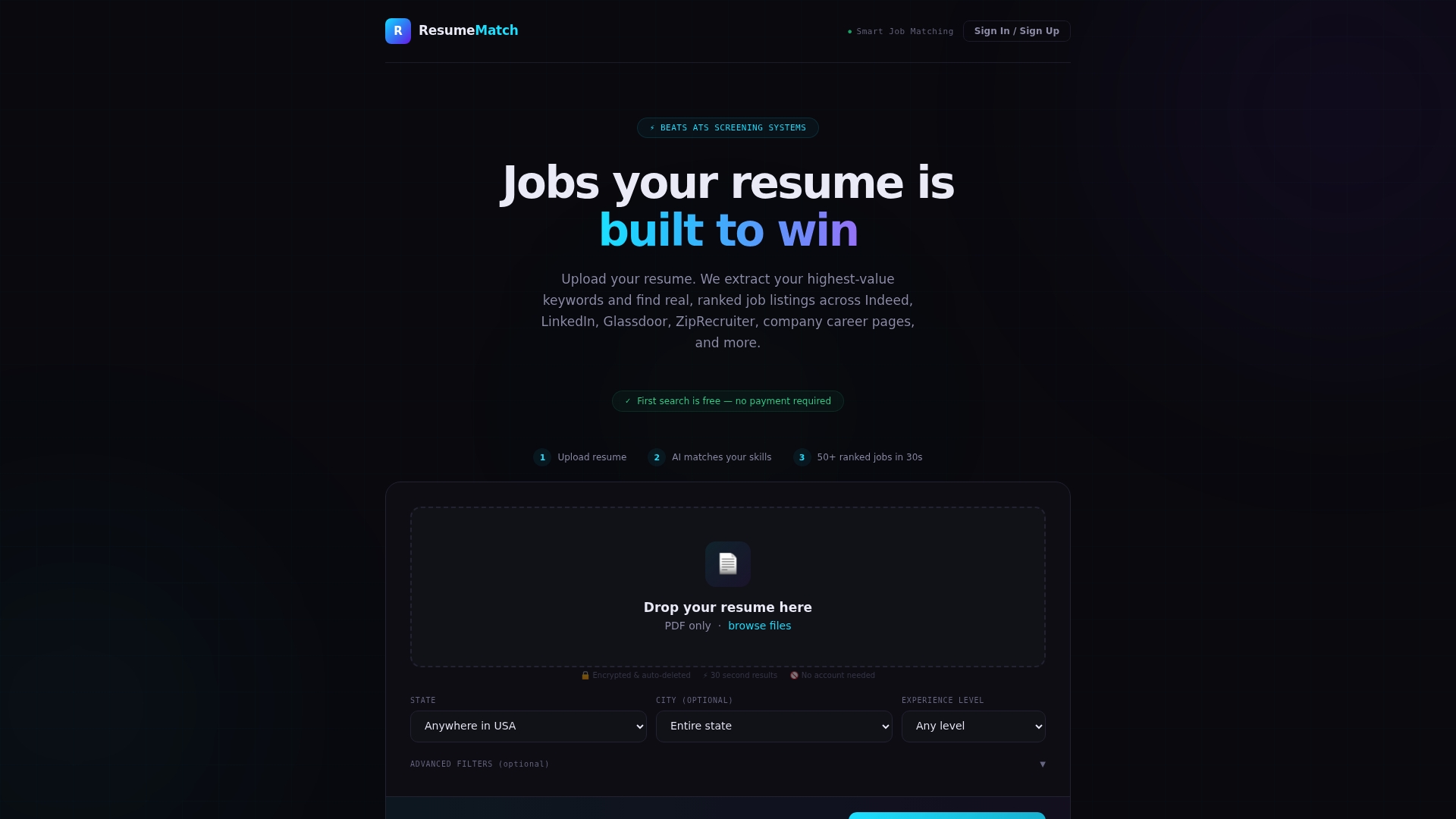
The ResumeMatch Membership is $15 per month and starts with a 72-hour free trial. If you would rather spend your time preparing than applying, our Let Us Apply For You service is a one-off $50, where agents apply to jobs on your behalf. Curious how we compare to resume scanners? See our comparison with Jobscan.
Final Pre-Interview Checklist You Can Copy
Paste this into your notes and tick items off.
Research
- [ ] Reread the job description and highlight key requirements
- [ ] Research the company, its products and recent news
- [ ] Look up your interviewers
Answers
- [ ] Write a two-minute “tell me about yourself” pitch
- [ ] Prepare five or six stories with clear results
- [ ] Practice out loud at least twice
- [ ] Prepare an answer for why this company and why this role
Questions for them
- [ ] Write 2 to 3 personalized questions
- [ ] Ask about next steps and timeline
Logistics
- [ ] Confirm date, time, time zone and format
- [ ] Plan your route, or test your video setup
- [ ] Choose your outfit
- [ ] Pack resume copies, notebook, pen and notes
After
- [ ] Send thank-you emails within 24 hours
- [ ] Write down what went well and what to improve
- [ ] Follow up after about 14 days if you have not heard back
If you want to use it as a printable page, paste the list into a document and print it, then keep one copy per interview so you can see exactly what you did each time.
FAQ
What are five things you should do to prepare for an interview?
Study the job description and the organization, think through your strengths and likely questions, confirm the interview details, decide what to wear, and plan what to bring. Colorado State’s checklist is built around these steps. If you only have an hour, spend it on the first two.
How far ahead should I start preparing?
Start three to seven days before if you can, so you have time to practice out loud and fix weak answers. If you only get a day’s notice, focus on the job description, your top three stories and your questions for the interviewer. Confirm logistics last.
What should I do if I am nervous?
Practice makes the biggest difference, because familiar answers feel easier to give. On the day, take a few slow breaths before you start and before each answer, as the UK government’s JobHelp guidance suggests. It is fine to pause and think before you respond.
What is a red flag to watch for in an interview?
Watch for answers that do not match the job posting, vague descriptions of what success looks like, and interviewers who dodge direct questions or treat you or others with disrespect. One flag is not always a dealbreaker, but a pattern is worth thinking about. Ask follow-up questions so you can decide with more information.
Is there an interview checklist PDF I can download?
Yes. Colorado State University publishes a free interview checklist PDF that covers preparation, logistics, attire, what to bring and follow-up. You can also copy the checklist above into any document and print it.
Sources
- Your Checklist for Effective Interviewing Preparation, Colorado State University
- Things to Do Before, During, and After Your Interview, Columbia University
- TEAMS Interview Skills Participant Guide, U.S. Department of Labor
- Interview Tips, U.S. Department of Labor
- Ace the Interview, UC Riverside
- Preparing for Interviews, Tufts University Career Center
- Interview Day Checklist, GAEN
- 5 Tips for Interview Success, JobHelp