
Stop Chasing Numbers: What Your Resume Score Means and How to Fix It
Stop Chasing Numbers: What Your Resume Score Means and How to Fix It

A resume score is an estimated compatibility and parseability rating, a signal of how well a resume matches a job description and how cleanly it can be read by software, not a verdict on whether you’ll get hired. Treat it as a diagnostic: use it to prioritize fixes, starting with formatting and keywords, until your resume parses reliably. Once it does, shift your energy toward writing measurable, human-readable bullets, because that’s what actually persuades a recruiter.
TL;DR:
- Most scoring tools flag formatting issues like embedded tables, multi-column layouts, or missing contact details before assessing keyword relevance.
- Different resume checkers vary in weighting keywords, titles, and parses, leading to inconsistent scores for the same resume.
- A score of 80 or above usually indicates good keyword alignment and clean parsing, while scores below 60 often reflect structural failures.
- Scores are a diagnostic of parseability and keyword presence, not an indication of actual suitability or impact for the role.
- Improving your score involves fixing formatting issues, standardizing headings, and naturally integrating key terms from the job description.
Table of Contents
- What a resume score is really measuring
- Why scoring tools disagree with each other
- What the numbers usually mean
- What resume scores miss and why that matters
- Turning your score into a fixed resume, step by step
- Knowing when to stop chasing the number
- Why we built ResumeMatch around this idea
- Try the Career Probability Report
- Sources
- FAQ
What a resume score is really measuring
When a tool hands you a number, it’s checking several distinct things at once, and each one maps to a fix you can make.
File format and structure come first. A resume score is a diagnostic estimate of compatibility with a job description, and most scoring tools start by confirming the file actually opens cleanly into text. Single-column, text-based resumes with clear section headings and no embedded images produce far more reliable results than creative, multi-column layouts, according to Workday’s resume parsing guidance.
From there, scoring tools typically check:
- Keyword coverage: whether your resume includes the required and preferred terms from the job posting, plus common synonyms.
- Canonical headings: labels like “Experience” and “Education” instead of creative substitutes that confuse a parser.
- Contact info and dates: basic fields that need to extract cleanly for the rest of the resume to score well.
- Content signals: measurable bullets, consistent date formatting, and alignment between your past titles and the target role.
Some issues are what we’d call hard fails. A resume trapped inside a table or a text box, or one missing a phone number or email, can cap your score no matter how strong the writing is underneath. Fix the structural problems first. Everything else builds on top of that foundation.
Why scoring tools disagree with each other
Here’s the part that trips up a lot of job seekers: you run the same resume through two different checkers and get two different numbers. That’s not a bug, it’s how these systems are built.
- Tokenization and entity extraction: Modern tools don’t just count how many times “project management” appears. They break your resume into meaningful chunks and try to identify skills, job titles, and dates as distinct entities, which is a more nuanced process than simple keyword matching.
- Weighting rules vary by tool: One checker might weight required keywords heavily and treat title similarity as a bonus. Another might flip that priority. There’s no universal formula, so the same resume can land in different bands depending on which tool you use.
- Third-party scores are heuristics, not employer results: A percentage score you see on a checker is an educated guess at how an employer’s applicant tracking system might behave. Employer-side systems typically parse resumes into structured fields and hand recruiters a ranked list, not the same 0 to 100 number the candidate sees.
- Two mechanics cause most hard fails: multi-column templates that scramble parsing order, and missing contact fields that leave a profile incomplete before the content is even evaluated.
None of this means the score is meaningless. It means you should read it as a rough compass, not a precise instrument.
What the numbers usually mean

Score bands are not universal law, but a few practical patterns show up across most balanced tools, and they’re worth knowing before you panic over a single result.
A score of 80 or above generally signals a well-tailored resume with strong keyword alignment and clean parsing, according to industry scoring guidance. If you land here, small tweaks like tightening a headline or adjusting one or two bullets are usually enough. Scores between 60 and 79 point to fixable gaps, often missing keywords or inconsistent formatting rather than a fundamentally broken resume. Below 60 usually signals structural or parsing failures, meaning the tool struggled to read your resume before it even got to evaluating content.
- 90 to 100: Fine-tune, don’t rewrite. Focus on tightening language.
- 80 to 89: Solid foundation. Check for one or two missing keywords.
- 60 to 79: Moderate gaps. Revisit headings, keyword coverage, and bullet structure.
- Below 60: Start with the file itself, format and contact fields before anything else.
A score around 80 or higher tends to signal a resume that’s tailored and parses cleanly, according to common industry rubrics. Because cutoffs differ by tool, watch the trend across two or three checkers rather than fixating on one exact number.
What resume scores miss and why that matters
A number can tell you whether your resume parses cleanly and whether it echoes the right keywords. It can’t tell you whether you’re actually the right person for the job, and it can’t capture nuance, tone, or the kind of demonstrated impact that convinces a hiring manager to pick up the phone.

There’s a real research basis for treating these scores cautiously. Research from Brookings documents evidence of bias in language-model-based resume screening tied to protected attributes, and recommends human oversight to keep automated screening fair. That’s not a reason to distrust every tool wholesale, but it is a reason to keep a human reviewing the shortlist, not just the software.
The stakes also shift depending on the job itself. A screening model described in a recent preprint found that discrimination in automated screening varies with how much subjective judgment a role requires: routine jobs with verifiable criteria tend to narrow callback gaps, while judgment-heavy, analytical, or interpersonal roles see automated scores predict callbacks less reliably than objective credentials or sample work. If you’re applying for a role that leans on discretion and relationship skills, your portfolio or writing sample may matter more than your score ever will.
A resume score is a starting point for revision, not a substitute for judgment, whether that judgment belongs to a hiring manager or to you.
That’s the honest way to read these tools. Keyword stuffing might nudge a number upward temporarily, but it tends to read as awkward or dishonest to an actual reader, and it can actively hurt you once a person opens the document.
Pro Tip: Write for the job description’s language naturally, in context, rather than pasting in a list of terms at the bottom of your resume.
Turning your score into a fixed resume, step by step
Once you understand what the score is checking, improving it becomes a short, ordered checklist rather than a guessing game.
- Run a parse test first. Before touching your wording, confirm the file itself opens cleanly. A quick parse test will surface formatting issues like tables, text boxes, or embedded graphics that block accurate reading.
- Normalize your headings and contact fields. Swap creative section titles for standard ones like “Experience” and “Skills,” and double check that your phone number, email, and dates are all in plain, extractable text.
- Mirror your top five to seven keywords. Pull the highest-value terms straight from the job description and work each one naturally into your bullets once, in context, rather than repeating it multiple times. This is the approach MatchCV recommends to avoid the penalty that comes with obvious stuffing.
- Convert duties into quantified outcomes. “Managed a team” becomes “Managed a five-person team that cut order processing time by two days.” Numbers give both the algorithm and the human reader something concrete to grab onto.
- Iterate across more than one checker. Run the revised resume through a couple of tools and watch for flags that show up repeatedly. A recurring warning is worth fixing; a one-off quirk from a single tool usually isn’t.
If you’re applying to government or federal roles, formatting rules get stricter still, and it’s worth reading up on federal resume format standards before you submit.
Pro Tip: Fix issues in the order they appear on this list. A perfectly worded bullet point won’t matter if the parser never reads it in the first place.
Knowing when to stop chasing the number
At some point, more tweaking stops paying off. For most job seekers using balanced, general-purpose checkers, landing in the low 80s is enough to clear the mechanical filters that would otherwise get a resume screened out before a person ever sees it.
Once you’re in that range, the smartest move is to redirect your time. Spend it writing sharper, more specific stories about your impact, and spend it reaching out directly to people at companies you want to work for. A resume score is useful precisely because it’s a diagnostic tool, not because it’s a finish line. Treat 100 as an unrealistic and honestly unnecessary target, and treat “good enough to parse well” as the real goal.
Why we built ResumeMatch around this idea
We built ResumeMatch because we kept seeing job seekers stare at a single number and freeze, unsure whether to rewrite everything or change nothing at all. Our Career Probability Report treats your score as one diagnostic signal inside a bigger picture: how your resume matches real, live job listings, where your skill gaps sit, and what a realistic salary range looks like for your background. We built AI-based matching to compare your actual skills against real openings, not just count keyword overlaps, because we’ve watched too many strong candidates get filtered out over formatting alone.
— Resume
Try the Career Probability Report
If you’ve fixed the formatting basics and you’re still not sure what to do with your score, that’s exactly where a hands-on tool earns its place. Some tools analyze your resume, extract keywords, and match you to tailored listings across multiple job boards within a short time.
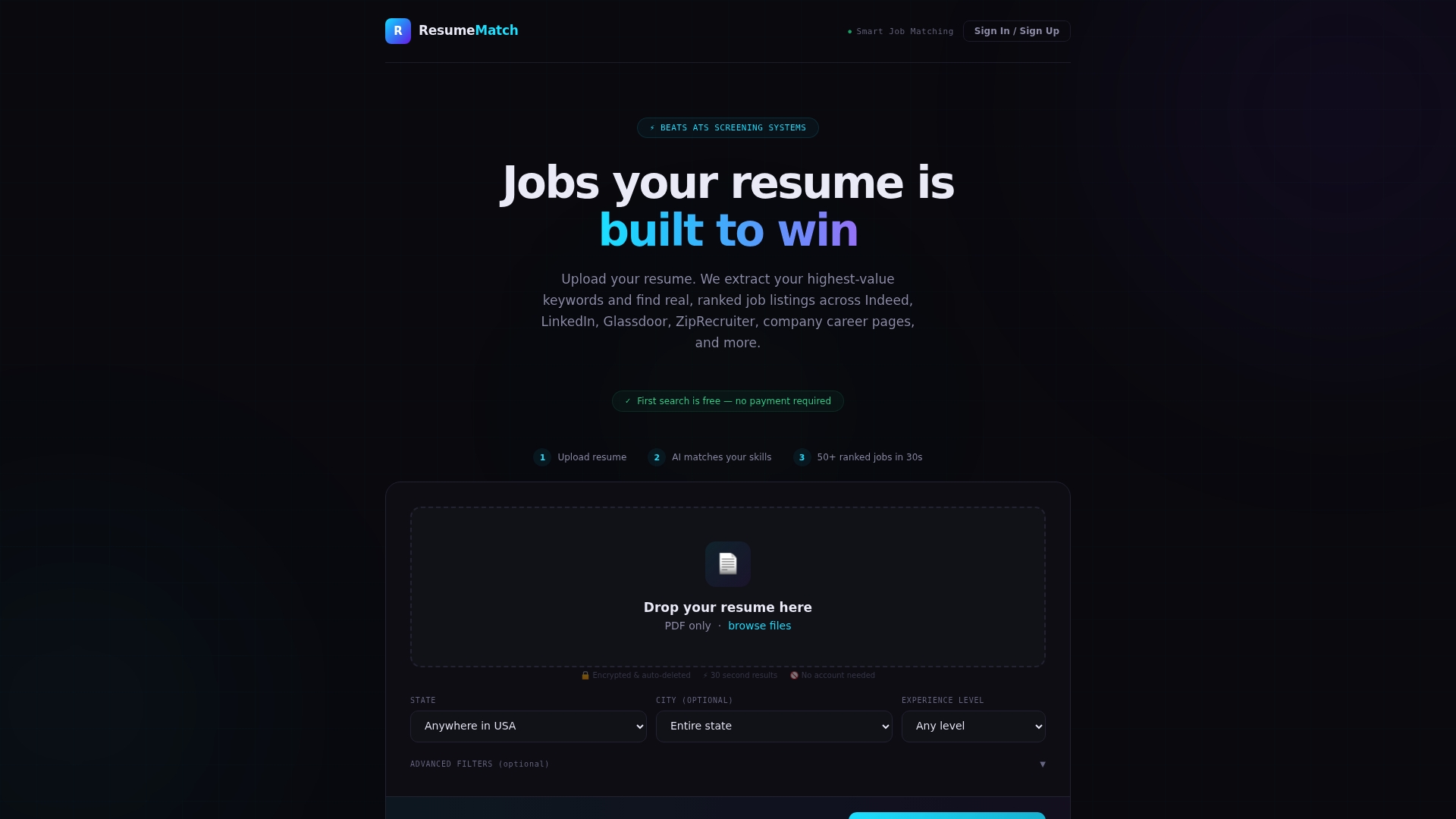
- AI resume analysis that flags parsing issues and keyword gaps in one pass.
- Career Probability Report covering competitive job matches, salary insights, and a personalized career strategy.
- Let Us Apply For You, a one-time $50 service where an agent submits applications on your behalf.
Self-editing works well once you know what to fix. When you’d rather skip the guesswork and let a system map your score to real openings, the ResumeMatch Membership starts at $15 per month and comes with a free trial.
Sources
For deeper reading on bias in automated screening, see the Brookings research on AI resume screening and the arXiv preprint on screening discretion. For technical parsing behavior, Workday’s developer documentation and Kloqk’s ATS explainer are both worth a read. Vendor-specific behavior always varies, so check your target employer’s own documentation when you can find it.
- Gender, race, and intersectional bias in AI resume screening via language-model retrieval | Brookings
- Screening, discretion, and callback gaps (arXiv preprint)
- Resume REST API documentation and parsing guidance | Workday Developer
- What Is a Resume Match Score and How Is It Calculated? | MatchCV
- Resume score meaning and good ATS score guidance | Resumello
FAQ
What is a good resume score?
A score of 80 or higher on most balanced checkers generally signals a well-tailored, cleanly parsed resume, according to common industry benchmarks. Anything in the 60 to 79 range usually points to fixable gaps rather than a fundamentally broken resume.
Is 72 a good ATS score?
Scores between 60 and 79 point to fixable gaps, often missing keywords or inconsistent formatting rather than a fundamentally broken resume, based on standard scoring benchmarks. It’s not a red flag, but it’s worth reviewing your headings and keyword coverage before applying.
How is a resume score calculated?
Most tools combine several checks: whether the file parses cleanly, how many required and preferred keywords appear, whether standard headings and contact fields are present, and whether your bullets show measurable impact. Because each tool weights these factors differently, the exact formula varies, which is why the same resume can score differently across checkers.
How do you score a resume yourself without a tool?
Start by checking whether your file is single-column and text-based with no embedded images, since parsing guidelines show this alone determines whether software can read it at all. Then compare your resume against the job posting’s top five to seven keywords and count how many appear naturally in context.