
Resume Red Flags: 9 Warning Signs and How to Fix Each
Resume Red Flags: 9 Warning Signs and How to Fix Each

A resume red flag is anything that makes a recruiter doubt your attention to detail, your honesty or your fit within the first few seconds. The good news: nearly all of them are fixable before you apply. Typos, unexplained gaps, vague bullets and a string of short jobs each have a clear repair, and the best time to find them is before a recruiter does. That is why we built ResumeMatch to include a resume gap analysis in its Career Probability Report, so you see weak spots while you can still change them.
TL;DR
- Language errors are the most common flag. One slip is forgivable, several can cost you the interview, so proofread twice and get a second pair of eyes.
- Gaps and short jobs are not automatic dealbreakers. Unexplained ones are. Give a short, honest line and show what you did with the time.
- Generic, buzzword-heavy or AI-polished wording reads as shallow. Replace it with specific results and scope.
- Everything on the page must hold up in an interview and a background check.
- You can fill a gap with projects, volunteering, certificates or freelance work, listed the way you would list a job.
Table of Contents
- Why recruiters spot red flags so fast
- Red flag 1: Typos, grammar slips and wrong names
- Red flag 2: Unexplained employment gaps
- Projects that fill a resume gap
- Red flag 3: Job hopping without a story
- Red flag 4: Generic, buzzword-heavy wording
- Red flag 5: Duties instead of achievements
- Red flag 6: Messy formatting and the wrong length
- Red flag 7: Missing or wrong contact details
- Red flag 8: Inconsistencies and stretched truths
- Red flag 9: One resume for every job
- A quick pre-apply checklist
- Perspective
- Check your resume before a recruiter does
- FAQ
- Sources
Why recruiters spot red flags so fast
A recruiter may have hundreds of resumes for one opening. They are not hunting for reasons to like you first. They are sorting, and anything that looks careless, inflated or confusing makes sorting easy.
The numbers show how common the problems are. An Adzuna analysis reported by SHRM found that 63.6% of resumes had at least one mistake and 13.5% had five or more. The same analysis found 30% of resumes had unexplained gaps of two months or more. If your resume is clean on these points, you already stand out from a large share of the pile.

The flags below are ordered roughly by how often they come up and how easy they are to fix.
Red flag 1: Typos, grammar slips and wrong names
This is the flag nobody argues about. Recruiter Levine told CNBC that typos and misspelled names, even of your own university, signal a lack of attention to detail. One error can be forgiven. More than one, in her view, would discourage a company from meeting you.
The National Technical Assistance Center’s resume toolkit reports that language problems were the most common issue in its study and are heavily penalized by employers. It recommends pairing spell-check with a second human review.
The fix:
- Run spell-check, then read the resume out loud, slowly.
- Check proper nouns by hand: employer names, school names, software names, your own name.
- Ask a friend, mentor or campus career office to read it. The University of Illinois HR guide also recommends having someone else proofread.
Red flag 2: Unexplained employment gaps
A gap is a stretch of time between jobs with nothing on the page. Forbes notes that hiring managers who see an unexplained gap may assume the candidate was fired, could not find work or was not productive. SHRM also reported research from 2019 in which applicants with work gaps had a 45% lower chance of landing interviews.
The word that matters is unexplained. A gap you address in one honest line is a different thing from a blank space.
The fix:
- Be brief. VA Careers suggests that a short line such as taking time off to care for family or pursuing professional development is often enough. Then point to the transferable skills you built, like communication, organization or project management.
- Use years instead of months for dates, add a skills-focused summary and list related volunteer work, projects, courses or certifications from the gap period, as Columbia Career Education recommends.
- Save the longer context for your cover letter. Washington State’s Resume Kit 2026 suggests one or two positive sentences there rather than on the resume itself.
- Never change dates to hide a gap. Recruiter Levine warns that background checks will reveal the truth.
For wording you can say out loud in an interview, see our guide to fixing employment gaps on a resume with U.S. rules and short scripts.
Projects that fill a resume gap
If you have a gap and little to show for it, the answer is not to invent anything. It is to do something real, even small, and list it properly.
Oregon State University’s career services lists these as legitimate gap-fillers: volunteering, academic or independent projects, certificates, contract work, committee service and community leadership. The key advice is to showcase them just as you would a job.
Here are project ideas that work for the readers we hear from most:
| If you are… | Project ideas | How to label it |
|---|---|---|
| A recent graduate | Capstone follow-up, an open-source contribution, a small data analysis of a public dataset, a student organization role | “Data Analysis Projects” or “Leadership Experience” |
| Changing industries | A certificate in the new field, a freelance job for a local business, a volunteer role using the target skill | A heading that names the skill, such as “Fundraising Experience” |
| Returning after caregiving or health leave | Short contract work, a course with a finished assignment, community committee service | “Professional Development” with dates |
| Between roles | A portfolio piece, a mock project plan, a volunteer event you organized | “Selected Projects” |
Oregon State recommends tailored headings such as “Fundraising Experience” or “GIS & Mapping Projects”, and the NTAC toolkit adds that these entries should carry dates and a short description of accomplishments.
A worked example. Say you spent eight months out of work after a layoff. You took a free online course in project management, organized a fundraiser for a local food pantry and did two freelance scheduling jobs. On the resume, that becomes one entry: “Independent Projects, 2025: Coordinated a food pantry fundraiser with 12 volunteers; managed scheduling for two small-business clients.” That is a concrete line with scope. It turns a blank into a story.
If the target role involves project management, our collection of best resume keywords for project managers shows how to word entries like this so they match what employers search for.
Red flag 3: Job hopping without a story
Several short jobs make some recruiters wonder whether you will stay. The reality is more nuanced. Hire in South explains that short stints are normal for contractors, consultants, seasonal workers and startup employees. What raises concern is a repeated pattern of unexplained exits and vague or inconsistent explanations. Layoffs, restructurings, career progression and relocations are all accepted reasons.
The fix:
- Label the job type. Washington State’s Resume Kit suggests marking roles as temporary, seasonal or internship, and using the staffing agency as the employer for agency placements.
- Group short stints. For many roles under six months, the same kit suggests listing only the year and describing combined experience in the summary.
- Explain in a sentence. SHRM advises a brief, honest note in the cover letter and a positive answer in the interview, without bad-mouthing former employers or over-explaining, which can sound defensive.
- Use Context, Decision, Result. Kinsa recommends one sentence of context and one of intent: what was happening, what you chose and what you gained.
For example: “The company restructured my team, so I took a contract role that let me build reporting skills, which led to this analyst path.”
Red flag 4: Generic, buzzword-heavy wording
Phrases like “results-driven professional with a passion for excellence” tell a recruiter nothing. Career expert Klatt, quoted by NC State, says HR teams see resumes that check the keyword boxes but lack depth. Over-polished generic language and buzzwords without substance are specific warning signs. Klatt also advises using AI only as a drafting tool and being ready to defend everything on the page.
The fix: Replace each adjective with a fact. “Strong communicator” becomes “Presented weekly updates to a 15-person department.” If you cannot back a phrase with an example, cut it.
Red flag 5: Duties instead of achievements
A list of responsibilities says what the job was. It does not say what you did with it. The University of Illinois guide suggests asking yourself what problems you solved or improvements you made and using action verbs and specific examples. Harvard’s career center also lists not demonstrating results as a top-five resume mistake.
Klatt adds that what stands out is evidence of impact: results, metrics and context on scope, scale and complexity.
| Weak | Stronger |
|---|---|
| Responsible for customer emails | Answered 40+ customer emails a day and kept response time under two hours |
| Helped with social media | Grew the club’s Instagram following from 300 to 1,100 in one semester |
| Managed a team | Scheduled and coached a team of eight bartenders during peak weekend shifts |
That last row matters for career changers. A bartender who schedules and coaches a team has management skills that an account manager role needs, even if the job title does not say so. Your wording has to make that link for the reader.
The numbers must be true. If you do not have exact figures, use honest estimates you could defend in an interview.
Red flag 6: Messy formatting and the wrong length
Harvard lists poor organization and skimmability among the top mistakes. Forbes recommends a clean, professional template with consistent formatting. The Illinois guide recommends one to two pages depending on experience, and cutting anything that does not help you get the job you want now.
The NTAC toolkit gives practical specifics: one standard font at 10 to 12 point, consistent bullets and spacing, contact information in the body rather than the header or footer, standard headings, and no tables or text boxes. That last set of rules is about applicant tracking systems, the software many employers use to read and sort resumes. A layout that looks great but parses badly can drop your phone number or scramble your experience.
The fix: Keep one clean column and standard section names. Check that the PDF keeps its formatting when converted. Our walkthrough on fixing ATS-friendly resume design with a parse test shows how to confirm your file reads the way you expect.
Even the file name counts. Odd symbols can break uploads, as this note on symbols that can break uploads explains. A simple pattern like the one in our copy-ready resume file naming guide avoids the problem.
Red flag 7: Missing or wrong contact details
Harvard lists missing email and phone information among its top five resume mistakes. It sounds too basic to happen, yet it does. Check that your email is professional, your phone number is current and any link to a portfolio or profile opens.
Red flag 8: Inconsistencies and stretched truths
Recruiters compare your resume with your LinkedIn profile and with what you say in interviews. Klatt points to consistency across all three as a signal that stands out. Indeed, the NC State piece lists a sophisticated resume with little depth in the interview as a red flag in itself.
The harder line is about honesty. Recruiter Levine advises against changing dates or claiming degrees you do not hold, since background checks will reveal it and the discovery makes it very hard for an employer to trust you afterward. Describe your real work in its best honest light instead.
Red flag 9: One resume for every job
A cookie-cutter resume signals that you did not read the posting. Tailoring does not mean rewriting everything. It means matching your strongest, truest experience to the language of each role and putting it near the top.

If you are changing industries, this matters most. Your titles may not match, but your skills do. Our guide to a career change resume format shows how to lead with transferable skills.
A quick pre-apply checklist
- Two proofreads, one by you out loud and one by another person.
- Every gap over a couple of months has a short, honest line or a listed project.
- Each job has at least one result, not just duties.
- No phrase on the page you could not explain in an interview.
- Clean one-column layout, standard headings, 1 to 2 pages.
- Contact details correct and consistent with your online profiles.
- Dates and degrees accurate.
- Resume wording matches the specific role.
Perspective
We built ResumeMatch because we have felt the other side of this: sending out application after application and never learning why nothing came back. Most red flags are not about talent. They are about how a resume tells the story. A bartender who ran a team and an account manager who ran a team have the same skill, but only one resume says it in the words a hiring manager expects.
That is why our Career Probability Report looks at your resume the way an employer would. It includes a resume gap analysis, competitive job matches, salary insights and a career strategy, so you can fix weak spots first and apply with confidence. Our AI scores your resume against real skills, not just keywords, and matches you to live job listings across multiple job boards in about 30 seconds.
If a job search feels overwhelming, start with what you can control: a resume that is honest, specific and ready. You can do this, and we are here to help.
Resume
Check your resume before a recruiter does
The fastest way to find red flags is to see your resume next to real job listings. ResumeMatch reads your resume, extracts the key skills and matches you to tailored openings across multiple job boards, then gives you a Career Probability Report with resume gap analysis and salary insights. You can start with a 72-hour free trial. The membership is $15 per month after that.
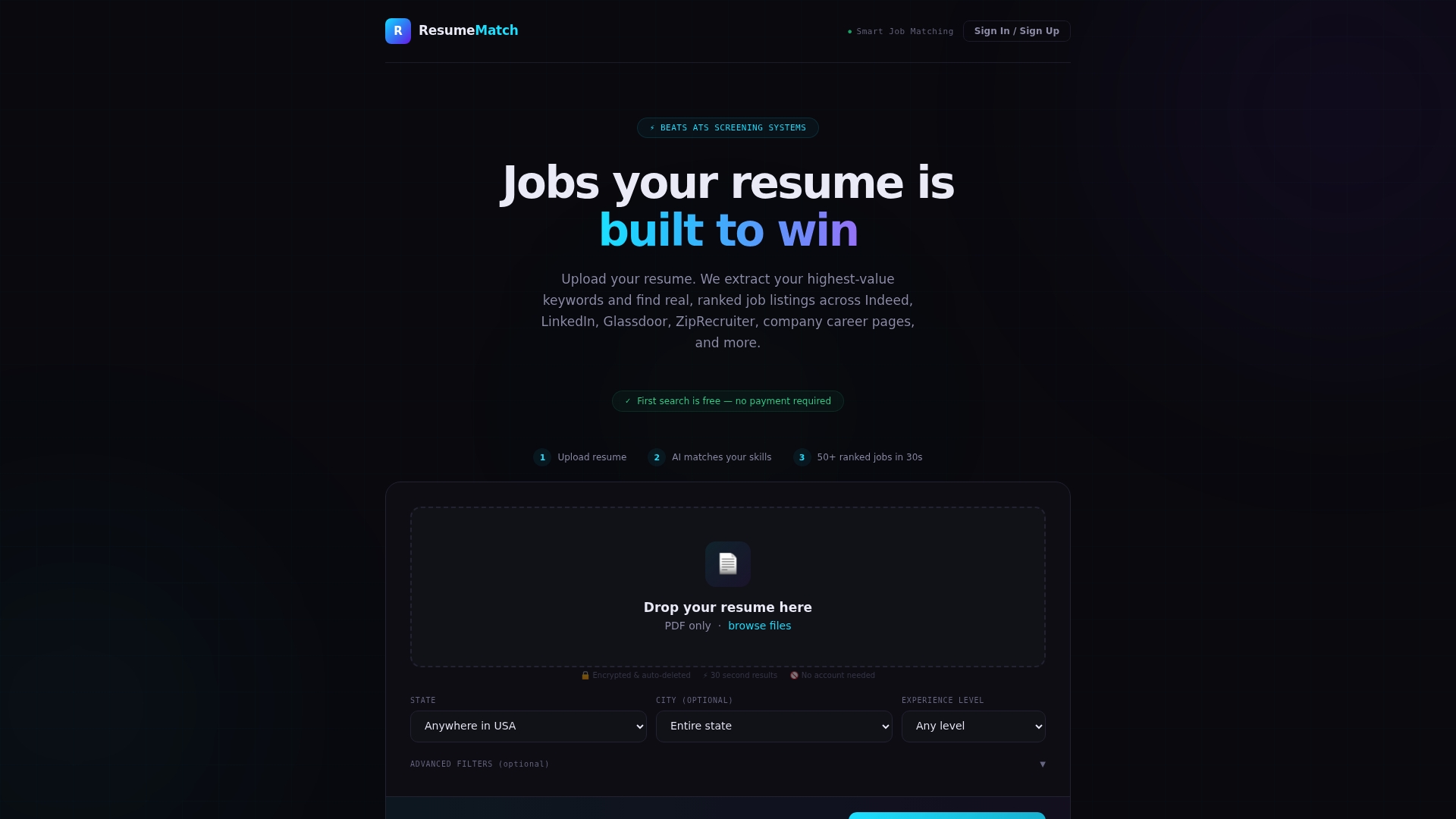
If you would rather not spend evenings on applications, our Let Us Apply For You service is a one-off $50, and our agents apply to jobs on your behalf with a guaranteed minimum number of personalized applications. You can find both on the ResumeMatch site.
FAQ
What is the biggest resume red flag?
Typos and grammar errors are the most commonly penalized. The NTAC toolkit found language problems to be the single most common issue in its study. Spell-check plus a second human reader catches most of them.
Are employment gaps always a red flag?
No. Unexplained gaps are the issue. A short, honest line, such as time off for family care or professional development, combined with relevant skills or projects, usually answers the question. Never alter dates to hide a gap.
Is job hopping a red flag?
One or two short stints rarely worry experienced recruiters. A repeated pattern with no clear reason does. Label contract or seasonal roles, group very short jobs and prepare a one-sentence reason for each move.
What projects can I add to fill a resume gap?
Volunteer work, independent or academic projects, certificates, freelance or contract jobs and community leadership all count. List them like a job, with dates and a short description of what you accomplished.
How long should my resume be?
The University of Illinois guide recommends one to two pages, depending on experience. Recent graduates usually fit on one page. Cut anything that does not help you get the job you want now.
Sources
- Don’t Make These Resume ‘Miztakes’ (SHRM)
- Biggest resume red flags from a recruiter (CNBC)
- Resume Toolkit for Blind and Low Vision Job Seekers (NTAC)
- Resumes and Cover Letters: Resume Review (University of Illinois HR)
- Harvard College Guide to Creating a Strong Resume
- Tips for Creating a Successful Résumé (NC State Alumni)
- How to Explain Employment Gaps (Columbia Career Education)
- Turning resume gaps into opportunities (VA Careers)
- 7 Resume Red Flags Hiring Managers Spot Instantly (Forbes)
- How to Handle a Job Gap in Your Resume or Interview (Oregon State University)
- Resume Kit 2026 (Washington State ESD)
- How to Explain Job Hopping in an Interview (SHRM)
- How to Explain Job Hopping in an Interview (Kinsa)
- Is Job Hopping Still a Red Flag When Hiring in 2026?
- CV File Names: The Symbols That Can Break Uploads