
Questions to Ask Interviewers: 40+ Smart Ones by Topic
Questions to Ask Interviewers: 40+ Smart Ones by Topic

The best questions to ask interviewers are the ones that only make sense for this role, this team and this stage of the process. Prepare six to ten, ask the two to five you have time for, and choose them from four areas: the work itself, how success is measured, the people, and the next steps. Save salary and benefits for the offer stage. Below you will find the questions, who to ask each one, and what to avoid.
We built ResumeMatch because job seekers told us the same thing again and again: they could handle the questions they were asked, but froze at “Do you have any questions for us?” You do not have to. This is a question bank you can pick from in ten minutes.
TL;DR
- Prepare six to ten questions, expect to ask two to five, and keep backups because some will be answered during the conversation.
- Pick questions by area: day-to-day work, success and evaluation, team and manager, and next steps.
- Match the question to the person: strategy for the hiring manager, role details for the supervisor, culture for future teammates.
- Do not ask about salary, vacation or benefits in a first interview, and skip anything the company website already answers.
- Close with the timeline: ask what the next step is and when you can expect to hear back.
Table of Contents
- Why your questions matter as much as your answers
- How many questions to prepare
- Match the question to the person across the table
- Questions about the day-to-day work
- Questions about success and expectations
- Questions about the position’s history and growth
- Questions about the team, manager and culture
- Questions about the company’s direction
- Questions to close the interview
- What not to ask in the first interview
- Make your questions specific to the job
- A simple prep routine
- Our perspective
- Where ResumeMatch fits
- FAQ
- Sources
Why your questions matter as much as your answers
An interview is a two-way evaluation. Your questions show that you listened, that you did your homework, and that you are thinking about how you would contribute. Princeton Career Services says good questions should reveal more about the role, expectations and culture, and show how you would contribute rather than what you would receive. Benefits and rewards can wait until there is an offer.
The same questions also protect you. If you are a recent graduate, you may not yet know what a healthy team sounds like. If you are changing industries, you need to find out how your existing skills will be used. Either way, the answers tell you whether you want the job.

How many questions to prepare
The sources agree on a rough rule: bring more than you will use.
| Source | How many to prepare | How many you will likely ask |
|---|---|---|
| U.S. Department of Labor TEAMS guide (2026) | Six to seven | Two or three |
| University of Maine career hub | Six to ten | Whatever is left unanswered |
| Virginia Tech Career and Professional Development | Four or five | Two or three, with backups |
| Wake Forest career office | Four or five | As time allows |
The practical takeaway: write down eight, star your top three, and cross off any that get answered along the way. Never say “No, I think you covered everything” with nothing in your pocket. Virginia Tech also advises avoiding yes/no questions, since open questions get you stories instead of one-word answers.
Match the question to the person across the table
Not every interviewer can answer every question. La Follette (UW–Madison) notes you will likely only get three to five questions in, so choose by who is interviewing you: a recruiter, a potential supervisor or future teammates. The Darden School at UVA splits questions into three types:
- Company and strategy questions go to the hiring manager or the most senior person in the room.
- Role-specific questions dig into the work and suit a supervisor or someone who does the job.
- Fit and culture questions suit a potential direct superior or teammate.
A recruiter on a first phone screen usually knows the process, the timeline and the basics of the role. If you want to rehearse that stage, our guide to phone screen questions covers what recruiters ask. Save the detailed day-to-day and team questions for the people who will actually work with you.
Questions about the day-to-day work
These are the safest and most useful opening questions. They help you picture a normal Tuesday and show that you are already thinking like a team member.
- What does a typical day or week look like in this role?
- What would my primary responsibilities be, and which projects would I contribute to first?
- How much autonomy would I have, and how often are check-ins or reporting?
- How does the team prioritize tasks and manage deadlines?
- If I started tomorrow, what would be the top priority on my to-do list?
- What challenges do people in this role commonly run into?
The University of Maine guide lists most of these as ways to drill down on everyday tasks, including autonomy, routine meetings and deadlines. If you are going for a technical position, role-specific question sets help you go deeper, such as these software developer interview questions about the team and daily responsibilities.
Questions about success and expectations
These questions show ambition without sounding pushy. They also tell you whether the employer has a clear picture of what good work looks like.
- What would success look like for me in this position, and how is it measured?
- What is the most important thing I should accomplish in my first ninety days?
- What would you like to see from me on day one, in three months, six months and a year?
- What are the KPIs or metrics you use to evaluate this role?
- A year from now, looking back on this hire, what would I have done to exceed every expectation?
- What do you see as the most challenging part of this job?
The first two come straight from University of Colorado Boulder and the Maine guide. The “year from now” question and the KPI question come from MIT Sloan’s Career Development Office. If the answer is vague, that is information too. A team that cannot say what success looks like may not have thought through the role.
Questions about the position’s history and growth
This is where mid-career changers and first-time job seekers can learn the most.
- Why is this position open?
- Is this a new role? If not, what happened to the person who held it before?
- How has this position evolved?
- What is the typical career path for someone in this role?
- How does the team I would be part of keep growing professionally?
MIT Sloan explains why the “why is it open” question works: the answer can point to a promotion, an expansion or a departure, and each opens a useful follow-up. Ask it calmly and curiously, and listen to how the interviewer responds. The career path question comes from the Wake Forest list.
Questions about the team, manager and culture
These are best for a potential manager or teammate. Fidelity’s talent acquisition team says they like it when candidates ask about them as a person, such as what they enjoy about the group or what brought them there. They also say your questions should show that you were listening.
- Can you tell me about the team I would be working with?
- How would you describe the work environment?
- How would you describe the management style here?
- What do you enjoy most about working for this organization?
- What influenced your decision to join the company?
- What was the department’s biggest challenge last year, and what did you learn from it?
- What advice would you give someone new in this position?
UC Davis Career Center advises asking about the team, success in the role and next steps, and avoiding anything easily answered on the company website. Wake Forest lists several of the culture questions above.
Two cautions. Fidelity recommends avoiding overly personal questions and anything that pries into office politics or difficult bosses. And La Follette (UW–Madison) points out that your interviewer is often your first contact and perhaps your future boss, so how they respond reveals their attitude and values. Notice whether they seem open and engaged when they talk about the team.
Questions about the company’s direction
Save these for a hiring manager or senior leader. Darden advises that strategy questions need research beyond the company website: recent press statements, media coverage, filings and analyst reports. Fidelity groups these as company-wide goals and initiatives.
- What are the company’s biggest priorities for the next year, and how does this team support them?
- I read about a recent announcement. How does it change this team’s work?
- What are the biggest challenges or opportunities this role will face in the next year?
The more specific your reference, the better. A question that mentions a real product launch, a new market or a published goal sounds like preparation. A question that could be asked of any company sounds like a script.
Questions to close the interview
The last question is often the most important. Goucher College’s Career Education Office calls “What’s the next step in the process?” the key closer, because it can reveal the timeline and how many other candidates are in the pool.
- What are the next steps in the selection process?
- When can I expect to hear from you?
- How soon do you plan to fill this position?
- Is there any other information I can provide?
- Is it okay to check in, and do you prefer a call or an email?
The first three are in the Department of Labor guide, and the last two come from La Follette and FedWeek. La Follette adds that an interviewer who is vague about next steps may already have another candidate in mind, so keep your search going either way.
Then end with a short statement: thank them, repeat in one sentence why your skills fit, and say you are excited about the next step. Colorado Boulder recommends a strong closing statement that reminds the interviewer of your skills and asks about next steps.
When to follow up
FedWeek suggests setting a specific follow-up date, usually a week or two out. If you were given no timeline, wait at least a week but not more than 10 to 14 days before asking about the status. Our interview prep checklist walks through what to do before, during and after, and our note on the best time to email a recruiter helps with timing.
What not to ask in the first interview
The government and university sources are strikingly consistent here.
- Salary, vacation, benefits and flextime. The Department of Labor’s guide lists these, along with how long it takes to get promoted, as questions to avoid. My Texas Future says to raise pay and benefits separately with HR or the recruiter, and to be ready to answer if the employer asks about your expected range.
- Anything the website answers. It signals you did not prepare.
- Yes/no questions. They end the conversation instead of starting one.
- Questions that probe gossip. Skip anything about difficult bosses or office drama.
Pay is still a legitimate topic. It just belongs to a later stage, once the employer wants you. When that conversation arrives, you will do better if you already know your market value. Here is a look at how recruiters capture salary expectations, which helps you see why they ask early and how to be prepared.
Make your questions specific to the job
Generic questions get generic answers. The strongest candidates tie each question to something in the posting, their own resume or a gap they noticed.

Here is an example. Say you worked as a bartender and managed a small team on busy nights, and you are applying for an account coordinator job. A generic question is “What is the culture like?” A tailored one is “I have led a team through high-pressure shifts. How does this team handle busy client periods, and who steps in when deadlines collide?” The second shows your transferable skills while still asking about the work.
If you are a recent graduate, tie questions to what you learned in class or internships: “My capstone used this reporting tool. Is that part of the team’s daily workflow?” If you are changing industries, ask how people from other backgrounds have succeeded on the team.
The same logic applies earlier in the process. The better you understand how your skills line up with the posting, the sharper your questions get. Our guide to getting personalized job matches that fit explains how to read a listing against your own skills.
A simple prep routine
- Read the posting twice. Underline the duties and the skills they ask for.
- Research the company. Find one recent announcement, product or goal.
- Write eight questions. Include two for each area: the work, success, the team and the next steps.
- Rank them. Pick your top three for each interviewer.
- Take notes in the interview. Cross off answered questions and note follow-ups.
- Send a thank-you. Mention one answer that stuck with you.
If practice helps you stay calm, our post on AI interview prep shows how to rehearse smarter.
Our perspective
We built ResumeMatch because we remember how it feels to prepare for an interview with only a job title and a hope. Most people practice their answers and leave their questions to the last five minutes. That is a missed chance.
Good questions come from understanding the role. The more clearly you see how your skills match a listing, and where the gaps are, the easier it is to ask about the work, the team and what success looks like. That is why our Career Probability Report includes a resume gap analysis, salary insights and career strategy alongside competitive job matches. When you know where you stand, you ask better questions and negotiate with more confidence.
We also built interview preparation and application tracking into the same workflow, so the notes you take in one interview carry into the next. You do not need to feel overwhelmed. You need a clear picture of the job and a short list of questions that are yours.
Resume
Where ResumeMatch fits
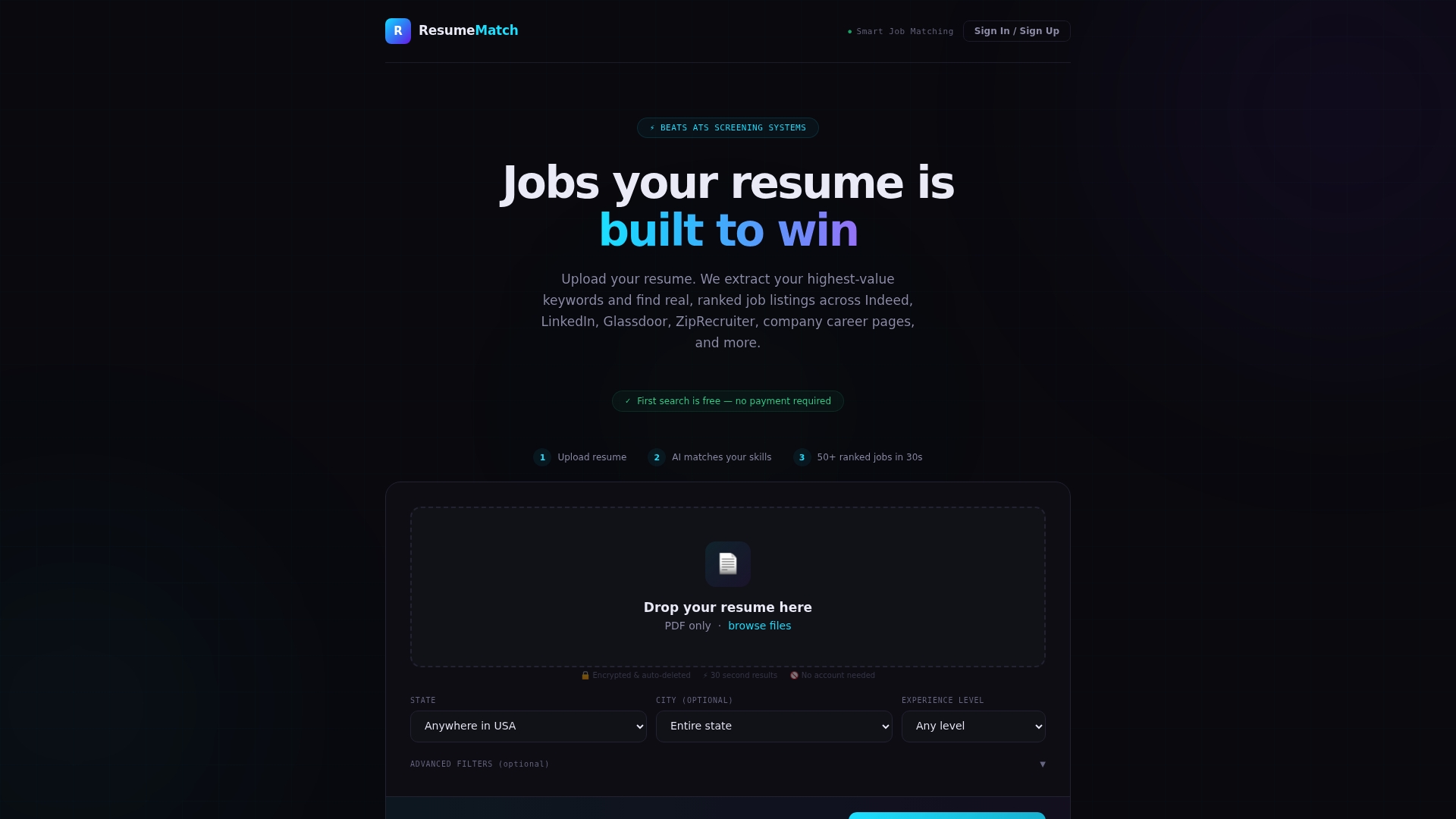
If you would rather spend your energy on interviews than on searching, ResumeMatch analyzes your resume, extracts the keywords that matter and matches you to live job listings across multiple job boards in about 30 seconds. The Career Probability Report adds salary insights, a gap analysis and a career strategy, and the platform includes interview preparation, recruiter outreach templates and application tracking. Membership is $15 per month after a 72-hour free trial.
If applications are the bottleneck, our Let Us Apply For You service is a one-time $50, where agents apply to jobs on your behalf, with a guaranteed minimum number of personalized applications. See ResumeMatch Membership and the application service. To understand how many applications it typically takes, see how many applications lead to a job and the application to interview ratio.
FAQ
What are the best questions to ask an interviewer?
Start with what success looks like in the role, what a typical week involves, and what the biggest challenge is. Add one question about the team and one about next steps. These work because they show interest in doing the job well, and they give you real information about the employer.
How many questions should I ask at the end of an interview?
Prepare six to ten, but plan to ask two to five. The Department of Labor’s guide suggests six or seven prepared and two or three asked. Backups matter because earlier conversation may answer some.
Can I ask about salary in the interview?
Not in a first interview. Several university career offices and the Department of Labor recommend saving salary, vacation and benefits for the offer stage or a separate conversation with HR or the recruiter. Be ready with a range in case the employer asks you directly.
What should I ask a hiring manager versus a recruiter?
Ask the recruiter about the process, timeline and basics of the role. Ask the hiring manager about priorities, expectations, management style and how success is measured. Ask future teammates about daily work and team culture.
How do I end the interview well?
Ask about next steps and when you can expect to hear back, then restate in one sentence why you are a strong fit. Send a thank-you note the same day and follow up on the date you agreed, or after a week to two weeks if none was given.
Sources
- U.S. Department of Labor TEAMS Interview Skills Participant Guide (2026)
- Princeton Career Services Interview Guide
- University of Maine: Potential Questions to Ask an Employer
- Virginia Tech: Questions to ask at the end of the interview
- Wake Forest: Questions to Ask the Interviewer
- Darden School of Professional Practice: Questions to Ask in an Interview
- University of Colorado Boulder: The most important interview question
- MIT Sloan Career Development Office: 40+ Smart Questions
- UC Davis Career Center: Interviews and Offers Guide
- Fidelity: What should I ask at the end of my interview?
- La Follette School (UW–Madison): Questions to ask employers
- Goucher College: Preparing for an Interview
- FedWeek: Interview mistakes and how to follow up
- My Texas Future: Tips on How to Prepare for an Interview
- Software developer interview questions
- How recruiters capture salary expectations