
Salary Range Negotiation: How to Set Your Number and Ask
Salary Range Negotiation: How to Set Your Number and Ask

The best way to negotiate a salary range is to arrive with your own range already built from market data, tied to your skills, and anchored toward the upper half of what the role pays. Then let the employer make the first formal offer, counter with evidence, and look at the whole package. The work happens before the conversation. A job that matches your skills gives you the strongest case, which is why we built ResumeMatch to match your resume to live listings and show salary insights in its Career Probability Report.
Below you will find how to determine a realistic range, how to set a target, what to say in the room, and what to do when the offer comes in low.
TL;DR
- Build your range from three to five data points: government wage data, live job postings with posted pay, and people in the field. Adjust for location and experience.
- Set three numbers: a dream number, a realistic target, and a walk-away minimum. Keep the walk-away number to yourself.
- Let the employer raise pay first when you can, never share your salary history, and if you must name a range, make sure every figure in it is one you would accept.
- When the offer is low, thank them, ask for a day or two, then counter with specific evidence. Look at bonus, PTO, title and flexibility too.
- Negotiate from a role that truly fits your skills. A tailored resume and well-matched jobs give you leverage.
Table of Contents
- How to determine a realistic salary range
- How to set your target salary range
- When to talk numbers (and what not to say)
- How to negotiate once you have an offer
- What to say when the offer is below the posted range or your target
- What not to say
- Why a better job match is your best leverage
- Where ResumeMatch fits
- Our perspective
- FAQ
- Sources
How to determine a realistic salary range
A range you can defend starts with data, not a feeling. Start with the free, government-backed numbers and then add live market signals.
Start with the wage distribution
The Bureau of Labor Statistics publishes employment and wage estimates by occupation at the national, state and metropolitan levels through its OEWS program. Its guide to using that data in salary talks explains that the full spread of wages (the 10th, 25th, 50th, 75th and 90th percentiles) is more useful than a single average. It also says people just starting out may expect wages near the 10th or 25th percentile, while those with more experience and education may expect wages near the 75th or 90th.
That gives you a simple way to place yourself:
| Where you are | Where to look in the distribution |
|---|---|
| First job out of school | 10th to 25th percentile |
| A few years of relevant experience | Around the median (50th) |
| Deep experience, advanced credentials, rare skills | 75th to 90th percentile |
Note that the BLS guide was published in 2010, so treat it as a method and pull the current figures for your occupation from the BLS site.
Add three to five data points
One number is a guess. A university career office recommends gathering three to five data points from government data, industry reports, salary sites, alumni and informational interviews, then adjusting for location and experience. Harvey Mudd College’s career guide adds a practical reminder: cost of living can be significantly higher in a large metro area than in a small city, so a national figure rarely fits you exactly.
Use posted pay ranges as live evidence
Some states now require employers to post pay ranges, and California, New York and Colorado are among them. Where postings include pay, they show what employers are willing to spend right now. Collect a handful of postings at your level and note the low and high of each. Check the pay transparency rules for your own state, because they differ widely.
This is where matching helps. When you run your resume through ResumeMatch, you get ranked job matches from multiple job boards, and the Career Probability Report includes salary insights, so your data points come attached to roles you are actually qualified for.
Check the employer’s own structure
The Department of Labor’s TEAMS guide notes that many positions have a pay scale with a minimum and maximum, and sometimes a midpoint, which gives the company room to offer an amount based on the job and the candidate’s expertise. In other words, the posted range is not one price. Where you land inside it depends on how well you show your fit.
How to set your target salary range
Once you know the market, turn it into three numbers. Coursera describes them as a dream number, a realistic target and a walk-away minimum, and the DOL guide uses the same logic: know your target, the midpoint and your walk-away minimum.
- Dream number. The top of the market for someone with your experience. You rarely open with it, but it sets your ceiling.
- Realistic target. The fair midpoint of your research. This is the number you expect to land near.
- Walk-away minimum. The lowest offer you would accept.
Find your minimum with a budget
Harvey Mudd’s guide suggests looking up the job title using the 25th to 75th percentile, picking a target, then calculating take-home pay from that target and comparing it with your basic budget to find the minimum you can accept. Do this before any interview, when you are calm.
Keep the minimum private
Deloitte’s career transition guidance says to keep your true minimum as a personal data point, not something to share with employers. It also warns that a rigid demand like “nothing less than a 20% increase” may get you removed from consideration. Anchor on market value and your skills, not on a percentage bump over your last job.
Aim high, stay realistic
The DOL guide advises being realistic but aiming high when you state a desired range, because you can come down but cannot talk your way back up if you aim too low.
Worked example
Say you are a training coordinator with four years of experience and the postings in your metro show pay between $58,000 and $72,000. Your research puts the median near $64,000. Your realistic target is $66,000 to $70,000, because you have supervised a team and built onboarding materials. Your dream number is $72,000. Your walk-away minimum, from your budget, is $60,000, and nobody hears that one. If asked, you say you are looking at $66,000 to $70,000, and you would happily take $66,000.

When to talk numbers (and what not to say)
Timing is part of the strategy. The DOL guide recommends letting the employer make the first move into salary negotiation, so first show how your skills line up with the role. The GMU guide is direct about two things: do not start a salary conversation before an offer, and do not share your current salary or salary history.
You also have legal footing. In many places it is illegal for employers to ask about your previous or current pay, and you do not have to say it either way. Redirect to the role: “I’d like to focus on what the position is worth in this market. Based on my research, I’m looking at $66,000 to $70,000.”

If you must name a range
Sometimes a recruiter insists. Harvard’s career center advises naming a range that comes from your research and needs, and making sure it is one you are comfortable with, because some employers default to the lower end of the range you give. Two rules follow:
- Keep the range tight. A spread of about $4,000 to $6,000 sounds informed. A spread of $40,000 sounds like a guess.
- Make the bottom figure a number you would say yes to.
If the posting has a very wide band, say $70,000 to $110,000, and the employer notes that new hires usually start near the beginning, Harvard suggests choosing a range between your target and your ideal that sits toward the beginning of the band. Choosing a number does not mean you cannot negotiate later.
How to negotiate once you have an offer
Here is the sequence that works for most U.S. job offers.
- Express enthusiasm first. The GMU guide recommends showing appreciation and enthusiasm, building context, then sharing a range that reflects your value.
- Ask for time. The Idaho Department of Labor workbook says it is fine to ask for time to consider an offer, but not more than a day or two, and to be specific about how long. The DOL guide notes counters often happen within 24 to 48 hours.
- Compare the offer to your numbers. Is it inside the posted range? Near your target? Above your minimum?
- Counter with evidence. Cite your experience, the scope of the role and your market data, not personal needs.
- Widen the conversation if base pay is capped. More below.
- Get the final terms in writing. Happen advises getting the agreed offer in writing, ideally signed by both sides, with salary, duties, benefits and anything else you negotiated.
How big a counter is reasonable?
There is no official figure. Many career writers suggest roughly 5 to 10% above the offer, but your research matters more than any rule of thumb. If the offer sits at the bottom of a band and your data supports the middle, ask for the middle.
Scripts you can adapt
Opening the counter: “Thank you, I’m excited about this role and the team. Based on my research for this role in this market, and my experience leading onboarding for a team of eight, I was expecting something closer to $68,000. Is there flexibility?”
Asking for time: “I’d like to review everything carefully. Can I get back to you by Thursday afternoon?”
If they say the budget is fixed: “I understand. Could we look at a sign-on bonus or an earlier salary review?”
What to say when the offer is below the posted range or your target
This is the moment people dread, and it is more workable than it feels. The steps depend on where the gap is.
Case 1: The offer is below the posted range
Stay calm and keep the tone collaborative. Thank them, then ask how the number was set relative to the posted band. You might say: “I’m excited about this role. The posting listed $62,000 to $74,000, and the offer is $57,000. Can you help me understand how the number was determined?” Then present your case: the scope of the role, your relevant experience and the market data you gathered. The DOL guide advises negotiating before declining, especially when research supports a higher value.
Case 2: The offer is inside the range but under your target
This is the most common situation. Name your number and the reasons. “The offer is $63,000. Given my four years of experience and my team leadership background, I’d like to discuss $68,000.” Use specifics, such as skills the posting asks for that you already have.
Case 3: The base cannot move
The DOL guide suggests considering the whole package and negotiating other components if the employer cannot match your desired salary: for example a shorter review period, a sign-on bonus or more vacation. Robert Half lists commonly negotiable elements: base salary, annual bonus, signing bonus, PTO, flexible or hybrid schedules, professional development budget, relocation and start date. Deciding what you value beyond pay is its own exercise, and thinking through the full compensation picture can keep you from trading away what matters most.
Can you lose the offer by negotiating?
It is unlikely. Happen notes an offer is unlikely to be rescinded just because you tried to negotiate, though being rude or too pushy can change that. Courtesy and evidence keep you safe. One firm boundary: do not reopen salary after you have formally accepted. Robert Half warns it can make you look indecisive.
What not to say
- “I need this much because my rent went up.” Personal need is not a market argument.
- “My current salary is…” Skip it. You do not have to share it.
- “I’ll take whatever you can offer.” It signals your minimum is low.
- “I won’t accept less than a 20% raise.” Deloitte’s guidance flags this kind of ultimatum as risky.
- A very wide range, such as $70,000 to $110,000, which tells the employer you are guessing.
Why a better job match is your best leverage
Negotiating power comes from fit. If your resume speaks the language of the role, you enter the conversation as a strong candidate instead of a hopeful one. A University of California, Irvine career guide explains that applicant tracking systems scan and rank resumes by keywords and job requirements, that exact job description wording matters, and that candidates should aim for at least a 75% match with the description.
To raise your ATS score honestly, use the job description to identify the skills the employer wants, work those skills into your action statements and back them with examples, as Kansas State University’s career center advises. Keep the layout simple: standard section titles like Experience, Education and Skills, no tables or text boxes, and a Word document or PDF.
If you want to see what these systems really do, our guide to ATS myths clears up the common misunderstandings. If you are changing fields, transferable skills examples show how to translate past duties into the language of a new role, such as a bartender who ran a shift team and managed inventory reading like a strong candidate for an account or operations role. Our piece on skills-based job matching explains why skills, not titles, should drive your search.
The stronger your match, the stronger your case that the job deserves the upper half of the range.
Where ResumeMatch fits
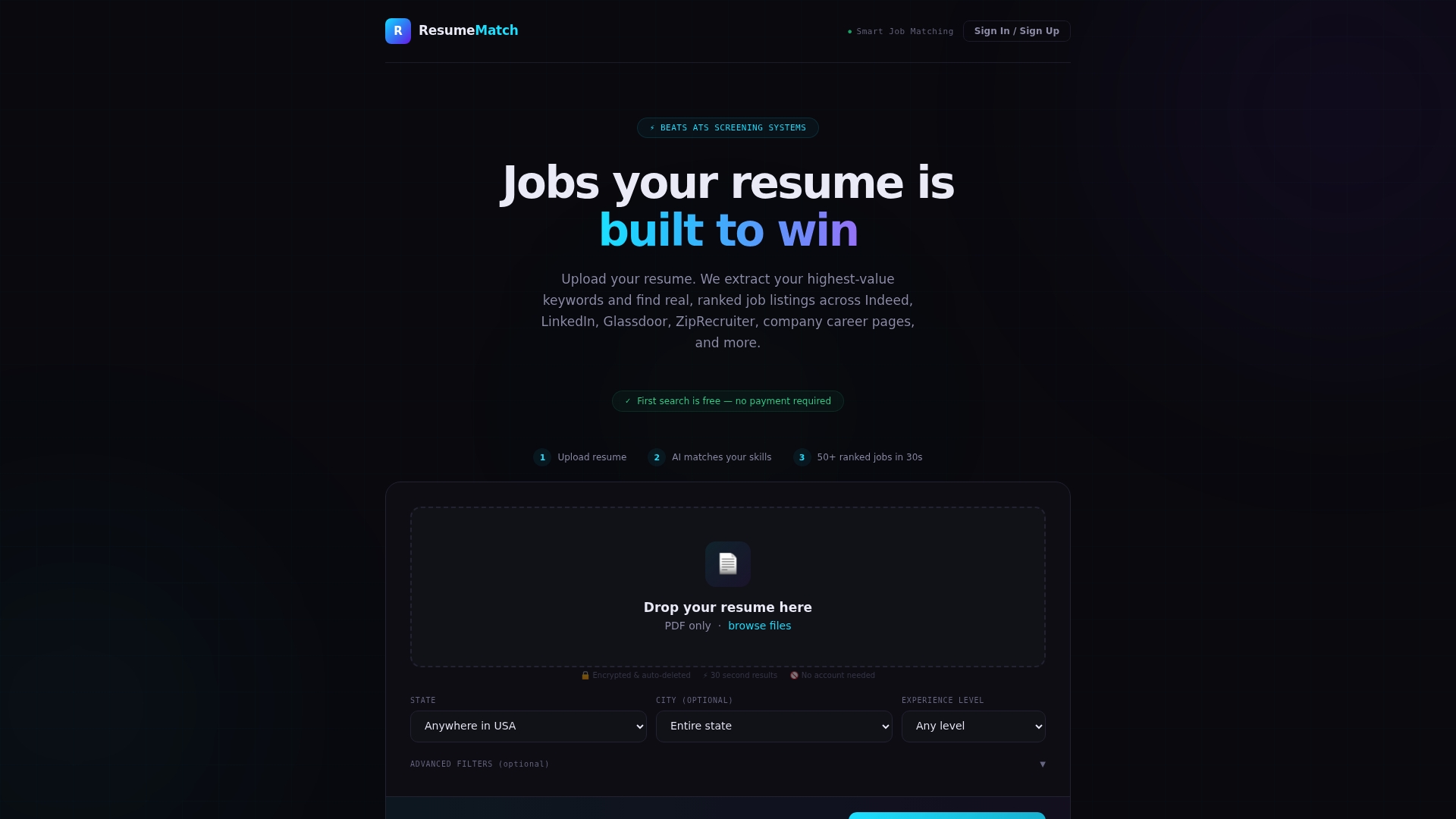
A 30-second upload gives ResumeMatch what it needs to extract the key skills from your resume and match you to live listings across multiple job boards. Its Career Probability Report brings together competitive job matches, salary insights, a resume gap analysis and a career strategy, so you can walk into a negotiation with a range and a reason. The same workflow covers application tracking, interview preparation and recruiter outreach templates.
The ResumeMatch Membership is $15 per month after a 72-hour free trial. If you would rather hand the applications off, Let Us Apply For You is a one-off $50, and our agents apply to jobs on your behalf with a guaranteed minimum number of personalized applications. You can start at resume-match.app.
To see how the matches are built, read our guide to personalized job matches that fit.
Our perspective
We built ResumeMatch because we know how it feels to send application after application and wonder whether anyone reads them. Salary talks are the same story. People walk in with a vague number because they never had a clear picture of their own market value.
We think the fix starts earlier than the negotiation. When your resume reflects your real skills, and you apply to roles that value those skills, you are already negotiating from strength. That is why our scoring looks at real skills, not just keywords, and why the Career Probability Report puts salary insights next to your job matches and resume gaps.
A job title is often a poor summary of what you can do. A bartender who managed a team and a schedule has account management skills. Once those skills show up on your resume, the range you can credibly ask for moves up with them.
You do not need to be a natural negotiator. You need a researched range, a fitting role and a plan. We want to help you with all three.
Resume
FAQ
How do I negotiate a salary when the posted range is very wide?
Research where new hires in your occupation and metro area typically fall, using BLS percentiles and live postings. Then name a tight range inside the band that matches your experience. If the employer says new hires usually start near the beginning, Harvard’s career center suggests choosing a range toward the beginning that spans your target and ideal numbers.
Should I give a number or a range first?
Whenever you can, let the employer raise compensation first, as the DOL TEAMS guide advises. If you must go first, give a narrow range based on research, with a bottom figure you would truly accept.
Can I lose a job offer for negotiating salary?
It is unlikely when you stay polite and use evidence. Offers are most at risk when a candidate is rude or too pushy. Do not reopen pay after you have formally accepted.
How do I improve my ATS score before negotiating?
Mirror the exact wording of the job description where it honestly describes your experience, add the required skills to your action statements with examples, and use a simple layout with standard headings. Aim for at least a 75% match, as the UC Irvine career guide suggests.
Sources
- BLS: How to Find a Job, Occupational Outlook Handbook
- BLS: Using OES data during wage and salary discussions
- U.S. Department of Labor: TEAMS Salary Negotiation Participant Guide
- GMU Student Support and Advocacy Center: Salary negotiation guide
- Harvey Mudd College Career Guide
- Harvard FAS Mignone Center: Evaluating and negotiating job offers
- Idaho Department of Labor: Job search workbook
- Coursera: How to answer salary expectations questions
- Deloitte: Planning for salary discussions
- Robert Half: When and how to negotiate salary
- Happen: How to negotiate a salary after getting a job offer
- Gerald: 2026 salary ranges guide
- UC Irvine Career Center: 2025 Mastering ATS Career Guide
- Kansas State University Career Center: Resume guide
- Life Clarity: Pay and job satisfaction