
Skills Gap Analysis: Your Resume-to-Job Action Plan
Skills Gap Analysis: Your Resume-to-Job Action Plan

A personal skills gap analysis compares what your resume currently shows against what a target job description actually requires, then tells you exactly which keywords, certifications, or proof points you are missing. You can start closing gaps today.
Get moving in the next 24 hours:
- Pick one specific target role (not a category, one actual job title)
- Pull three to five real job postings for that role and highlight the required skills
- Rate yourself honestly on each skill from 1 to 5
- Upload your resume to Resume-match and run the Career Probability Report for an AI-powered gap score in under 30 seconds
Key Takeaways
A structured, role-specific skills gap analysis, reassessed every 30 days, is the most direct path from a weak resume to a higher interview rate.
| Point | Details |
|---|---|
| Focus on one role at a time | Running a separate analysis per role prevents fake gaps and keeps your fix list to 10–20 skills. |
| Categorize before you act | Split gaps into missing, rusty, context shift, or unproven to avoid relearning skills you already have. |
| Prioritize by impact vs. effort | Fix high-impact, low-effort gaps first; defer or skip low-impact, high-effort ones. |
| Proof beats credentials | A linked portfolio project with a measurable result closes more gaps faster than most certifications. |
| Resume-match accelerates the process | The Career Probability Report scores your keyword gaps, matches jobs, and surfaces salary data in 30 seconds. |
Table of Contents
- What a personal skills gap analysis really covers
- How to run your own resume skills gap analysis
- How to prioritize gaps using an impact vs. effort matrix
- Practical tactics to close high-priority gaps
- Your fillable 90-day action plan
- How to measure progress and validate improvement
- How Resume-match automates your skills gap analysis
- Common mistakes that waste your time
- Our take on where job seekers lose the most time
- Resume-match gives you a gap report in 30 seconds
- Sources
What a personal skills gap analysis really covers
A personal skills gap analysis is about one thing: matching your resume to a specific job. It is not the organizational workforce assessment HR teams run to plan company-wide training. That version is a different tool for a different audience. What you need is tighter and more personal.
According to MindTools, a well-structured gap analysis maps your current capabilities to the requirements of a specific role and produces a prioritized plan focused on hire-facing skills. The analysis covers:
- Keywords and phrases that ATS systems scan for
- Required hard skills (tools, platforms, certifications)
- Soft skills the job description emphasizes
- Proof points showing you have used the skill in a real context
- ATS fit score between your resume and the posting
Three gap types show up most often. A true gap means you genuinely lack the skill. A proof gap means you have the skill but your resume does not show evidence of it. A transferable-skill match means you did the same work under a different job title or industry. Knowing which type you are dealing with changes everything about how you fix it.
How to run your own resume skills gap analysis
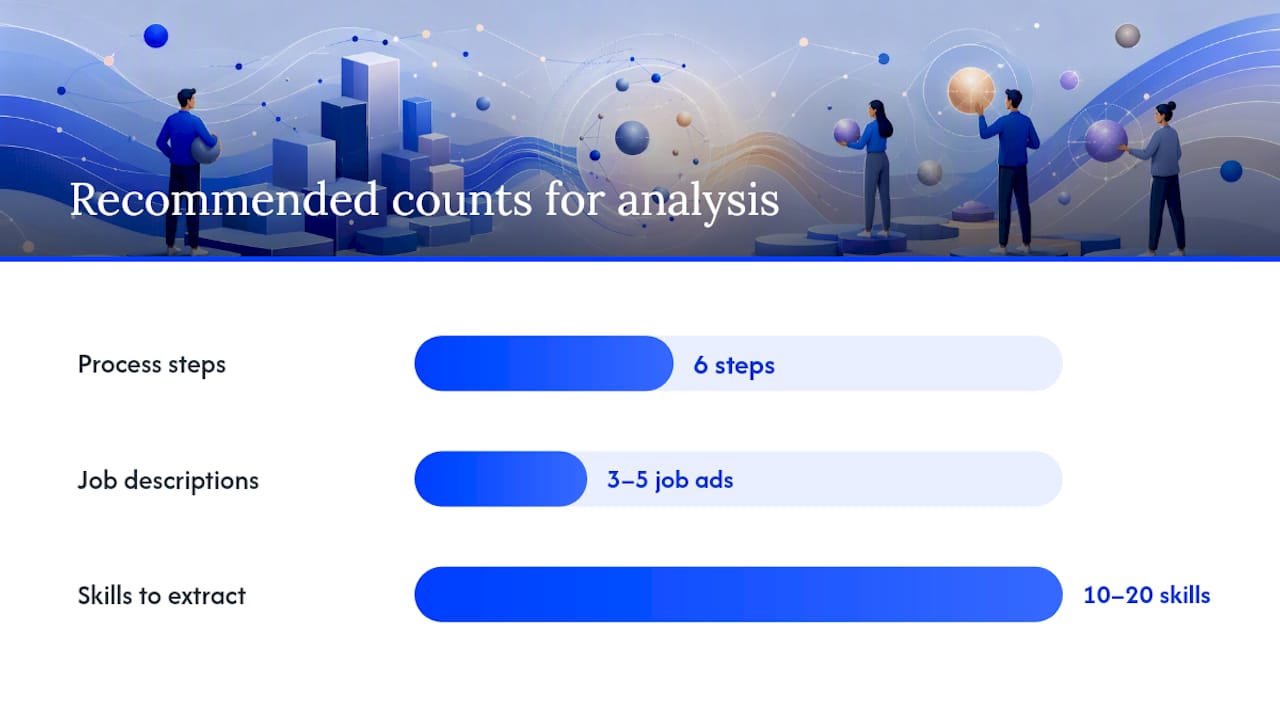
Scale reports that job seekers who follow a structured skill-gap plan improve their interview likelihood by roughly 50%. The six-step process below is repeatable and takes less than two hours the first time.
- Set one target role. Run a separate analysis for each distinct role. Mixing two roles produces fake gaps and wastes your time.
- Gather three to five job descriptions for that role from real postings. Copy the requirements section into a plain text document.
- Extract the top 10 to 20 skills and keywords. Look for terms that appear in at least two of the five postings. Resume-match’s AI extraction does this automatically.
- Build your skills inventory. For each extracted skill, record a self-score (1 to 5), your evidence level (none, partial, strong), and whether it is transferable from another role.
- Validate externally. A mentor, peer, or small timed task will catch blind spots that self-assessment misses, per Mba.
- Categorize each gap as missing, rusty, context shift, or unproven. Traecta recommends this split to avoid relearning skills you already have.
Sample inventory entry:
| Skill | Self-Score (1–5) | Evidence Level | Gap Type | Transferable? |
|---|---|---|---|---|
| SQL queries | 3 | Partial (class project) | Unproven | Yes |
| Salesforce CRM | 1 | None | Missing | No |
| Data visualization | 4 | Strong (work samples) | None | Yes |
How to prioritize gaps using an impact vs. effort matrix
Not every gap deserves equal attention. Career experts at MindTools recommend scoring each gap on two axes: impact (how critical the skill is to getting hired) and effort (time and cost to close it). That combination tells you where to spend the next 90 days.
Map your gaps into four quadrants:
- High impact, low effort: Fix these first. A missing keyword on your resume, a short proof project, or a free certification often falls here.
- High impact, high effort: Plan these carefully. A full certification or new technical skill belongs here. Budget time and money before committing.
- Low impact, low effort: Do these only after the top two quadrants are clear.
- Low impact, high effort: Skip or defer. These rarely move the hiring needle.
Pro Tip: Before enrolling in any course, ask whether a small portfolio task would prove the same skill faster. A two-hour SQL project you can link in your resume often outperforms a 40-hour online course with no visible output.
Practical tactics to close high-priority gaps
The right fix depends on the gap type. Practical experience and proof projects tend to outperform credential accumulation, especially for proof gaps and context-shift gaps, as Mba notes.
By gap type:
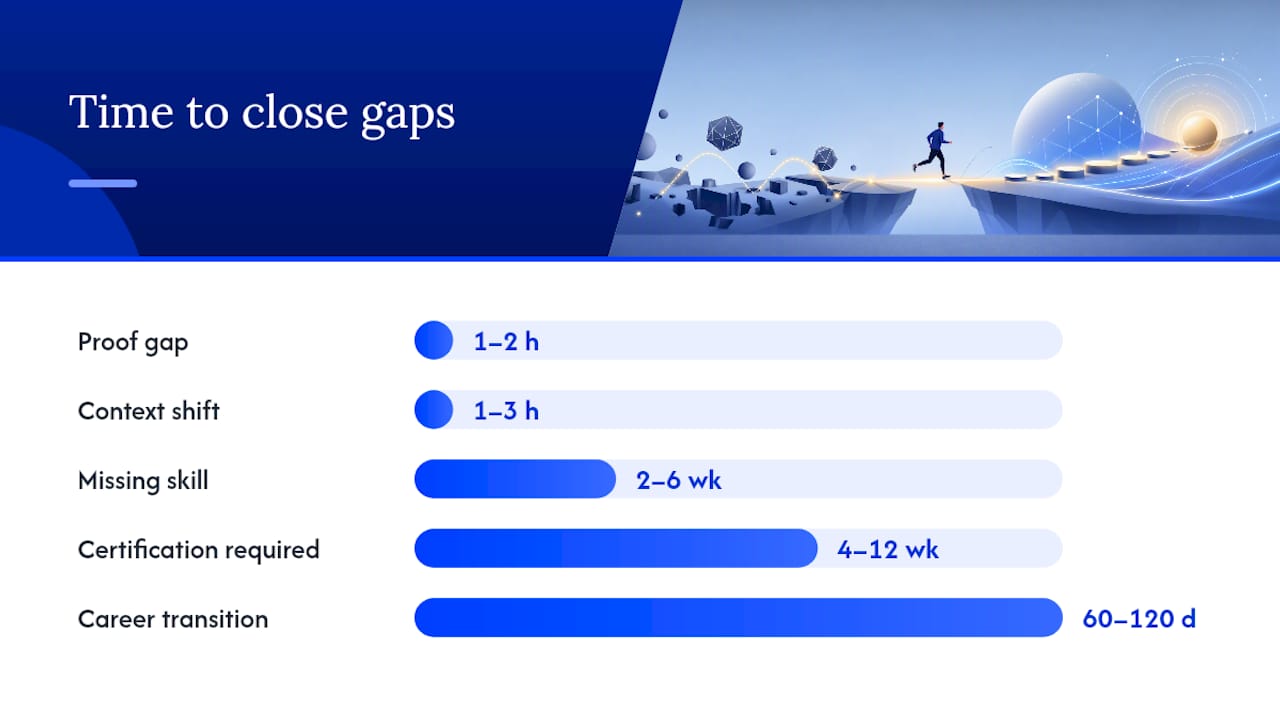
- Proof gap: Add a bullet to your resume with a measurable result. Rewrite the line to include the exact keyword from the job description. Cost: free. Time: one to two hours.
- Rusty skill: Complete one timed task or mini-project to refresh and document it. Cost: free to $50. Time: a few hours to one week.
- Missing skill (new): Short course with a portfolio output (Coursera, LinkedIn Learning, Google Career Certificates). Cost: free to $200. Time: two to six weeks.
- Certification required: Only pursue when the job description lists it as required, not preferred. Cost: $200 to $1,500+. Time: four to twelve weeks.
- Context shift: Reframe existing experience in the language of the target industry. Cost: free. Time: one to three hours of resume editing.
A career transition timeline for most mid-level roles runs 60 to 120 days when you focus on the top three gaps rather than trying to fix everything at once.
Your fillable 90-day action plan
Turn your prioritized gap list into a concrete schedule. Here is a template you can copy and a completed example for a mid-level data analyst role.
Template:
- Target role: ___
- Top priority gap: ___
- Proof task: ___ (deliverable + deadline)
- Resume update: ___ (keyword + line to rewrite)
- Weekly check-in metric: ___
Completed example (mid-level data analyst):
| Week | Task | Output | Metric |
|---|---|---|---|
| 1–2 | Build a SQL portfolio project using a public dataset | GitHub link | Project live |
| 3–4 | Rewrite resume with extracted keywords; re-run Resume-match report | Updated resume | ATS score change |
| 5–8 | Complete Google Data Analytics Certificate (if required) | Certificate link | Added to resume |
| 9–12 | Apply to 10 targeted roles; track interview rate | Applications log | Interviews per 10 apps |
SMART goals keep this honest. Instead of “get better at SQL,” write “complete and publish one SQL analysis project by [date] that answers a real business question.”
How to measure progress and validate improvement
Metrics tell you whether the plan is working. Check these every 30 days:
- ATS pass rate: Are your applications getting past the first screen?
- Interview rate: How many interviews per 10 applications?
- Recruiter messages: Are inbound LinkedIn messages increasing?
- Career Probability score: Is your Resume-match score trending up after each resume update?
- Salary match: Are the roles you qualify for moving closer to your target salary band?
When metrics stall after 30 days, revisit your keyword extraction. Job descriptions shift, and a skill that was optional three months ago may now appear in every posting. Reassess on a 30-day cycle and update your inventory accordingly.
How Resume-match automates your skills gap analysis
Doing this manually takes hours. Resume-match compresses the extraction, scoring, and matching steps into about 30 seconds. Here is what the Career Probability Report gives you:
- AI keyword extraction: Pulls the exact terms from your resume and compares them to target job descriptions
- Gap score by skill: Shows which missing keywords carry the most weight for your target role
- Matched job list: Surfaces roles across multiple job boards where your current resume already fits
- Salary insights: Shows the compensation range for roles at your current match level versus your target level
- 90-day plan template: Suggests prioritized next steps based on your specific gaps
Upload your resume, select a target job title, and the report runs immediately. The AI personalization behind the matching means the gap scores reflect real hiring patterns, not generic advice. You can also track how your score changes each time you update your resume, which turns the 30-day reassessment into a concrete, visible number.
Common mistakes that waste your time
Most job seekers make at least one of these errors. Catching them early saves weeks.
- Overlearning: Spending 40 hours on a course when a two-hour proof project would close the same gap
- Mislabeling transferable skills: Calling a skill “missing” when you did the same work under a different title
- Ignoring proof gaps: Having the skill but not showing it on your resume, which is the most common reason qualified candidates fail ATS screens
- Chasing low-impact credentials: Earning certifications that do not appear in the target job description
- Running the analysis for multiple roles at once: This creates a bloated gap list that is impossible to prioritize
Pro Tip: One strong proof project, linked from your resume and described with a measurable result, does more for your application than three certificates with no visible output. Recruiters can click a link. They cannot verify a course completion on its own.
Our take on where job seekers lose the most time
The biggest mistake we see is treating a skills gap analysis as a one-time exercise. Job seekers run it once, fix two things, and then apply for months without updating their analysis. The job market shifts. Keywords that mattered in January may not appear in postings by March. A monthly reassessment, even a quick 20-minute pass through three new job descriptions, keeps your resume aligned to what hiring managers are actually looking for right now.
We also think the proof-gap framing from Traecta is underused. Most people assume a gap means they need to learn something new. Often, they just need to show what they already know. That reframe alone can cut your remediation time in half.
Resume-match gives you a gap report in 30 seconds
Doing a skills gap analysis by hand is worth it. Doing it faster, with AI-scored gaps and matched salary data, is better.
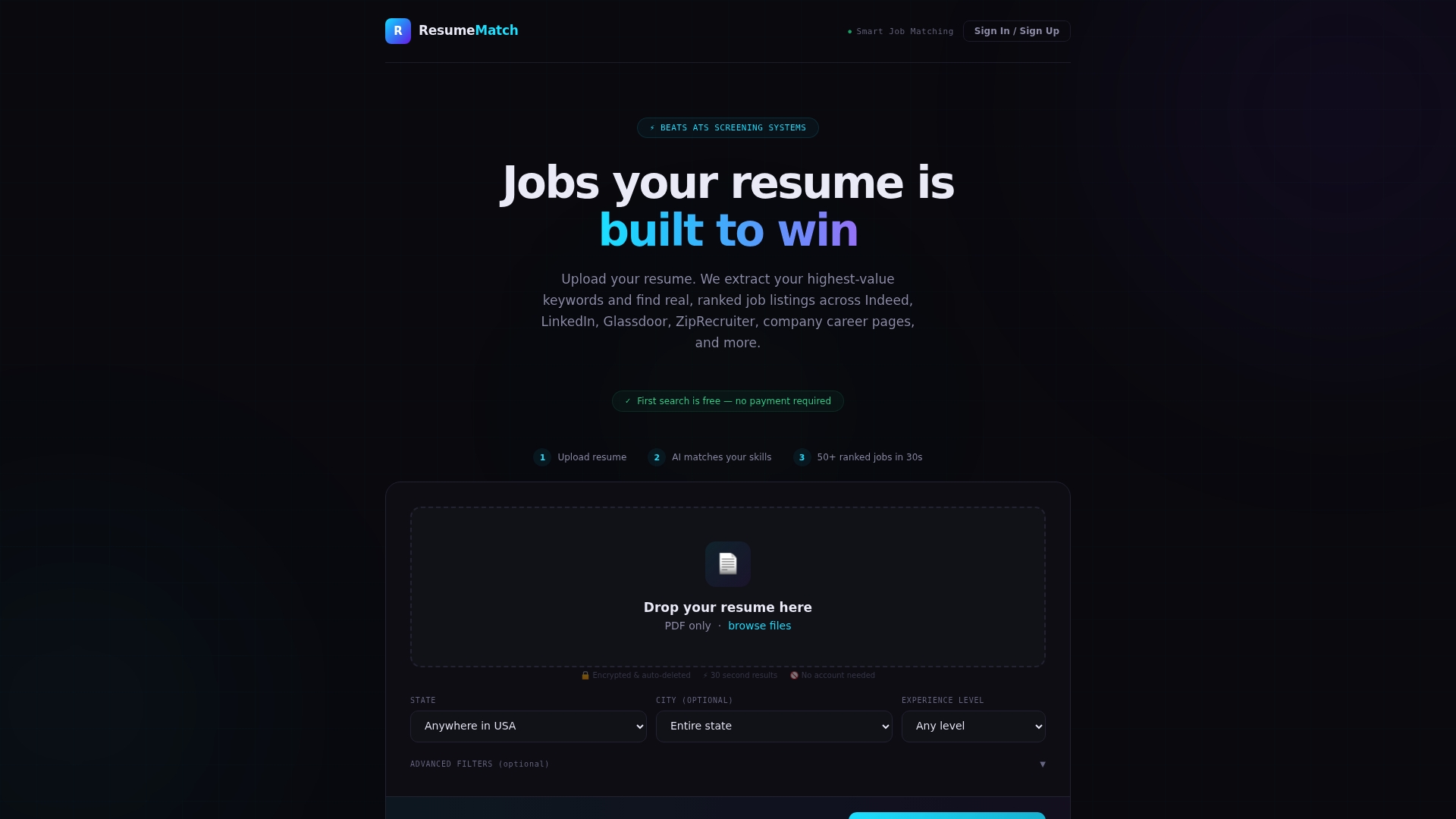
Resume-match’s Career Probability Report gives you keyword gaps ranked by hiring impact, a matched job list pulled from multiple boards, salary range data for your target role, and a prioritized 90-day plan template, all from one resume upload. The 72-hour free trial includes the full report. If you want to go further, the agent service applies to jobs on your behalf while you focus on closing gaps.
The job seekers who get the most from it are mid-career professionals targeting a specific role and recent graduates who need to see exactly where their resume falls short before they apply. Start your free trial at Resume-match and run your first Career Probability Report today.
Sources
- Skills Gap Analysis: Close Your Development Gaps | Mindtools
- How to Identify Skill Gaps Without Relearning Everything
- Personal Skills Gap Analysis: How to Identify Which Skills You’re Missing
- Skill Gap Analysis Checklist for Job Seekers