
Start With 2–3 Quantified Achievements to Quantify Resume Bullets
Start With 2–3 Quantified Achievements to Quantify Resume Bullets

Quantify your resume bullets by using the Action + Project + Result formula (or Yale’s XYZ version: accomplished X, measured by Y, by doing Z) and leading each role with 2 to 3 quantified achievements. When you don’t have exact figures, use a defensible range, a frequency or a scope instead of a raw guess, and write down how you arrived at it so you can back it up in an interview.
TL;DR:
- Quantify achievements using metrics such as dollars saved, percentage improvements, or scope to make accomplishments credible and compelling.
- Use clear templates like Action + Project + Result, XYZ, or PARQ to organize quantification, ensuring the numbers are supported and easily explained in interviews.
- When precise data is unavailable, estimate with ranges, frequencies, or scope, and keep notes on how figures were derived to maintain credibility.
- Focus on your top two to three quantified achievements per role, highlighting the most impressive results at the top of each list to attract recruiter attention quickly.
- Avoid fabricating numbers, vague modifiers, or metrics without baseline data, as these weaken your resume’s impact and may lead to misunderstandings.
Table of Contents
- What Can You Actually Quantify on a Resume?
- Which Formula Should You Use to Quantify Resume Bullets?
- What If Your Job Has No Obvious Metrics?
- Before-and-After: Weak Bullets Turned Into Quantified Ones
- Where Quantifying Bullets Usually Goes Wrong
- How Many Bullets Should You Actually Quantify?
- Quick Templates and a 7-Point Editing Checklist
- Why We Built ResumeMatch Around Quantified Bullets
- Let ResumeMatch Flag What Your Bullets Are Missing
- Sources
- FAQ
What Can You Actually Quantify on a Resume?
Almost every job produces a number somewhere, you just have to know which bucket to look in. Forbes identifies five practical metric families that cover nearly any role: percentage change, dollars generated or saved, time saved, progress against a target or KPI, and people-related scope, like team size or customers served.
Here’s how those metric families show up across different jobs:
- Sales: dollars closed, quota attainment, close rate, average deal size
- Customer support: tickets resolved per day, average response time, CSAT score change
- Operations: process time reduced, error rate, units processed per shift
- Education or training: attendance rate, pass rate, number of learners coached
- Marketing: campaign reach, conversion rate, cost per lead
One judgment call trips people up more than any other: percentage or raw number? Use both when you can. When the raw number alone would sound small, like reducing errors from 2 to 1 per week, a percentage (“cut error rate by 50%”) gives it proportion. Show whichever number makes the achievement easier to believe, and add the second one if it adds context instead of clutter.
Which Formula Should You Use to Quantify Resume Bullets?
Three templates handle almost every quantify resume bullets situation you’ll run into, and you can rotate between them depending on how much space you have.
- Action + Project + Result (A+P+R). Yale’s Office of Career Strategy frames this as: what did you do, on what, and what happened because of it. Example: “Redesigned the onboarding email sequence for 400 new hires, reducing first-week support tickets by 22%.”
- XYZ format. Also from Yale: accomplished [X], as measured by [Y], by doing [Z]. Example: “Increased quarterly repeat bookings by 18% by building a personalized follow-up email cadence.”
- PARQ. Virginia Tech’s career center frames bullets around problem, action, result, and quantify, a useful prompt when you’re stuck describing a fix rather than a routine task. It pairs well with STAR (situation, task, action, result), which interview coaches use for the same reason: it forces you to name what changed.
Whichever format you pick, add a baseline whenever you use a percentage.
Pro Tip: Write the raw numbers first, then convert to a formula. It’s much easier to spot a missing baseline before you’ve dressed the sentence up in action-verb language.
What If Your Job Has No Obvious Metrics?
Plenty of roles never hand you a dashboard. That doesn’t mean the numbers don’t exist, it means you have to go find them.
- Check CRM records, ticketing systems, shared drives, or old performance reviews for anything you tracked, even informally.
- Count calendar events: how many meetings did you run, trainings did you lead, or client calls did you handle in a typical month?
- Estimate a weekly or monthly average from memory, then round conservatively rather than up.
- Ask a former manager or a finance or operations contact if they can confirm a number you’re unsure about.
- Use public industry benchmarks as a comparison point, not a stand in for your own results.
When none of that gets you a hard figure, use a range, a frequency, or a scope instead. “Handled 15 to 20 support tickets daily” or “coordinated weekly vendor check ins for a 12 person team” both read as concrete without pretending to a precision you don’t have. Columbia’s career center is direct about this: add results where they’re accurate, but don’t invent figures. A qualitative outcome, stated honestly, beats a fabricated one every time. Keep a private note of how you estimated each number, since that’s exactly what an interviewer will ask about.
Before-and-After: Weak Bullets Turned Into Quantified Ones
Seeing the transformation side by side makes the pattern click faster than any rule does.
- Customer service. Before: “Handled customer complaints and resolved issues.” After: “Resolved 35+ customer complaints weekly, maintaining a 92% first-contact resolution rate.” The revision shows both volume and quality.
- Marketing. Before: “Managed social media accounts.” After: “Grew Instagram following from 2,000 to 8,500 in six months through a weekly content calendar.” A before-and-after number is more convincing than any adjective.
- Project management. Before: “Led cross-functional projects.” After: “Coordinated a 6-person cross-functional team to launch a product feature two weeks ahead of schedule.” “Coordinated” replaces “led” here since the role wasn’t formal management, which keeps the claim defensible.
- Research. Before: “Assisted with data analysis for research team.” After: “Analyzed survey data from 1,200 respondents, identifying three trends that shaped the final report.” Scope (1,200 respondents) stands in where a percentage wasn’t available.
- Teaching. Before: “Taught high school math classes.” After: “Taught algebra to 90 students across four sections, raising average test scores by 14%.” Class size gives the reader scale before the outcome even lands.
- Hospitality. Before: “Provided excellent guest service.” After: “Maintained a 4.8/5 guest satisfaction score across 200+ reservations per month.” A rating plus volume beats a vague quality claim.
- Administration. Before: “Organized office schedules and files.” After: “Streamlined scheduling for a 15-person office, cutting double-booked meetings by 60%.” Even routine admin work has a measurable inefficiency behind it.
- Sales. Before: “Contributed to sales team success.” After: “Closed $180,000 in new business, exceeding quota by 22% in Q3.” “Contributed to” becomes a specific dollar figure the reader can verify.
Where Quantifying Bullets Usually Goes Wrong
Most bad quantified bullets fail in one of five predictable ways.
- Invented numbers. If you can’t explain how you got a figure, don’t use it. Columbia’s guidance is blunt on this point: a qualitative claim beats a fabricated one.
- Percentages with no baseline. “Increased sales by 40%” from a $500 starting point isn’t the achievement it sounds like. Add the starting and ending figures, or a defensible range.
- Team results claimed as personal wins. Yale recommends verbs that match your actual role, like “coordinated” or “contributed to,” and reserving “led” for when you genuinely managed the effort.
- Metrics buried at the end of a long sentence. Put the number where a scanning eye will hit it, usually right after the action verb.
- Vague modifiers standing in for numbers. “Significantly improved,” “greatly increased,” and “helped grow” all dodge the one thing a recruiter actually wants to see.
Pro Tip: If you genuinely can’t support a number, don’t quantify that bullet at all. A strong qualitative statement is more credible than a number you’ll fumble explaining in an interview.
How Many Bullets Should You Actually Quantify?
Not every line needs a number, but your strongest ones do, and where you place them matters as much as whether you have them.
- Lead each role with your 2 to 3 strongest quantified achievements, since that’s what a recruiter reads first and remembers longest.
- Save longer, multi-clause bullets for complex projects that need context; use short one-liners for routine, lower-impact tasks, as recommended in Firefighter Interview Prep: What Actually Works.
- Order bullets by relevance to the job you want, not chronological importance to your old employer.
- Put your best measurable win as the very first bullet under each role. Recruiters often skim the top line and decide whether to keep reading.
Quick Templates and a 7-Point Editing Checklist
Keep a short list of fill-in-the-blank formats on hand for the next resume update:
- A+P+R: “[Action verb] [project/context], resulting in [measurable result].”
- XYZ: “Accomplished [X], measured by [Y], by doing [Z].”
- PARQ: “Identified [problem], took [action], which led to [result], quantified as [number].”
Run every bullet through this before you save the file:
| Checklist item | What to check |
|---|---|
| Metric present | Does the bullet have a number, range, or scope? |
| Baseline included | Is the starting point clear for any percentage? |
| Scope stated | Team size, customer count, or time frame noted? |
| Strong action verb | Does it match your actual level of ownership? |
| ATS keyword aligned | Does it echo language from the job posting? |
| Brevity | Is it one line, not a paragraph? |
| Defensible | Could you explain this number in an interview? |
Save your source notes, ticketing exports, old reviews, whatever backed the number, in the same folder as your resume drafts, so you’re never scrambling before an interview.
Why We Built ResumeMatch Around Quantified Bullets
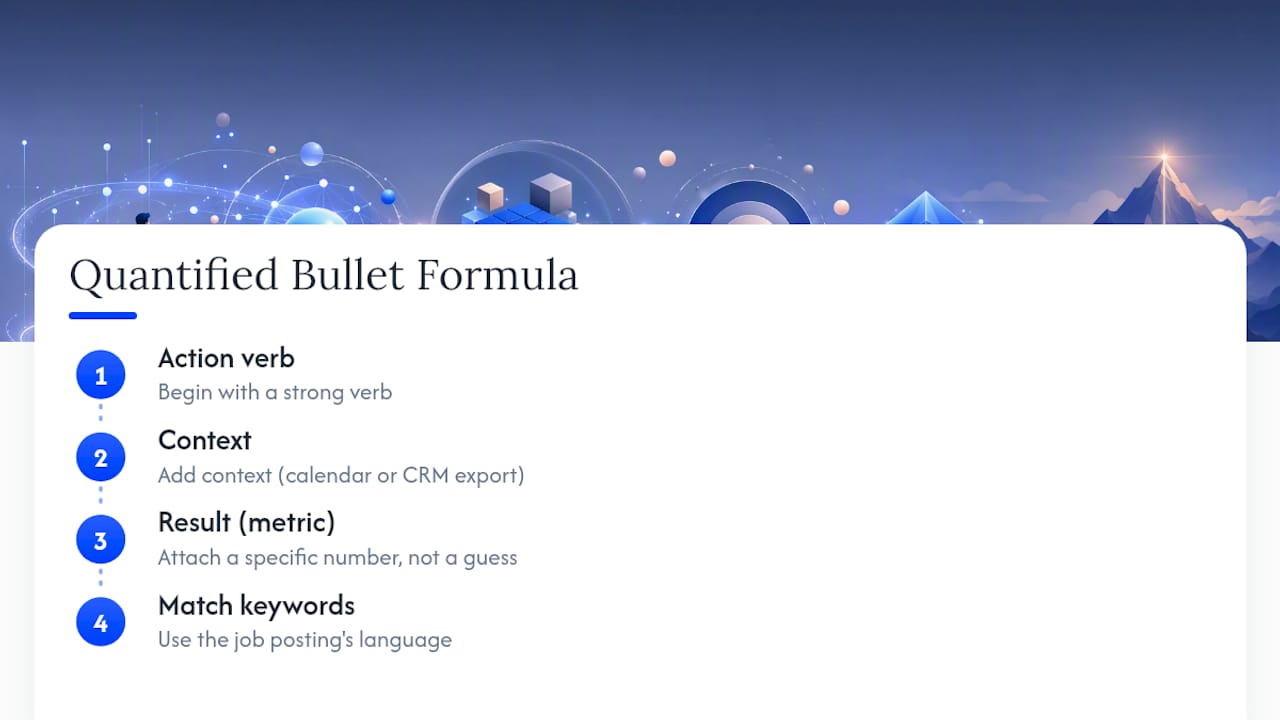
Recruiters skim in seconds, and applicant tracking systems parse structure before meaning, so a bullet with a real number and an aligned keyword does double duty. MIT’s career advising office ties these together directly: start with an action verb, add context, attach the result, and match the language of the job posting while you’re at it. Resumes that pair specific numbers with the right keywords tend to move further through both automated and human review.
We built ResumeMatch’s scoring around exactly this gap, because it’s the one we kept running into ourselves: a strong bullet with no metric reads as a task, not an achievement. Our pragmatic tip? Start with your calendar or your CRM export, not your memory. Numbers you can point to beat numbers you’re guessing at.
— Resume
Let ResumeMatch Flag What Your Bullets Are Missing
Resume-match reads your resume the way a recruiter and an applicant tracking system both do, and it tells you exactly where a bullet is missing the metric that would make it land. Instead of guessing which lines need a number, the ResumeMatch Membership plan runs your resume through AI analysis that extracts the keywords recruiters and ATS software are actually scanning for, then matches you to relevant job listings in about 30 seconds.

A career probability report goes a step further: it flags weak or unquantified impact statements, estimates a salary range, and lays out a career strategy so you know which bullets to fix first. If editing and applying on your own still feels like too much on top of everything else, the Let Us Apply For You service has an agent submit a guaranteed minimum number of personalized applications on your behalf, one time, for $50.
Start with the free trial at Resume-match and see which of your bullets are quietly costing you interviews.
Sources
- Writing Impactful Resume Bullets - Office of Career Strategy
- Resumes with Impact: Creating Strong Bullet Points
- 5 Ways To Add Metrics To Your Resume For Quantifiable Success
- Resumes: Writing about your skills – Career Advising & Professional Development | MIT
FAQ
Is 7 Bullet Points Too Many on a Resume?
Seven is on the high end for a single role and usually too many for anything but your most recent or most relevant job. Most career centers, including Yale’s, suggest 3 to 5 tight, quantified bullets per role, with your strongest 2 to 3 achievements leading the list.
Is a 77% ATS Match Score Good?
Pairing strong keyword alignment with quantified results, as MIT’s guidance recommends, improves your odds regardless of the exact score an ATS assigns.
What Is the 7-Second Rule for Resumes?
It refers to the idea that a recruiter forms a first impression of your resume in about seven seconds, scanning for job titles, formatting, and standout numbers before reading closely. That’s the main reason to lead each role with your strongest quantified bullet instead of burying it lower down.
What Are the 5 P’s of a Resume?
There isn’t a single, widely agreed “5 P’s” framework in the career center guidance this article draws from, and different coaches define it differently. If you’ve seen a specific version referenced in a job posting or coaching program, treat it as that source’s own framework rather than a universal standard.
How Do I Quantify a Resume Bullet When I Have No Exact Numbers?
Use a defensible range, a frequency, or a scope instead of a precise figure, like “managed 15 to 20 support tickets daily” rather than guessing an exact count. Columbia’s career center confirms that honest qualitative outcomes are acceptable when a precise number isn’t available, as long as you don’t invent one.