
Apply in Under a Minute? When LinkedIn Easy Apply Actually Helps
Apply in Under a Minute? When LinkedIn Easy Apply Actually Helps

Whether Easy Apply is worth your time depends on what you’re trying to do. If you’re testing the market, casting a wide net, or applying to early-stage screening roles, it’s a solid tool. If you’re going after a priority role, skip the one-click route unless you customize your materials and follow up, because referrals and tailored applications convert at a meaningfully higher rate than job board submissions.
TL;DR:
- Applying through Easy Apply allows for rapid submissions but often results in generic materials that may not pass automated screening or attract recruiter attention.
- Many employers use automated filters and brief resume scans, so matching keywords and clear headlines are crucial for passing initial screening stages.
- Customizing your profile, resume, and adding relevant portfolio links before applying significantly improves the chances of standing out in a large applicant pool.
- Using Easy Apply as a volume-testing tool is effective for early-stage roles or industries but should be supplemented with direct applications and networking for priority positions.
- Following up with targeted messages within a few days after applying can increase visibility, especially when your profile and application materials are aligned with the role.
Table of Contents
- How LinkedIn Easy Apply works
- Pros and cons: the realistic benefits and trade-offs
- What recruiters and hiring teams see and why that matters
- Optimization checklist: exactly what to change before you click Easy Apply
- Where Easy Apply belongs in a multi-channel job-search workflow
- Why my approach to job search tools has changed
- If you want help converting priority roles: a compact ResumeMatch option
- FAQ
- Sources
How LinkedIn Easy Apply works
When you click Easy Apply, LinkedIn pulls information straight from your profile and sends it to the employer in a packaged format rather than as a traditional cover letter and resume combo. This is faster for you, but it also means the hiring team sees exactly what LinkedIn decides to show them, not necessarily your full story.
Here’s what typically gets transmitted:
- Your profile fields: name, headline, location, current role, and work history as listed on LinkedIn.
- Any uploaded resume file, if you choose to attach one instead of relying on your profile alone.
- Saved answers to standard screening questions, like years of experience or work authorization.
- Optional employer-configured fields, such as portfolio links or short written responses, when the employer has set them up.
Some employers configure Easy Apply to collect everything on LinkedIn’s platform, which keeps the process entirely within the app. Others redirect you partway through to their own applicant tracking system, where you may need to re-enter details or upload documents again. According to SmartRecruiters’ breakdown of Easy Apply, this hybrid setup means employers often only see a standard set of fields unless they’ve built in extra requirements, and anything beyond that, like a detailed cover letter or writing sample, is less likely to make it through unless the employer specifically asks for it.
Once you submit, LinkedIn logs the application in your activity history and notifies the employer through their recruiter dashboard or ATS inbox, depending on their setup. The employer doesn’t see a meaningfully different signal based on how fast you applied. What matters more is whether your profile and resume actually match what they’re screening for, which is where a lot of Easy Apply submissions start to fall short.
Pros and cons: the realistic benefits and trade-offs
Easy Apply earns its popularity honestly. It removes friction, and friction is often the reason people don’t apply at all. But convenience cuts both ways, and the same feature that gets you in the door fast also puts you in a much bigger pile.
- Speed: You can apply to a role in under a minute, which matters when you’re trying to cover a lot of ground in a single sitting.
- Centralized tracking: Every Easy Apply submission shows up in your LinkedIn activity, so you have a built-in record of where you’ve applied.
- Wide net testing: It’s an efficient way to gauge interest in a role or industry before you invest serious time tailoring materials.
- Higher applicant volume per posting: Because it’s so easy to apply, popular roles can pull in a large number of submissions quickly, which increases competition for your specific application.
- Limited customization: Many Easy Apply flows don’t leave room for a cover letter or a resume tailored to the specific posting, so you’re often sending generic materials.
- ATS mismatches: When you’re redirected to an employer’s own system, formatting or field requirements can create gaps between what you intended to submit and what the employer actually receives.
- Perception of low effort: Recruiters who’ve seen thousands of Easy Apply submissions sometimes treat them as a weaker signal of genuine interest compared to a tailored application.
For entry-level roles or postings where you’re still figuring out fit, Easy Apply makes sense. For specialized or senior roles, where the hiring team is comparing a smaller pool of more qualified candidates, the lack of customization can work against you.
Pro Tip: Reserve Easy Apply for roles where you’d be satisfied with a quick “no,” and save your tailored effort for roles you’d be disappointed to lose.
What recruiters and hiring teams see and why that matters
Recruiters rarely read every Easy Apply submission in full, especially for popular postings. Most teams triage first, using automated filters to narrow the pool before anyone looks at an actual resume.
That triage typically works through a few layers:
- ATS keyword filters that flag or deprioritize resumes missing specific terms from the job description.
- A quick manual scan, often just a few seconds long, to check title, years of experience, and location.
- Referral prioritization, where candidates who came through an employee referral get pulled to the top regardless of how they technically applied.
According to Indeed’s research on resume attention spans, employers scan resumes briefly before deciding whether to read further, which is exactly why a scannable headline and clear keyword alignment matter more in an Easy Apply flow than in a hand-written cover letter nobody has time to open.
A large share of Easy Apply submissions get filtered out before a recruiter ever reads them, since high application volume pushes hiring teams toward automated screening rather than manual review. SmartRecruiters notes that this volume is exactly why employers lean on screening technology once a quick-apply option is live on a posting. The practical takeaway is that profile completeness and resume alignment aren’t nice-to-haves, they’re what gets you past the first filter at all.

Optimization checklist: exactly what to change before you click Easy Apply
A few minutes of prep before you hit Easy Apply can change whether your application lands in front of a person or gets lost in the stack. Here’s the order that matters most.
- Fix your headline first. Replace a generic job title with language that mirrors the role you’re targeting, since this is often the first thing a recruiter scans.
- Rewrite your summary around outcomes. Lead with what you’ve done and the results you’ve driven, not a list of responsibilities.
- Align your skills section with the posting. Add the specific tools and terms the job description uses, since ATS filters often match on exact phrasing.
- Confirm your location and industry fields are current. A mismatch here can get you filtered out before anyone reads further.
- Build a tailored resume file for the role, rather than relying on your generic profile export, and name the file clearly with your name and the job title.
- Add portfolio links or work samples wherever the application allows optional attachments, since these are some of the only ways to stand out in a quick-apply flow.
- Keep required compliance answers consistent across applications, like work authorization or salary expectations, so you’re not caught off guard or giving conflicting information.
- Follow up within 24 to 72 hours by messaging the recruiter or hiring manager directly if you can identify them on LinkedIn. A short note referencing the specific role and one relevant qualification goes a long way.
A simple follow-up message might read: “Hi [Name], I just applied for the [Role] position and wanted to flag my background in [specific skill]. Happy to share more context if useful.” That’s it. You’re not asking for anything, just adding a human signal to an application that might otherwise blend into the pile.
Research from SUCCESS on recruiter attitudes toward Easy Apply backs this up directly: recruiters say the feature is convenient but risks making even qualified candidates invisible if their profile isn’t tailored, and that a quick follow-up message or visible customization materially improves the odds of getting noticed.
If you want a second set of eyes on your resume language before you submit, a tool like SparkCV can help tighten wording and keyword alignment, and a LinkedIn profile generator can help you sharpen your headline and summary before you start applying in volume.
Pro Tip: A short follow-up message within three days of applying does more to overcome volume-driven screening than any tweak to your resume format.
Where Easy Apply belongs in a multi-channel job-search workflow
Easy Apply works best as one tactic inside a bigger strategy, not the whole strategy. According to The Interview Guys’ 2025 research report, referrals and networking produce higher interview conversion than job-board submissions, with company career pages and recruiter-sourced roles generally outperforming cold applications as well.
A practical way to split your week:
- Spend your highest-energy hours on networking and warm outreach for roles you actually want.
- Apply directly through company career pages for your top-tier targets, since employers often prioritize these over job-board traffic.
- Use Easy Apply for volume, mid-tier roles, and market testing, batching these into a single block of time.
- Track everything in one place so you can see which channel is actually converting for you, not just which one feels productive.
Treat Easy Apply as the fast lane for exploration, not the main road to your next job.
Why my approach to job search tools has changed
I’ve spent years watching job seekers treat every application channel as equally valuable, when the data clearly says otherwise. The honest take is that Easy Apply isn’t broken, it’s just misused. People apply to forty roles in an evening and wonder why nothing converts, when the real lesson is that volume without targeting just produces more silence.
At ResumeMatch, we built our approach around this exact gap. Our AI analyzes a resume, extracts the keywords that actually matter, and matches job seekers to tailored listings across multiple platforms in about 30 seconds, because speed should serve precision, not replace it (ResumeMatch). Our Career Probability Report goes further, giving a critical read on a resume alongside salary insights and a personalized career strategy (ResumeMatch).
What readers should prioritize first is matching the channel to the role’s importance, not the other way around. Save your best effort for the roles worth winning.
— Resume
If you want help converting priority roles: a compact ResumeMatch option
For roles that actually matter to you, speed alone won’t close the gap, and that’s where a more guided approach pays off. We built ResumeMatch to handle the two biggest friction points in a job search: knowing which roles are worth your time, and getting your materials in front of the right people without burning every evening on manual applications.
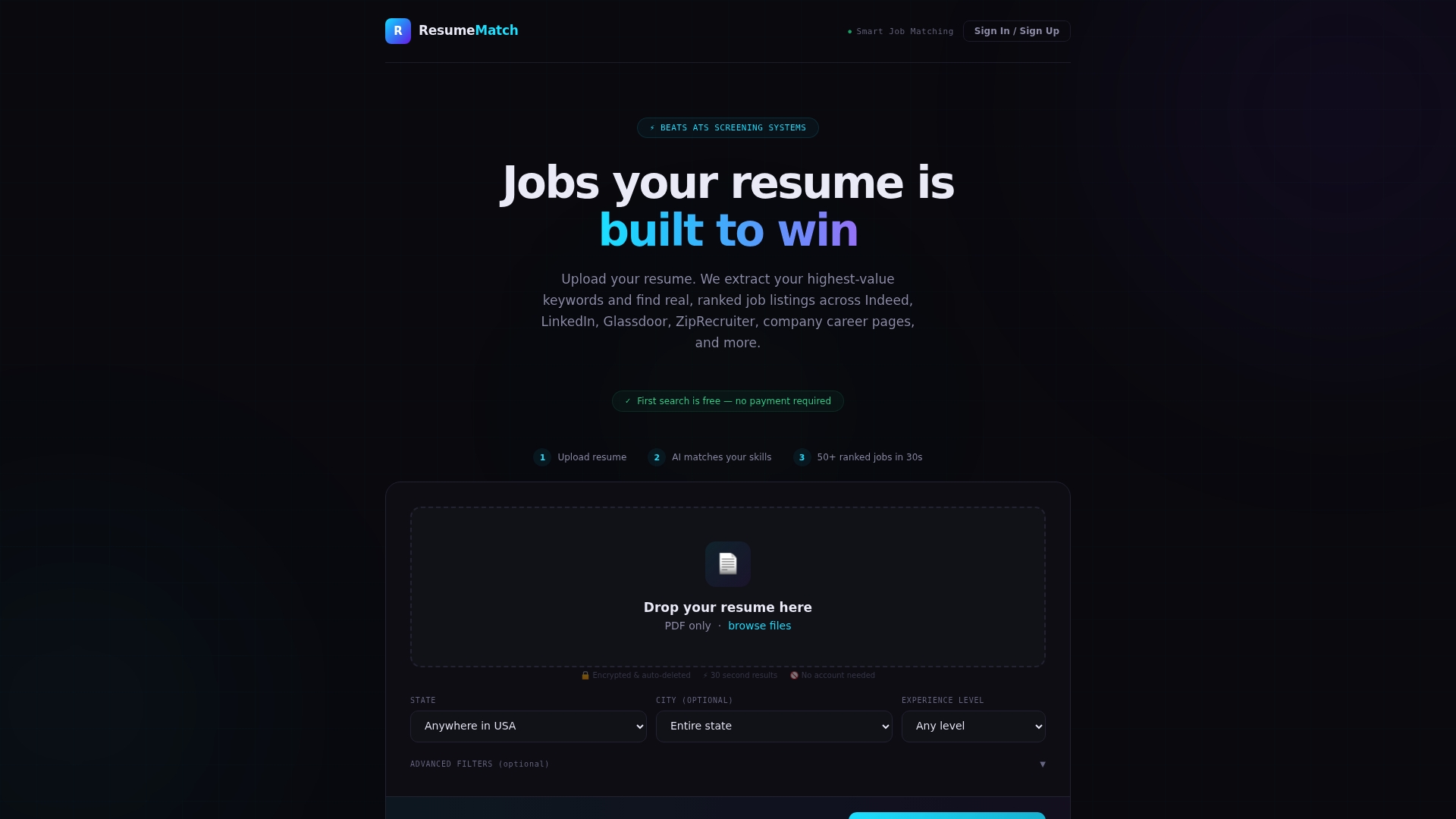
Here’s what that looks like in practice:
- Our membership plan analyzes your resume, extracts the keywords that matter, and matches you with tailored job listings across multiple platforms, plus a Career Probability Report covering resume gaps, salary insights, and a personalized strategy.
- Our agent-based service applies to jobs on your behalf for roles where you need managed outreach and don’t have the bandwidth to do it yourself.
If you’re short on time, juggling a search alongside a full-time job, or want a clearer read on where you actually stand before you apply, Membership is the place to start. If you’ve identified a shortlist of priority roles and want hands-on application support, the agent service fills that gap directly.
Before committing, check a sample Career Probability Report to see the kind of analysis you’d get, and go in with realistic expectations: the tools sharpen your targeting and save you time, they don’t guarantee an offer. You can explore both options on the ResumeMatch site.
FAQ
Does applying on LinkedIn actually work?
LinkedIn applications can work, especially for entry-level or high-volume roles, but conversion rates are generally lower than referrals or direct company-page applications. Research from The Interview Guys shows referrals and networking outperform job-board submissions on interview conversion, so treat LinkedIn applications as one part of a broader approach rather than your only channel.
What is the 4-1-1 rule on LinkedIn?
The 4-1-1 rule is a networking guideline suggesting you share four pieces of helpful content, comment thoughtfully once, and post one piece of original content for every six interactions on the platform. It’s used to build visibility and relationships organically, which can support warmer introductions before you ever submit an application.
What is the 7 second rule in resume?
The 7 second rule refers to the idea that recruiters and hiring managers often make an initial judgment about a resume within the first few seconds of scanning it. Indeed’s guidance on resume attention spans supports keeping your headline, formatting, and top third of the resume clear and scannable, since that’s what gets read first.
What should I include in my LinkedIn Easy Apply headline and summary?
Your headline should mirror the language used in the roles you’re targeting, not just your current job title, since it’s one of the first things a recruiter scans. Your summary should lead with concrete outcomes and skills relevant to that target role rather than a generic career overview, which gives both recruiters and automated filters a clearer match.
Should I use LinkedIn Easy Apply or apply directly on a company’s site?
Use Easy Apply for volume and early-stage exploration, and apply directly on a company’s site for roles you consider a priority, since direct applications and referrals tend to convert better according to The Interview Guys’ research. If you want a tailored view of which roles deserve the extra effort, a personalized job match tool can help you decide where to invest.