
What Is an Automated Job Match? A Job Seeker's Guide
What Is an Automated Job Match? A Job Seeker’s Guide

An automated job match is defined as an AI-powered process that compares your resume, skills, and experience against job descriptions to rank the most relevant opportunities for you. The industry term for this technology is AI candidate matching, and it has changed how job seekers connect with employers. Platforms like Resume-match and RippleMatch use job matching algorithms to surface roles you might never find through a manual keyword search. This guide explains how the automated job matching process works, what it does well, where it falls short, and how you can use it to your advantage.
What is an automated job match and how does it work?
AI candidate matching works by converting your resume and a job description into structured data, then comparing the two mathematically. The process starts with parsing: the system reads your resume and extracts skills, job titles, education, and experience into a clean data structure. It does the same with every job description in its database.
The next step is where modern systems separate themselves from older keyword scanners. Semantic embeddings convert text into high-dimensional vectors, which are essentially numerical representations of meaning. This means the system recognizes that “SaaS sales” and “cloud software revenue generation” describe the same competency, even though the words are different. You get matched to jobs based on what you actually know, not just what words you happened to use.
Once the vectors are built, the system calculates similarity scores between your profile and each job. AI scoring pipelines parse job descriptions into weighted criteria, treating required skills as 2–3 times more important than preferred ones. Your profile is then ranked against other candidates before a recruiter ever sees the list.

The systems also improve over time. The best AI matching tools learn continuously from recruiter feedback, adjusting their understanding of what a strong candidate looks like for a specific role. That feedback loop is what separates a good matching engine from a great one.
Pro Tip: When you upload your resume to any AI matching platform, use a clean, text-based format. The parser needs to read your content clearly before it can match you accurately.
- Resume parsing extracts skills, titles, and experience into structured data
- Semantic embeddings match meaning, not just exact words
- Weighted scoring ranks required skills above preferred ones
- Machine learning refines match accuracy with every recruiter decision
What are the benefits of automated job matching tools vs. traditional search?
Traditional job search methods rely on you typing keywords into a search bar and scrolling through results. That approach has a fundamental flaw: it filters by job title, not by what you can actually do. A bartender who has managed a team of 12, handled scheduling, and controlled inventory has account management and operations skills. A keyword search will never surface those connections.
AI in job matching fixes this by focusing on competencies. Skills-based AI matching expands candidate pools by up to 6 times compared to title-based searches. For specialized roles in areas like AI and data science, that expansion reaches 8.2 times. More relevant jobs appear in your results because the system looks at what you can do, not just what your last job was called.
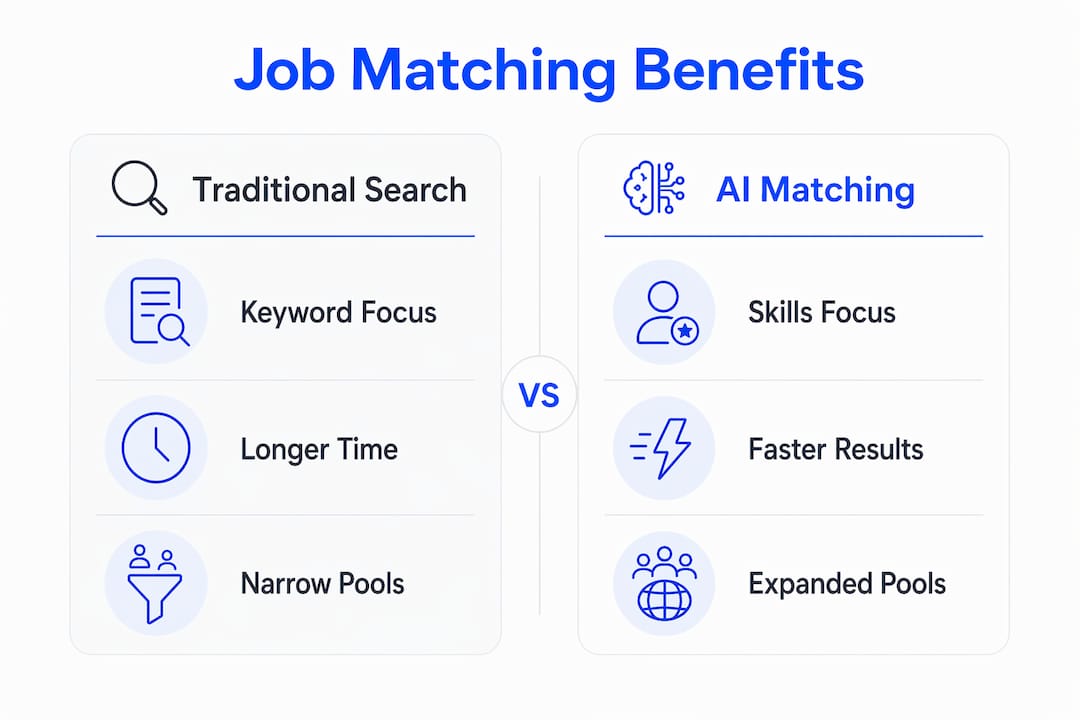
Speed is the other major advantage. AI shortlisting takes a median of 4.7 minutes compared to 3.2 hours manually. That time saving matters to you as a job seeker because it means faster responses and shorter waits between application and interview.
The quality of matches also improves outcomes downstream. Organizations using AI-driven screening report 35% better hire quality and 25–35% higher retention rates in year one. Better matches mean you are more likely to land a role where you actually succeed and stay.
| Factor | Traditional keyword search | AI candidate matching |
|---|---|---|
| Matching basis | Job title and exact keywords | Skills, competencies, and context |
| Candidate pool size | Narrow, title-dependent | Up to 6x broader |
| Time to shortlist | 3.2 hours (manual) | 4.7 minutes (AI) |
| Soft skill assessment | None | Limited but improving |
| Bias risk | High (title and credential bias) | Lower, but not eliminated |
Beyond the numbers, AI-enabled job matching focuses on career trajectories and related skills rather than rigid keywords. This improves relevance and inclusivity, especially for career changers and people with non-traditional backgrounds. If you have built real skills in one industry, the right AI system will find you opportunities in another.
What are the common limitations of AI job matching?
AI candidate matching is a powerful filter, not a final answer. Match scores reflect coverage of weighted criteria, not holistic job fit. A high score means your profile aligns well with the stated requirements. It does not mean you are the right person for the team culture or the manager’s working style.
The technology also has a formatting problem. Poorly formatted resumes prevent AI parsers from extracting information correctly, leading to low match scores regardless of your actual qualifications. A resume built with heavy graphics, text boxes, or unusual section headers will confuse the parser. Your skills may be excellent, but the system will not see them.
Bias is another real concern. AI systems learn from historical hiring data, and that data often reflects past patterns of who got hired. If a company historically hired from a narrow set of schools or job titles, the algorithm may replicate that preference. Transparency is also limited: most systems do not explain exactly why you scored a certain way, which makes it hard to know what to fix.
Here is what AI matching cannot assess well:
- Cultural fit and team dynamics
- Soft skills like communication, adaptability, and leadership presence
- Motivation and career intent
- Personality and interpersonal style
Successful AI job matching relies on a blend of automation for scale and human judgment for nuance. Recruiters still make the final call, and that is appropriate. Use your match score as a starting point, not a verdict.
Pro Tip: If you are getting low match scores despite strong qualifications, the problem is often your resume format, not your skills. Convert to a clean, single-column layout with standard section headings like “Experience,” “Skills,” and “Education.”
How can you optimize your resume for AI job matching?
Your resume is the raw input for every AI matching system. If the input is unclear, the output will be wrong. The good news is that optimizing for AI parsers and optimizing for human readers are mostly the same thing: be clear, specific, and well-organized.
Follow these steps to improve your match scores across automated recruitment tools:
- Use a clean, text-based resume format. Avoid tables, columns, graphics, and text boxes. Single-column layouts with standard fonts like Arial or Calibri parse cleanly on every platform.
- Lead with a skills section. List your core competencies near the top of your resume. AI systems weight skills heavily, and placing them early ensures the parser captures them.
- Mirror the language in job descriptions. If a job posting says “project management,” use that phrase rather than “managing projects.” Semantic matching is good, but exact matches still carry weight.
- Quantify your experience. Numbers give the AI more data points to work with. “Managed a team of 8” is more parseable and more compelling than “led a team.”
- Update your profile regularly. Platforms like Resume-match analyze your resume and extract keywords to match you with current listings. A stale resume produces stale matches.
- Follow AI recommendations. When a platform suggests adding a skill or rephrasing a section, take it seriously. Those suggestions are based on what the algorithm needs to match you accurately.
The shift toward competency-based placement predicts job success 5 times better than years-of-experience or title filters. That means your actual skills matter more than ever. Make sure your resume reflects what you can do, not just where you have been.
Platforms that offer AI-powered profile tools, sometimes called SmartCVs or tailored profiles, go one step further by dynamically adjusting your profile to match specific job requirements. If you have access to AI candidate screening tools that offer this feature, use them. They close the gap between what you know and what the algorithm sees.
Key Takeaways
Automated job matching works best when your resume is clean, skills-focused, and aligned with the language of the roles you want.
| Point | Details |
|---|---|
| Core definition | AI candidate matching compares your skills and experience to job descriptions using semantic analysis. |
| Speed advantage | AI shortlisting takes 4.7 minutes vs. 3.2 hours manually, meaning faster responses for you. |
| Skills over titles | AI matching expands your opportunity pool up to 6x by focusing on competencies, not job titles. |
| Resume formatting matters | Poorly formatted resumes produce low match scores regardless of your actual qualifications. |
| AI is a filter, not a verdict | Match scores reflect criteria coverage, not cultural fit or soft skills. Human review still decides. |
Why I think most job seekers are using AI matching wrong
Most people treat AI job matching as a passive tool. They upload a resume, wait for matches to appear, and apply to whatever the algorithm surfaces. That approach misses the point entirely.
The real value of automated job matching is that it shows you the gap between how you describe yourself and how employers describe the roles you want. When I look at how Resume-match works, the most useful output is not just the job list. It is the keyword analysis that tells you what your resume is missing. That gap is your action item.
I have seen career changers get matched to roles they never would have searched for manually, simply because the AI recognized transferable skills they had not thought to highlight. A warehouse supervisor with strong inventory management and team scheduling experience matched to operations coordinator roles at tech companies. The job seeker had never considered that path. The algorithm saw it immediately.
The uncomfortable truth is that most resumes are written for human readers who will skim them in six seconds. AI systems read every word, weigh every skill, and score every section. A resume that looks impressive to a person may score poorly with a machine because it buries the skills section at the bottom or uses vague language like “responsible for overseeing.”
My advice: treat your first AI match score as a diagnostic. If it is lower than you expect, do not blame the algorithm. Read what it is telling you about your resume. Fix the format, sharpen the skills section, and run it again. The system is giving you feedback that most recruiters never will.
Networking and storytelling still matter. AI gets you in front of the right jobs. You still have to win the interview.
— Resume-match
See how Resume-match matches you to the right jobs
Understanding the technology is one thing. Putting it to work for your actual job search is another.
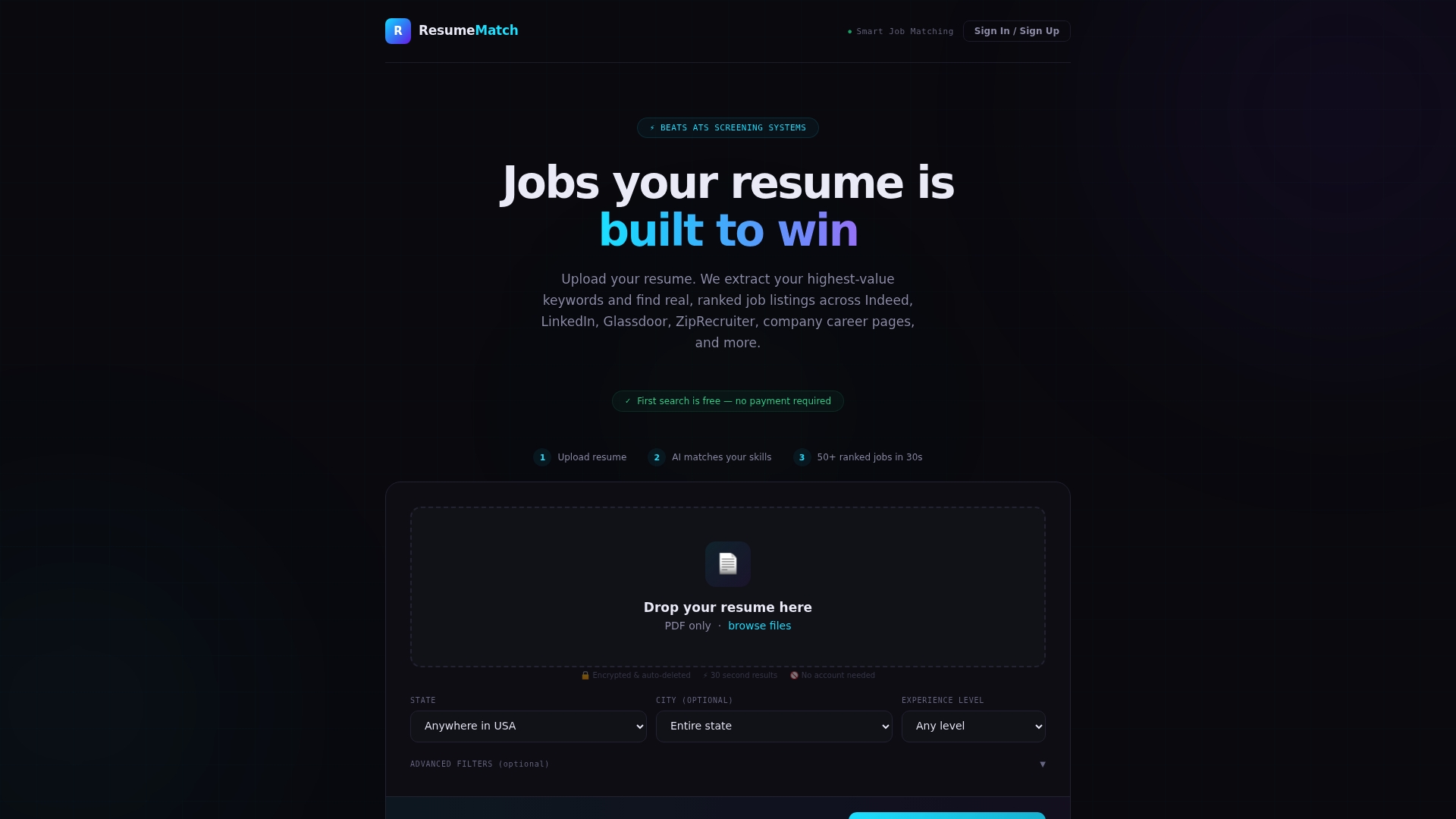
Resume-match analyzes your resume in 30 seconds, extracts your key skills and experience, and matches you with tailored job listings across multiple platforms. You also get a Career Probability Report with salary insights and personalized career strategies built around your specific background. If you have been applying to jobs that feel like a stretch or a mismatch, the problem is likely how your resume is being read, not your qualifications. Find jobs built for your resume and see exactly where you stand.
FAQ
What is an automated job match?
An automated job match is an AI-driven process that analyzes your resume and compares it to job descriptions using algorithms to rank the most relevant opportunities for your skills and experience.
How accurate is AI job matching?
AI matching is accurate for skills and keyword alignment but cannot assess cultural fit or soft skills. Match scores reflect how well your profile covers a job’s stated criteria, not whether you are the right person for the team.
Why is my resume getting low match scores?
Poorly formatted resumes prevent AI parsers from reading your content correctly. Switch to a clean, single-column layout with standard section headings to improve your scores.
Does AI job matching replace the recruiter?
No. AI candidate matching creates a ranked shortlist, but recruiters make the final hiring decisions. The technology speeds up the screening process and reduces bias in early filtering.
What makes skills-based matching better than keyword search?
Skills-based AI matching expands your candidate pool by up to 6 times compared to title-based searches, surfacing roles that match what you can do rather than what your last job was called.