
New Industry Job Search Best Practices for 2026
New Industry Job Search Best Practices for 2026

Targeted, quality applications beat mass applying every time when you are switching industries. New industry job search best practices in 2026 center on three core moves: focusing your search on a small number of realistic industries, presenting transferable skills with concrete evidence, and reaching out directly to the right people. AI screening tools now score applications before a human ever reads them, which means precision matters more than volume. The job seekers who land roles fastest are not the ones who apply to everything. They are the ones who apply to the right things, prepared the right way.
1. How to apply new industry job search best practices from day one
The single most common mistake career changers make is treating every industry as equally worth pursuing. Limit your search to a maximum of three industries at once. Spreading across more than three dilutes your messaging, your resume, and your energy. You end up with a generic pitch that fits no one well.
Start by listing the industries where your existing skills transfer most directly. A project manager in construction, for example, carries scheduling, budgeting, and stakeholder communication skills that translate cleanly into tech, healthcare operations, or logistics. Identify the overlap before you write a single application.

Pro Tip: Apply only to roles posted within the last seven days. Older postings are often stale or already filled internally, and applying to them wastes time you could spend on live opportunities.
Set clear criteria before you start: target salary range, location or remote preference, and company size. These filters prevent you from chasing roles that look good on paper but will not work in practice.
2. Researching industry viability before you apply
Not every industry is hiring at the same rate, and applying to a shrinking sector without knowing it is a costly mistake. Research company health before you submit anything. Check recent earnings reports, news coverage, and LinkedIn company pages for signs of growth or contraction.
Ghost job postings stay visible for weeks but rarely lead to interviews. Verify that a role is real by finding the hiring manager on LinkedIn and confirming the team is actively growing. This one step saves hours of wasted effort.
Look at the job descriptions across multiple companies in your target industry. If you see the same five skills listed repeatedly, those are the skills the market is paying for right now. That pattern tells you exactly where to focus your preparation.
3. Rebranding your resume and LinkedIn for a new field
Your resume and LinkedIn profile must tell a coherent story about where you are going, not just where you have been. Rebranding your CV to frame your pivot as a logical progression, rather than a restart, is one of the highest-impact moves a career changer can make.
Lead your resume summary with the role you are targeting, not your previous job title. A former teacher applying to instructional design roles should open with something like: “Learning professional with seven years of curriculum development and adult training experience.” That framing immediately signals relevance.
Your LinkedIn headline should match your target role, not your current one. Recruiters search by job title keywords, so a headline that says “Aspiring Data Analyst” is far less effective than “Data Analyst | SQL, Python, Tableau.”
4. Demonstrating transferable skills with real evidence
Listing skills on a resume without proof is the weakest version of a job application. Strong communication, collaboration, and resilience are universally valued by hiring managers, but only when backed by specific examples. “Excellent communicator” means nothing. “Led weekly cross-functional meetings for a 12-person team across three time zones” means something.
Build a short portfolio of evidence to support your claims:
- Side projects: Complete a small project in your target field. A marketing professional moving into UX can run a usability test on a local nonprofit’s website and document the findings.
- Public write-ups: Publish a short article or case study on LinkedIn showing how you applied a skill from your old field to a new context.
- Volunteer or freelance work: Even one paid or unpaid project in the new industry gives you a real entry on your resume.
- Credentials: A four-week online course with a certificate adds recent, relevant learning to your profile.
Pro Tip: Frame every example using the STAR method: Situation, Task, Action, Result. This structure works for both resume bullets and interview answers, and it forces you to include the outcome, which is what hiring managers actually care about.
5. Closing skill gaps with targeted credentials
Short credentials close the gap between what you know and what employers need. Role-specific courses that fill gaps noted in job descriptions help candidates stand out, especially when AI screening tools score applications for recent learning signals.
Choose credentials strategically:
- Match the job description: If every posting in your target field mentions Salesforce, take the Salesforce Administrator certification. Do not take a general business course when a specific tool is being asked for.
- Prioritize short tracks: A one-to-four-week credential program is more useful than a six-month course you cannot finish before your next application deadline.
- Look for career-changer programs: Platforms like Coursera, LinkedIn Learning, and Google Career Certificates design some tracks specifically for people entering a field without a traditional background.
- Add completion dates: List the month and year you completed each credential. Recent completion signals active learning, which AI screening tools reward.
The goal is not to become an expert overnight. The goal is to show employers that you are actively closing the gap and that you understand what the role requires.
6. Networking to access the hidden job market
A large share of roles are filled before they are ever posted publicly. Accessing the hidden job market requires direct company research and targeted outreach, not just browsing job boards.
Build a list of 10–15 people in your target roles or companies. Prioritize hiring managers and team leads over generic HR contacts. HR screens candidates. Hiring managers make decisions.
“The best outreach message is short, specific, and asks for insight, not a job. Something like: ‘I am transitioning into product management and would love 15 minutes to hear how you made a similar move’ opens doors that a cold application never will.”
Referrals convert to job offers at four times the rate of cold job board applications. That number alone makes networking the highest-return activity in any job search. One good conversation can bypass the entire ATS screening process.
Follow up after every conversation with a thank-you note that references something specific from the discussion. This keeps you memorable and shows genuine interest in the person, not just the job.
7. Tailoring applications and acing interviews in a new sector
Generic resumes fail ATS screening. Tailoring your resume to mirror the keywords and required skills in each job description is the baseline requirement for getting past automated filters in 2026.
Use these practices for every application:
- Mirror the job description language: If the posting says “cross-functional collaboration,” use that exact phrase in your resume, not a synonym. ATS tools match strings, not concepts.
- Quantify everything possible: “Reduced onboarding time by 30%” beats “improved onboarding process” every time.
- Prepare STAR-method answers: Map your top five transferable experiences to the most common behavioral questions in your target industry. Practice saying them out loud, not just writing them down.
- Practice video interviews: Record yourself answering questions and watch it back. Check for filler words, eye contact with the camera, and clear delivery. Most first-round interviews in 2026 are video calls.
- Send a follow-up email: A strong follow-up after an interview adds new information, reiterates your interest, and sets expectations for next steps. It separates you from candidates who go silent after the call.
Cover letters still matter in career changes. Use yours to explain the pivot directly and briefly. Hiring managers want to know why you are making the move, not just that you are.
Key takeaways
Focused, evidence-backed applications in a small number of target industries consistently outperform mass applying for career changers in 2026.
| Point | Details |
|---|---|
| Limit your industry focus | Target no more than three industries at once to keep your messaging sharp and relevant. |
| Show evidence, not just skills | Back every skill claim with a specific project, result, or credential that proves it. |
| Use short credentials strategically | Complete one-to-four-week courses tied directly to skills listed in job descriptions. |
| Network before you apply | Build a list of 10–15 contacts in target roles and reach out for insight, not jobs. |
| Tailor every application | Mirror job description keywords and use STAR-method examples to pass ATS and impress interviewers. |
What I have learned from watching career changers succeed and fail
The candidates who struggle most are the ones who treat a career change like a numbers game. They send out 50 applications a week, get no responses, and conclude the market is broken. The market is not broken. Their approach is.
The candidates who succeed do something different. They spend more time preparing fewer applications. They research the company before they apply. They reach out to one real person at the company before the interview. They frame their story as a solution to the employer’s problem, not as a personal reinvention project. Viewing yourself as a problem-solver for the employer, rather than a job seeker asking for a favor, changes everything about how you write, speak, and present yourself.
Persistence matters too. A career change rarely happens in four weeks. The job seekers I have seen succeed are the ones who treat rejection as data, adjust their approach, and keep going. Resilience is not a soft skill in this context. It is the skill that determines whether you make it across.
— Resume-match
How Resume-match helps you focus on the right roles
Switching industries is hard enough without spending hours sorting through job listings that do not fit your background.
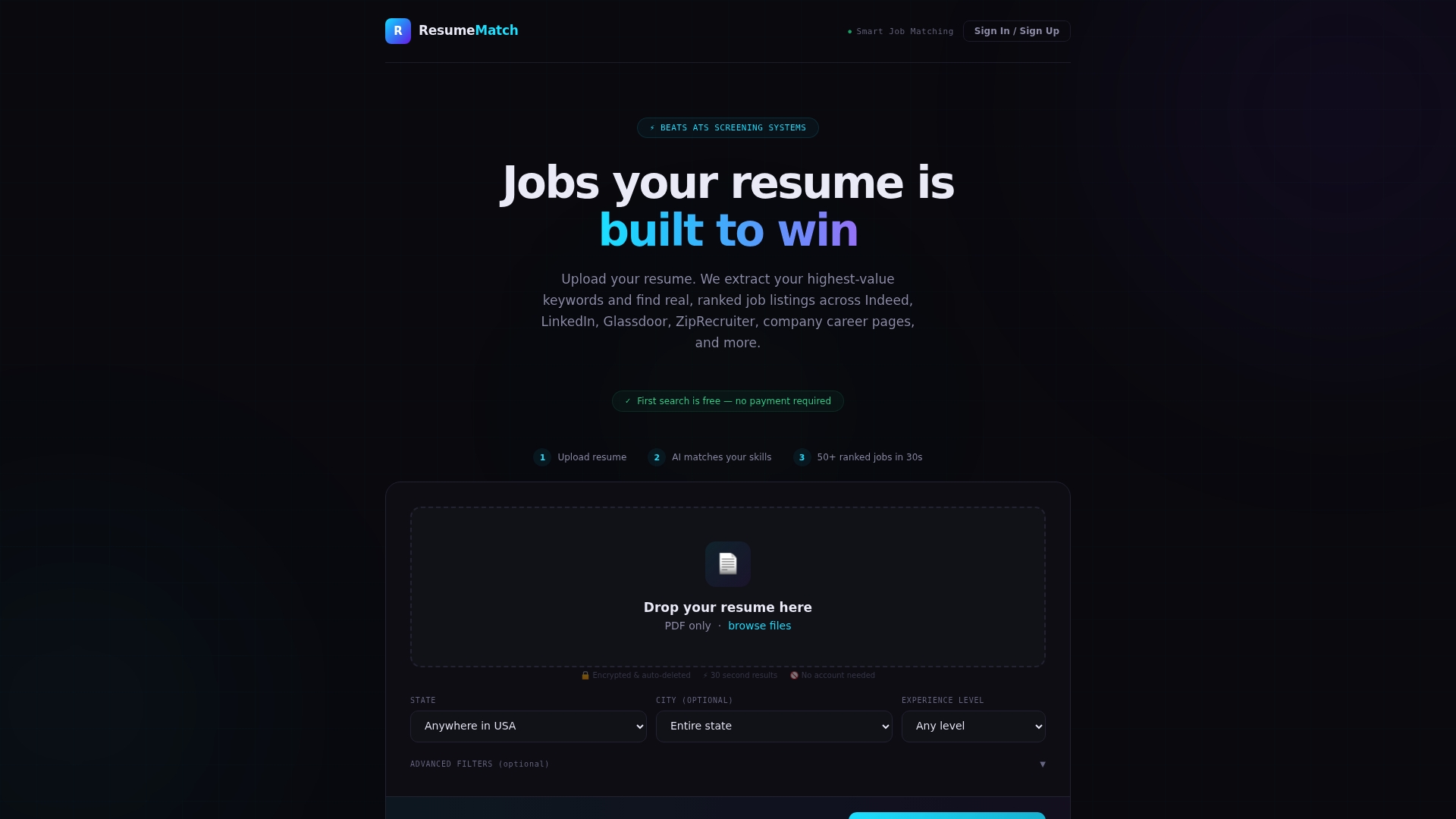
Resume-match analyzes your resume and extracts the keywords that define your actual skills, then matches you with roles across multiple platforms in 30 seconds. You see jobs that align with your real profile, not just your job title. The Career Probability Report goes further, giving you a clear picture of your salary potential and the career paths most likely to work for you. When you are making a deliberate move into a new field, that kind of clarity saves weeks of guesswork and keeps your search focused on quality over quantity.
FAQ
How many industries should I target in a career change?
Target no more than three industries at once. Focusing on fewer industries keeps your resume and outreach specific, which produces better results than a broad, unfocused search.
Do transferable skills really work without direct experience?
Transferable skills work when backed by concrete evidence. A specific project, measurable result, or recent credential turns a vague claim into proof that hiring managers and ATS tools can evaluate.
How important is networking compared to applying online?
Referrals convert to offers at four times the rate of cold applications. Networking with hiring managers and team leads in your target field is the most effective use of your job search time.
Should I get certified before applying to a new industry?
Short, role-specific credentials strengthen your application, especially when they address skills listed in job descriptions. A one-to-four-week course completed recently signals active learning to both AI screening tools and hiring managers.
What is the best way to follow up after an interview?
Send a follow-up email within 24 hours that adds a new piece of relevant information and reiterates your interest. A strong follow-up distinguishes you from candidates who go silent and gives the hiring manager a reason to keep you top of mind.