
How Job Platforms Rank Candidates: A 2026 Guide
How Job Platforms Rank Candidates: A 2026 Guide

Job platforms rank candidates using a multi-stage AI pipeline that combines resume parsing, semantic matching, and weighted scoring to predict job fit. The industry term for this process is “candidate ranking,” and it goes far deeper than simple keyword counts. Understanding how job platforms evaluate applicants gives you a real edge. The system scores you on skills relevance, experience recency, and must-have criteria before a recruiter ever sees your name.
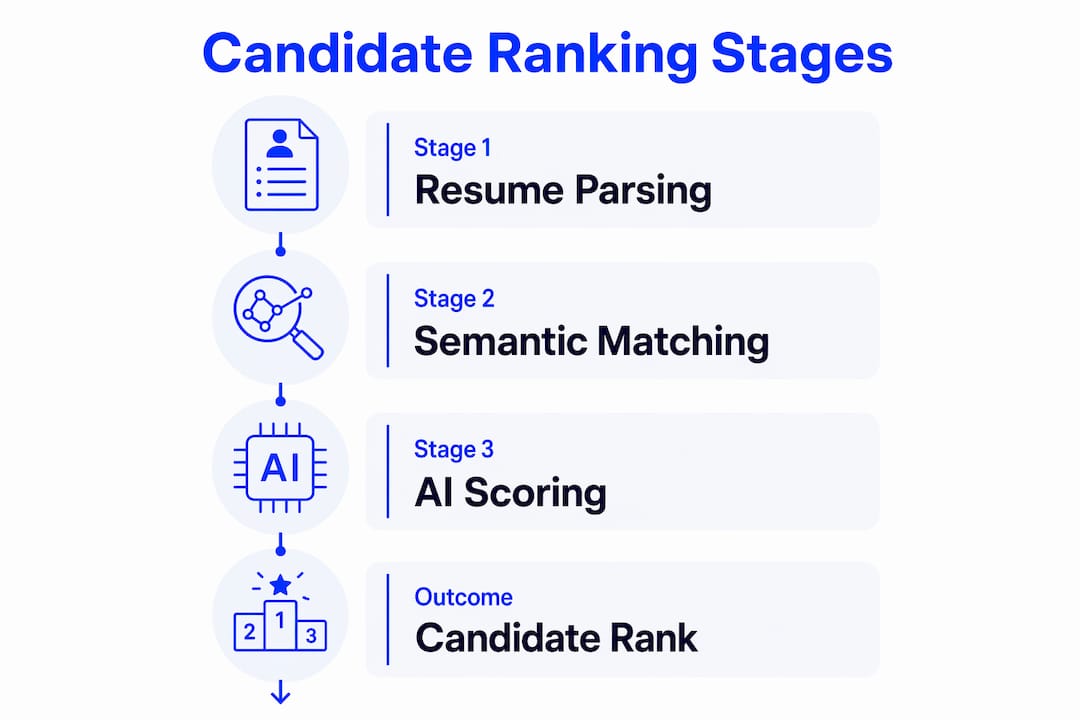
How job platforms rank candidates: the three-stage process
Candidate ranking on modern job platforms follows three distinct stages. First, the platform parses your resume into structured data. Second, it runs semantic matching against the job description. Third, it applies a weighted scoring model to produce a final fit score.
Each stage builds on the one before it. A failure at stage one means the algorithm never properly evaluates your skills at stage two. That is why the foundation matters so much.
The multi-stage AI pipeline uses cosine similarity with 768+ dimensional vectors to move beyond simple keyword frequency. That means the system compares the meaning of your resume content against the job description, not just whether the same words appear.

How does resume parsing work, and why does it matter?
Resume parsing is the step that converts your unstructured document into data a ranking algorithm can read. The system extracts your name, job titles, skills, dates, and employer names into separate, labeled fields.
Parsing accuracy depends heavily on your formatting. Non-standard formatting like tables, columns, and text boxes causes ATS parsers to scramble data, making your skills and job titles invisible for matching. A visually impressive resume with a two-column layout may parse as a jumbled string of text.
Here is what breaks parsing most often:
- Tables and multi-column layouts that split content across cells
- Headers and footers containing contact information
- Graphics, icons, or image-based text the parser cannot read
- Inconsistent date formats like “Jan '22” versus “January 2022”
- Job titles buried inside unusual section names
Resume parsing errors cause candidates to become invisible in ATS searches regardless of their actual qualifications. You could be a perfect fit and still score zero because the parser could not read your resume correctly.
Pro Tip: Use a single-column resume format with standard section headings like “Work Experience,” “Skills,” and “Education.” Save your creative layouts for portfolio sites and PDF attachments sent directly to hiring managers.
How do semantic matching and AI scoring algorithms work?
Semantic matching is where modern candidate ranking algorithms separate themselves from older keyword systems. The platform converts both your resume and the job description into high-dimensional vector representations. It then measures how closely those vectors align using cosine similarity.
Semantic ranking models interpret long technical phrases and semantic similarity rather than keyword frequency alone. That means writing “managed a team of five sales representatives” scores better than stuffing in the word “management” five times.
Large language models like GPT-4 power the scoring layer on many platforms. The LLM-based scoring system generates a fit score and a written rationale, then advances candidates above a set threshold score to human review. Employers typically set cutoffs around a score of 75 or higher before a recruiter sees your application.
The weighted criteria that affect your score include:
- Skills recency: A skill used in your most recent role scores higher than one from five years ago
- Must-have criteria: Skills the employer marks as required carry more weight than preferred skills
- Role alignment: Your most recent job title compared to the target role
- Experience depth: Years of relevant experience tied to specific skills, not just total career length
Factor-level breakdowns show which resume elements contributed to your score. Without that transparency, match percentages become black boxes that recruiters often ignore.
Pro Tip: Mirror the exact terminology from the job description in your resume. If the posting says “client relationship management,” use that phrase rather than “account management” or “customer success,” even if they mean the same thing to you.
How do recruiters interact with candidate rankings beyond automated scores?
Automated scores do not tell the whole story. Recruiters interact with candidate rankings in ways that can override or bypass the algorithm entirely.
Default recruiter views are organized by application date and pipeline stage rather than fixed ranking scores. A recruiter searching for a “project manager with Agile certification” will pull up candidates who match that search, regardless of their overall fit score.
Here is how recruiters typically move through a candidate pool:
- Apply knockout filters first. They eliminate anyone who failed mandatory screening questions before reviewing resumes.
- Search by must-have skills. They use keyword searches within the ATS to find candidates with specific tools or certifications.
- Sort by pipeline stage. Candidates already moved to “phone screen” or “interview” stages appear at the top.
- Review application date. Recent applicants often get more attention, especially for high-volume roles.
- Check overall fit score. The AI score becomes a tiebreaker, not a primary filter.
Recruiters frequently ignore opaque ranking scores without clear rationale, preferring profiles that show a clear match reason. Your resume needs to be findable through search, not just score-worthy through the algorithm.
Pro Tip: Apply within the first 48 hours of a job posting going live. Early applicants appear at the top of date-sorted views, giving you visibility before the recruiter pool grows.
What causes early rejection before ranking even starts?
Early rejection is the most overlooked obstacle in the application process. Knockout screening questions on work authorization, years of experience, and location remove candidates from the pool before resume evaluation begins. Your resume never gets parsed or scored if you fail these filters.
Common knockout triggers include:
- Answering “No” to work authorization questions for the listed country
- Reporting fewer years of experience than the minimum required
- Listing a location outside the role’s geographic requirement
- Indicating unavailability for required travel or on-site work
- Failing salary expectation screens where a minimum is set
The most common automatic filtering step is this silent early rejection via knockout questions. Most candidates never know it happened. They assume their resume was reviewed and found lacking, when in reality it was never seen.
Read every screening question carefully before submitting. If a role requires three years of experience and you have two years plus a relevant internship, consider how you frame your total time in the field. Honesty matters, but so does presenting your experience accurately and completely.
How can you improve your resume to rank higher?
Improving your ranking score starts with aligning your resume language to the job description. The shift from keyword stuffing to signal-based ranking based on measurable career outcomes is the most important change in how applicants are ranked today.
Apply these strategies to improve your position:
- Use the job description’s exact phrases. Copy specific skill names, tool names, and role titles directly into your resume where they honestly apply.
- Connect skills to dates and roles clearly. Write “Used Python for data analysis at [Company], 2023–2025” rather than listing Python in a skills section with no context.
- Keep formatting clean and linear. Single-column, plain-text-friendly layouts parse most reliably across all ATS platforms.
- State your location and work authorization upfront. Add your city, state, and work eligibility in your resume header to clear location-based filters immediately.
- Quantify outcomes where possible. “Increased sales by 30%” gives the algorithm a measurable signal that “improved sales performance” does not.
Bias reduction efforts in modern platforms include blind screening that redacts names and demographic signals. Human oversight remains part of the process, but the AI layer is where most candidates are won or lost. Getting your resume past the algorithm is the first battle. Making it findable to a recruiter is the second.
Pro Tip: Run your resume against the job description using Resume-match before applying. The platform extracts keywords and shows you where your resume aligns and where it falls short, in about 30 seconds.
Key Takeaways
Job platforms rank candidates through a three-stage process of parsing, semantic matching, and weighted AI scoring, and your resume must pass all three stages to reach a recruiter.
| Point | Details |
|---|---|
| Parsing comes first | Clean, single-column formatting prevents data scrambling that makes skills invisible to ATS systems. |
| Semantic matching beats keywords | Mirror the job description’s exact phrases to score higher on vector-based similarity models. |
| Knockout filters reject early | Answer work authorization, location, and experience questions accurately to avoid silent rejection before scoring begins. |
| Recruiters search, not just sort | Make your resume findable by must-have skill terms, not just score-worthy through the algorithm. |
| Recency and must-haves carry the most weight | Skills used in your most recent role and employer-marked requirements drive the largest share of your fit score. |
What AI ranking gets right and what it still misses
I have spent years watching candidates with genuinely strong backgrounds get filtered out before a human ever read their resume. The algorithm is not broken. It is doing exactly what it was designed to do. The problem is that most candidates do not know the rules of the game.
The transparency issue is real. When a platform shows you a match score of 68% with no explanation, that number means nothing to you or the recruiter. The platforms that show factor-level breakdowns, which skills matched, which were missing, and why the score landed where it did, are the ones that actually help both sides. Recruiters trust those scores. Candidates can act on them.
What I see people miss most often is the findability problem. They spend hours perfecting a resume for a high score, then apply three weeks after the posting went live. The recruiter has already moved their top candidates to the phone screen stage. The AI score becomes irrelevant because the recruiter is not looking at new applicants anymore.
The other thing worth saying plainly: AI ranking is powerful but imperfect. Bias reduction tools help, but human judgment still shapes who advances. A great resume that passes the algorithm still needs to connect with a person. Write for both audiences.
— Resume
Resume-match helps you see your ranking before you apply
Knowing how job platforms evaluate applicants is useful. Seeing exactly how your resume scores against a specific job description is better.
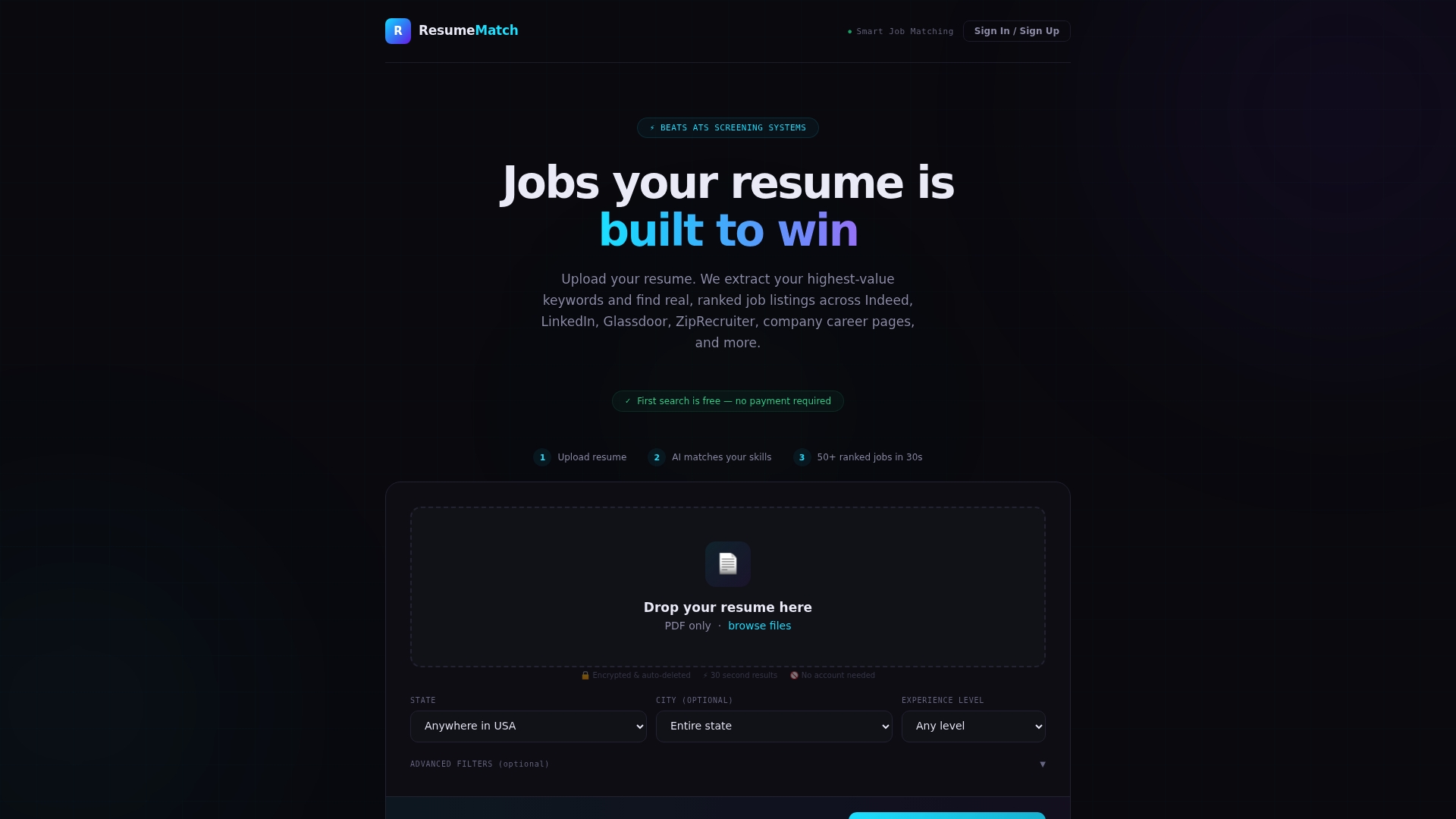
Resume-match analyzes your resume and extracts the keywords and skills that matter most for the roles you want. It matches you to job listings across multiple platforms in about 30 seconds and shows you where your application is strong and where it needs work. The Career Probability Report goes further, giving you salary insights and career strategy recommendations based on your actual profile. If you want to stop guessing why you are not hearing back, this is where to start.
FAQ
How do job platforms rank candidates automatically?
Job platforms use a three-stage AI pipeline: parsing resumes into structured data, running semantic matching with vector embeddings, and applying weighted scoring based on skills recency and must-have criteria.
What is the biggest reason candidates get rejected before ranking?
Knockout screening questions on work authorization, location, and years of experience cause automatic rejection before a resume is ever parsed or scored.
Does keyword stuffing improve your ranking score?
Keyword stuffing is less effective with modern semantic models. Platforms measure meaning and context, so aligning your language with the job description naturally produces better results than repeating keywords.
Why do recruiters sometimes ignore AI ranking scores?
Recruiters ignore scores that lack factor-level explanations. Without a clear rationale showing which skills matched and why, a percentage score is treated as a black box and often bypassed in favor of manual search.
How can you make your resume more findable to recruiters?
Include must-have skill names, your exact job title history, and your location in plain text. Recruiters search by these terms directly within ATS platforms, independent of your overall fit score.